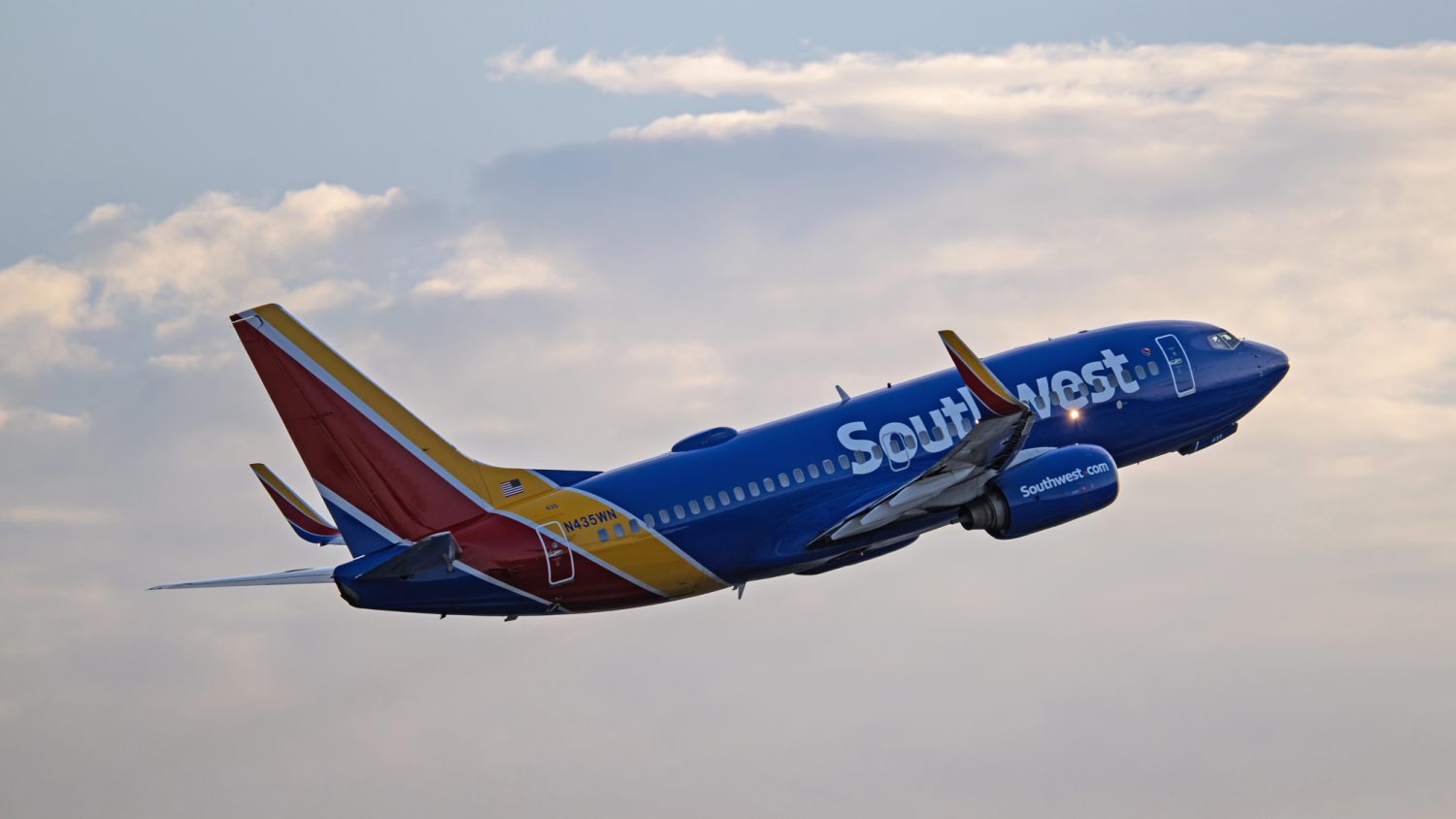
Two of Boeing’s largest U.S. customers are drawing a line on cockpit software. Southwest Airlines and United Airlines have asked Boeing to deliver incoming 737 MAX jets with an earlier software version, skipping the newer flight-management software tied to a navigation glitch now under federal investigation. The request rejects versions U.14 and U.14.1 of the affected software.
Neither carrier’s active fleet is not running the affected versions, according to CNBC. This is a forward-looking delivery decision, not a grounding.
What the Glitch Actually Does
The issue surfaces during a specific sequence: a crew abandons a landing, initiates a go-around, then modifies the aircraft’s preprogrammed route for another approach. Under those conditions, the automated vertical-navigation function, known as VNAV, may disengage.
VNAV automates altitude and descent guidance. Without it, pilots manage those steps manually, adding workload during a low-altitude phase of flight that already demands close attention.
Boeing says existing procedures allow crews to handle the situation safely and that pilots are trained to land without automated VNAV, according to Aviation Week. That is Boeing’s stated position, not an independent safety determination.
What Went Wrong
Boeing notified 737 MAX operators in late August 2026. The sequence since then:
- Late August 2026: Boeing alerts operators to the VNAV issue in software versions U.14 and U.14.1
- Initial assessment: Boeing said the problem did not meet its threshold for a formal safety review
- After airline feedback: Boeing reconsidered and opened a formal safety review
- FAA response: the agency announced a Corrective Action Review Board to evaluate the issue
- Fix in progress: Boeing and GE Aerospace, which developed the software, are working on a permanent update
Boeing has shared its findings with the FAA. How many aircraft worldwide carry the affected software remains unclear; Boeing said it was still determining the fleet population, according to Air Data News.
Why the Airline Request Matters
Southwest, United, Alaska, and American Airlines all confirmed their in-service MAX fleets are not running the affected versions. Southwest was specific: none of its aircraft, including newly delivered MAX 8 jets, use version U.14, per CNBC.
The request is a configuration preference, not a safety declaration. It signals that carriers consider avoiding the software a cleaner option while regulators work through the implications.
There is a regulatory complication worth understanding. Newly built aircraft must generally conform to the configuration approved during certification, which raises real uncertainty about whether Boeing can deliver MAX 7 jets to Southwest with earlier software without additional regulatory steps.
Southwest has waited years for the MAX 7 and plans to begin operating it in 2027. The FAA has delayed MAX 10 certification while it evaluates the software issue, according to CNBC. Delta, United, American, and Alaska all have MAX 10 orders, so a prolonged review could ripple into future fleet planning across the industry.
The Unavoidable Context
The 737 MAX carries more regulatory and public scrutiny than any other commercial aircraft in service. The 2018 and 2019 crashes killed 346 people; those accidents involved MCAS, a separate automated system that repeatedly pushed aircraft noses down. Boeing subsequently overhauled MCAS before the MAX returned to service.
The nature of the current problem is different from MCAS. Even so, the program’s history shapes how every new software disclosure is received.
The FAA has not made a final determination on whether the issue constitutes a safety-of-flight concern. Boeing has not said when its permanent fix will be available. Southwest and United said their active fleets are not operating the affected software, but whether new MAX 7 and MAX 10 aircraft can be delivered under revised software configurations without further regulatory approval remains an open question.