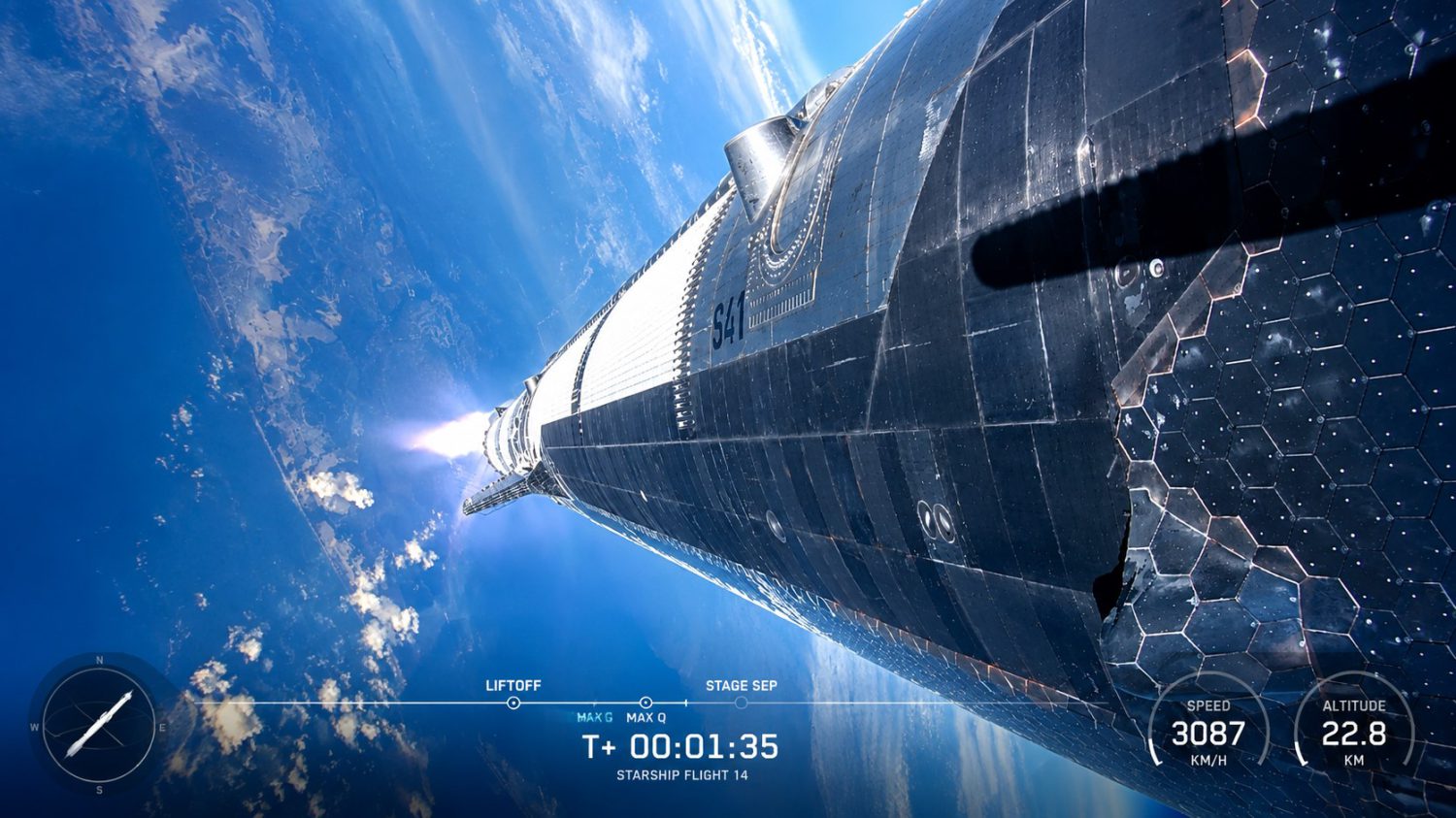
SpaceX’s Starship reportedly achieved Earth orbit for the first time on Monday, crossing a threshold that separates a rocket that merely reaches space from one that can actually stay there. Flight 14 launched from Starbase in South Texas and, according to reports, completed orbital insertion despite losing one of its six upper-stage Raptor engines shortly after stage separation.
One Engine Down, Still Going
The reported engine anomaly tested Starship’s design margins before the vehicle had even settled into orbit.
The anomaly reportedly prompted SpaceX to briefly call off the orbital attempt before the company decided to continue with the remaining five engines. The mission appears to have cleared the orbital bar, according to reports, though no verified primary-source statement or telemetry release has confirmed either the engine failure or the temporary cancellation and resumption of the attempt.
What Orbit Actually Means for Starship
Reaching orbit is a fundamentally different achievement from simply reaching space, and Flight 14 was planned as Starship’s first attempt to make that leap.
Reaching orbit requires sustained velocity of roughly 28,000 kilometers per hour. At that speed, a vehicle continuously falls around Earth rather than arcing back down on a ballistic path.
That distinction matters because Flight 13, conducted July 24, 2026, demonstrated that Starship could deploy Starlink V3 satellites but placed all 20 of them on a suborbital trajectory. Those satellites reentered the atmosphere shortly after deployment, per SpaceX’s official account.
Flight 14’s planned profile called for a 275-kilometer orbit, approximately six revolutions, and a mission lasting nearly 10 hours. The supplied brief reports that all 26 Starlink V3 satellites were dispensed successfully, though that outcome has not been independently confirmed by available reporting. The FAA had licensed the mission for its orbital debut, according to preflight reporting from Aviation Week.
Booster Recovery and What Remains Unproven
A reported improvement in booster recovery is encouraging, but a simulated water landing is not the same as a completed operational turnaround.
The Super Heavy booster reportedly performed a cleaner simulated water landing than previous V3 attempts. That is not equivalent to catching the booster at the launch tower or achieving the routine refurbishment cycle that Starship’s economics ultimately require.
SpaceX is a privately held company, so any secondary-market price movement should be treated as a short-term reaction, not confirmation that Starship has entered commercial service. The harder milestones remain: repeatable orbital insertion, controlled Ship reentry and recovery, reliable booster catch, and the orbital propellant-transfer demonstrations central to SpaceX’s Starship lunar-lander architecture for NASA’s Artemis program. Monday’s flight reportedly clears one significant bar; several more remain.