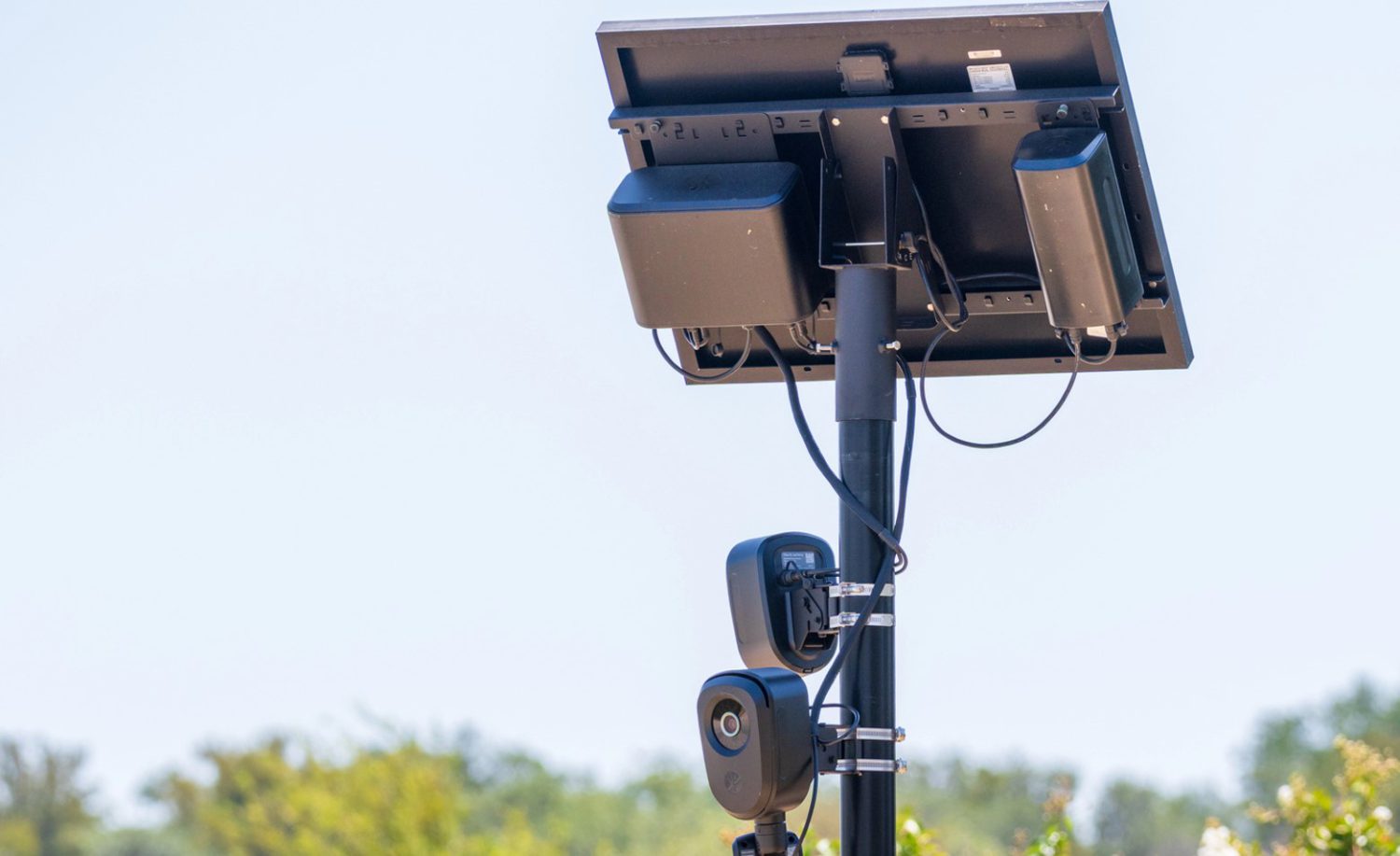
In WSB-TV’s route test, a 15-minute commute passed roughly 30 known Flock cameras. The “privacy route” took nearly twice as long and still passed two.
The crowdsourced mapping project DeFlock estimates more than 6,000 automated license plate reader (ALPR) cameras across metro Atlanta as of September 2026. That figure comes from volunteer contributors and OpenStreetMap data, not an official government inventory, so treat it as a minimum rather than a complete count.
Your Car Has a Fingerprint. The Network Reads It Every Few Blocks.
The cameras collect far more than a plate number, building a searchable record of where your vehicle goes and when.
Flock cameras log the time, the location, and physical vehicle details: bumper stickers, dents, and distinctive markings. DeFlock describes this combination as a vehicle “fingerprint.” Each recorded observation can become part of a searchable record, subject to retention policies and system configuration.
The density is what changes the nature of the system. Matthew Guariglia, a senior policy analyst at the Electronic Frontier Foundation, described the problem directly: “At some point a city reaches a saturation point. You drive the three miles to work and you pass multiple cameras, and it’s able to track when you go left somewhere, when you go right somewhere.”
Tools like DeFlock and FlockHopper, also referred to in reporting as “Don’t Get Flocked,” let you find mapped camera locations and plan routes around them. WSB-TV’s route test shows what that buys you: a longer commute and slightly less exposure to cameras that have already been mapped by volunteers. Cameras that haven’t been mapped are a separate problem the tools cannot address.
Documented Misuse Makes the Governance Gap Concrete
The oversight structures have not kept pace with a network that keeps adding cameras.
The network’s reach would be easier to accept if the oversight were airtight. It isn’t.
USA Today reported that at least 19 law-enforcement employees across five states faced serious consequences. Those included arrest, termination, administrative leave, and investigation for allegedly misusing Flock’s network. In Georgia alone, reported cases have involved agencies in Cherokee County, Albany, DeKalb County, Fayetteville, Greene County, and Richmond County, according to USA Today and CBS Atlanta.
The sharpest example involves Cherokee County deputy Jerry Shellhouse, who was fired and arrested, according to CBS Atlanta. He allegedly searched a single license plate at least 840 times between October 2023 and December 2025. He was charged with alleged violation of oath of office and unlawful retention of license-plate data.
Guariglia’s structural critique goes beyond individual bad actors. He criticized the ability to conduct historical searches without a judge’s approval or public justification, describing that structure as vulnerable to abuse. That is an expert advocacy position, not a court ruling, but documented misuse cases have made the concern concrete rather than theoretical. Readers interested in how a surveillance app can be weaponized against targeted groups will find a parallel case worth examining.
Flock has responded with an audit-assistance tool designed to flag abnormal search patterns, according to the Atlanta Journal-Constitution. The AJC also reported that data is typically deleted after 30 days under many agency practices. Georgia law requires destruction within 30 months of collection, unless the data connects to an active investigation.
Law enforcement’s case for the technology is also real. Cherokee County Capt. Jay Baker credited ALPR data with helping identify a suspect in a sexual-assault case involving a 14-year-old. “If it weren’t for the technology they use to identify the suspect,” Baker said, “it’s certainly unlikely we would be here today.”
The Question Isn’t Whether the Cameras Work
The stronger questions are about access, transparency, and accountability, and they still lack straight answers.
Authorities say ALPR data has helped identify suspects in serious investigations. The harder questions are the ones that currently have no clear public answers. Where exactly are the cameras? Who can search the records, and under what standard? What happens, consistently and with real consequence, when an officer allegedly searches a plate hundreds of times for reasons unrelated to public safety? Until those questions get straight answers, the cameras will keep multiplying faster than the rules meant to govern them , a pattern not unlike apps caught secretly tracking users with little accountability.