TÜV Nord measured the production van’s battery at 95.75% state of health after nearly 100,000 kilometers and more than 300 charging cycles across six continents. After nearly 100,000 kilometers and more than 300 charging cycles across six continents, the number that matters most is 95.75.
That is the battery state of health TÜV Nord measured when Volkswagen’s ID. Buzz Pro Long Wheelbase returned to Hanover in September 2026: independent, third-party confirmation of how a production EV holds up under genuinely punishing conditions.
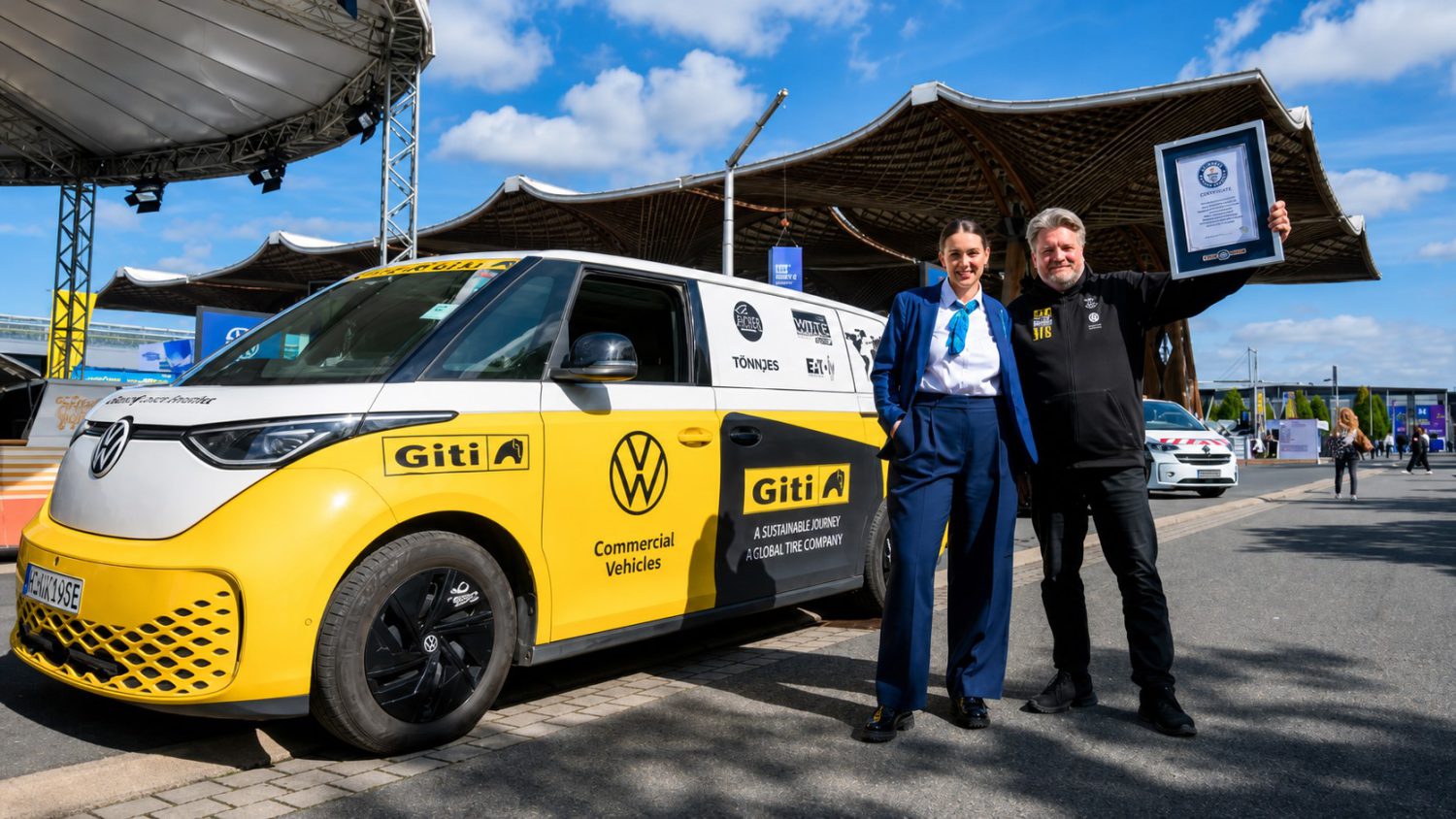
Guinness World Records officially recognized the feat at IAA Transportation 2026, certifying the ID. Buzz for “Most countries visited in a continuous journey by a battery-powered electric vehicle.”
Interesting Engineering and Electrek both flagged the TÜV Nord figure as the most concrete, skeptic-relevant result of the expedition, distinguishing it from the kind of manufacturer-controlled data that rarely moves the needle for EV fence-sitters.
Around the World in 445 Days
Rainer Zietlow departed Hanover on July 1, 2025, in a standard-production ID. Buzz Pro Long Wheelbase and spent 445 days completing the largest project of his 20-year long-distance driving career.
German long-distance driver Rainer Zietlow left Volkswagen Commercial Vehicles’ customer center in Hanover on July 1, 2025.
The route covered 92 countries across six continents, totaling 99,767 km (about 62,000 miles) before returning to Hanover. Sixteen container-ship crossings bridged the gaps between landmasses.
The vehicle reported zero technical breakdowns throughout.
Crucially, this was not a prototype. Zietlow drove a series-production ID. Buzz Pro LWB fitted with standard Giti tires, the same configuration available to any buyer.
“After 445 days of travel, crossing 92 countries and covering 99,767 km, or about 62,000 miles, Volkswagen’s electric van earned its place in the Guinness World Records.” , Electrek
What the Battery Data Actually Shows
TÜV Nord inspected the van before departure and again on its return, making its 95.75% state-of-health finding the most independently verified data point of the entire journey.
Traditional range anxiety debates center on the vehicle. This trip exposed something else entirely: how unevenly the world has built the infrastructure to support one.
TÜV Nord inspected the ID. Buzz before departure and again on its return. The agency confirmed the same production unit completed the journey and that its high-voltage battery retained 95.75% state of health after approximately 300 charging cycles across varied climates and terrains.
Independent battery researchers note that degradation varies with temperature, charging speed, and usage patterns, making single-expedition results illustrative rather than definitive. This is one vehicle on one carefully planned journey, not a fleet-wide controlled study.
The infrastructure gaps Zietlow encountered were equally instructive. In Zambia and Tanzania, the team had to charge at national power substations under supervision, a solution that functions for a record-setting expedition but has no practical equivalent for everyday drivers.
South Africa, Morocco, Rwanda, and Saudi Arabia showed stronger networks. Brazil, Chile, and China demonstrated meaningful progress in EV adoption and charging coverage.
“The ID. Buzz could cover the distance, but planning where and how to recharge remained an essential part of the expedition.” , Interesting Engineering
The Van Held Up. The Grid Did Not Always.
The journey’s clearest conclusion is a split verdict: the vehicle performed, and the world’s charging infrastructure remains deeply uneven.
That gap is a policy problem as much as a technology one.
Expect more third-party-verified endurance studies like this one, where independent inspection bodies such as TÜV Nord supply pre- and post-journey battery data that marketing alone cannot. If you have been waiting for real-world evidence before committing to an EV, this record offers a credible floor; what it cannot yet offer is a guarantee that the charger you need will be there when you arrive as you navigate life on the road.