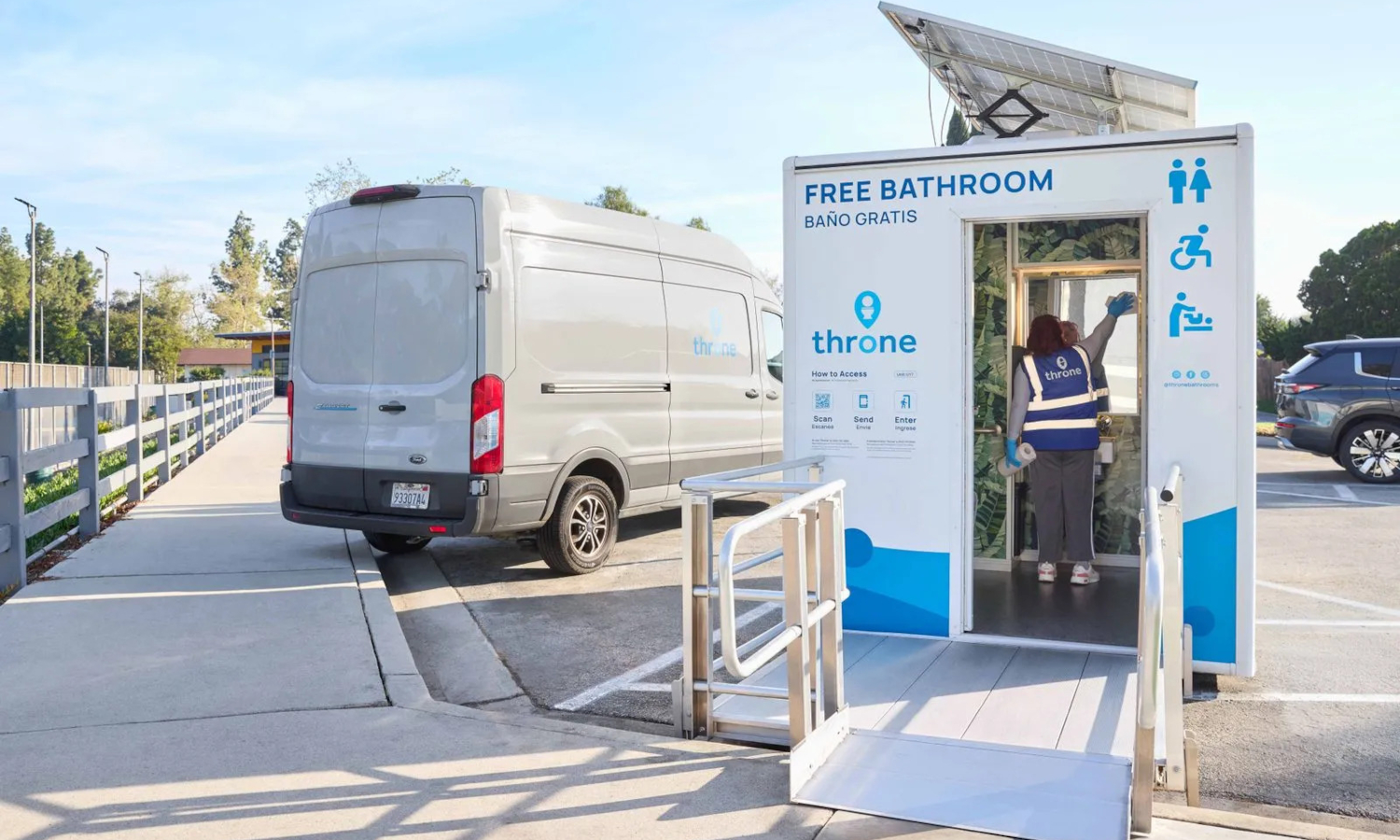
You step inside, the door slides shut, and a clock starts. Ten minutes later, if you’re still in there, an automated voice announces in English and Spanish: “Attention: Your use time has expired. The door is opening now.”
New York City has launched a one-year, $4 million pilot with Throne Labs to install 17 modular public bathrooms across all five boroughs. The program addresses a shortage that leaves roughly 8 million residents with access to only about 1,000 public restrooms, according to Gothamist.
Getting In
Getting inside is straightforward if you have a phone or a tap card, but the access requirement itself has drawn scrutiny.
Entry requires a QR code scan, the Throne Bathroom Network app, a text message to a designated number, or a phoneless tap card distributed free by local community partners. Signage on each unit directs users to tap card locations within a 10-minute walk, per the NYC Mayor’s Office.
When the Clock Runs Out
The timer sequence gives users multiple warnings before the door opens, but the mechanism is automatic once time expires.
Audio warnings play at five and eight minutes; at the limit, lights flash and the sliding door opens. Throne Labs COO Jessica Heinselman told AM New York that a roughly 30-second buffer follows the final warning: “If you are still pants down, we’re not going to open the door on you,”.”
If someone remains inside after the door opens, Throne Labs staff receive an occupancy alert and may visit in person. Police contact is possible if the person refuses to leave, according to Gothamist.
Why 10 Minutes
City officials frame the time cap as both a misuse deterrent and a safety tool.
Officials cite deterrence of drug use, prostitution, encampments, along with faster staff response to medical emergencies. Data from other Throne deployments shows the average visit runs about 3 minutes 20 seconds, according to Yahoo News, making the 10-minute ceiling generous for typical use.
Where to Find Them
The first units are already open in Brooklyn and Queens, with more planned across all five boroughs.
The first two units opened mid-September at Fulton Street and Truxton Street in Brooklyn, and 34th Avenue and 64th Street in Queens. Additional planned sites include areas near Yankee Stadium, Columbus Park, Astoria Boulevard, Cooper Square, and the North Shore Esplanade.
Units operate from 7 a.m. to 10 p.m. daily and are free and ADA-accessible. Each includes a flushing toilet, running water, climate control, a baby-changing station, and fully touch-free fixtures. No underground plumbing connections are required, which the NYC Economic Development Corporation says allows faster and more affordable installation than conventional restroom construction.
The Equity Question
Advocates welcome the added bathrooms but raise concerns about who the access requirements may leave out.
If you do not have a smartphone or a tap card, getting inside is not straightforward. Homelessness and civil-liberties advocates support the addition of clean public bathrooms but warn that the requirement can block access for the most vulnerable residents, according to Gothamist. Some researchers have noted broader concerns about apps tracking users without their full awareness.
No publicly available mechanism currently exists to extend sessions for people with mobility challenges or chronic conditions. Throne Labs has said it is developing one, per AM New York.
What Comes Next
The pilot’s outcome may shape how other cities approach the intersection of tech and basic public infrastructure.
NYC agencies will evaluate the program over its one-year run. The results could determine whether timed, app-mediated public bathrooms become a broader municipal model for cities facing similar shortages.