Australia has released an exposure draft of legislation that would impose a statutory “digital duty of care“ on nearly every online service operating in the country, from TikTok and YouTube to ISPs, app stores, and generative AI tools. Published 8 September 2026 and open for public submissions until 22 September 2026, the Online Safety Amendment (Digital Duty of Care) Bill 2026 is the most expansive overhaul of Australia’s online safety framework since the Online Safety Act 2021.
What the Bill Actually Does
The draft replaces existing industry codes with a direct statutory duty, requiring covered services to proactively identify foreseeable harms and take effective measures to mitigate them.
Providers must conduct annual risk assessments and retain them for six years. eSafety Commissioner Julie Inman Grant can request them at any time, and breaches carry maximum penalties of approximately A$109.2 million for corporations.
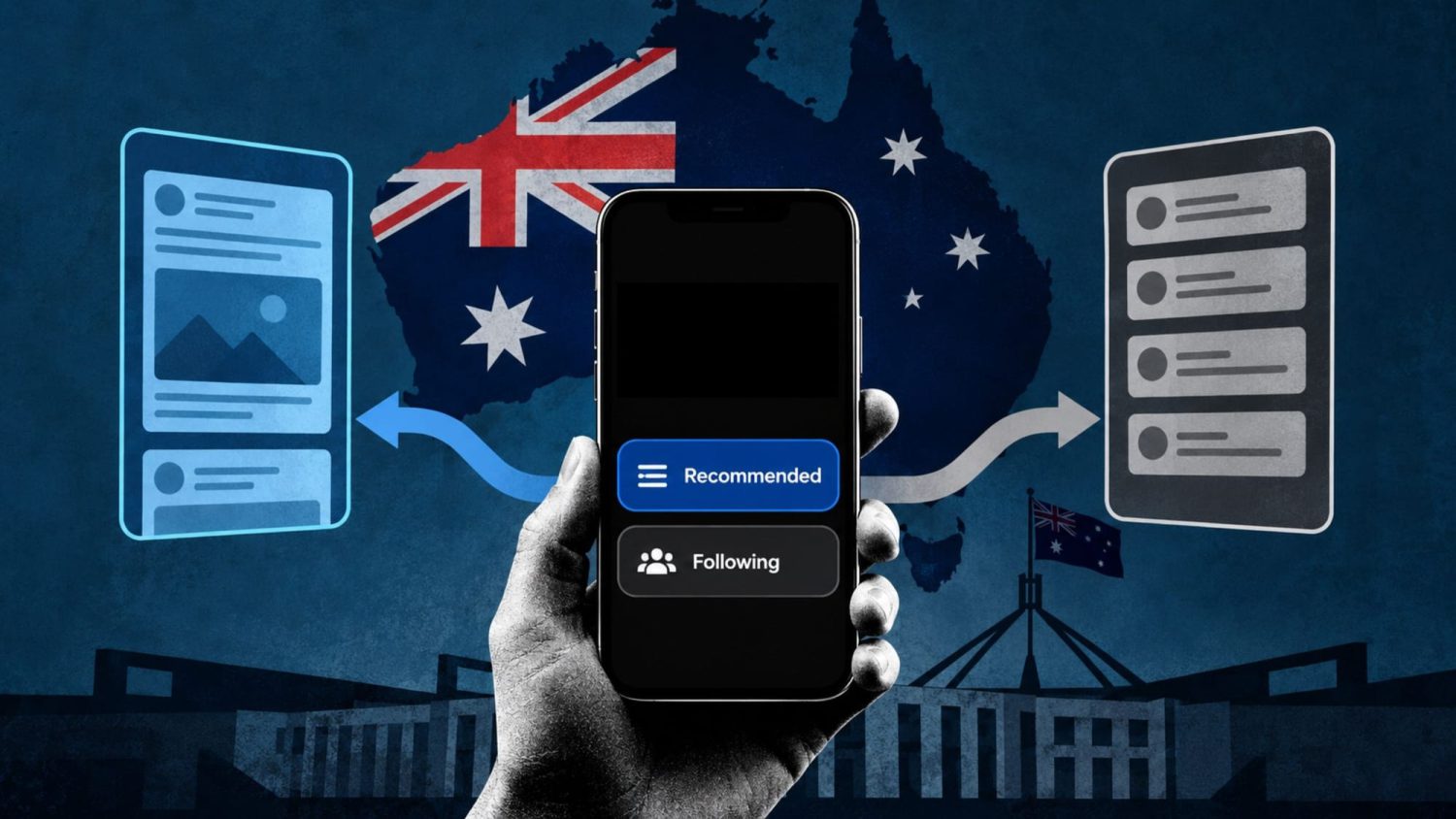
Your feed is directly in scope. Under a provision branded “My Feed, My Way,” platforms including Facebook, Instagram, TikTok, YouTube, X, and Reddit must offer you a genuine choice between algorithmic recommendations and a chronological feed showing only accounts you follow. Platforms cannot use subtle design mechanisms to push users back to AI-curated content.
For users under 16, the obligations go further. Platforms must disable all of the following:
- Algorithmic recommendations and content ranking
- Infinite scroll and endless feeds
- Engagement-feedback tools such as likes, reactions, and streaks
- Ephemeral content features including stories
The duty applies broadly across the digital landscape, covering social media and video-sharing platforms, messaging services, online games, websites and apps, hosting providers, cloud services, search engines, app stores, ISPs, and operating systems, as well as generative AI tools that enable sharing of AI-generated content via covered services.
“This is not about giving government control, it is about giving people control.” , Prime Minister Anthony Albanese, Sydney Morning Herald, 8 September 2026
One enforcement mechanism deserves attention. The minister retains authority to add new categories of harmful content via legislative instruments, after seeking advice from the eSafety Commissioner. Those instruments are subject to parliamentary disallowance.
Who’s Pushing Back, and Why It Matters
The bill has drawn opposition from across the political spectrum and sparked early friction with the United States.
Opposition Leader Angus Taylor has described the proposal as “an attempt by the government to censor social media,” according to an official Liberal Party of Australia statement dated 10 September 2026. The Coalition opposes the bill in its current form, and One Nation leader Pauline Hanson has called the regulatory architecture “Orwellian machinery.”
“An attempt by the government to censor social media.” , Angus Taylor, Liberal Party of Australia, 10 September 2026
The Greens broadly support giving users feed choice, but argue algorithmic curation should require users to actively opt in rather than opt out.
International pressure has also emerged. White House spokesman Kush Desai issued a pointed warning: President Trump has “unequivocally warned trading partners against imposing digital services taxes, fines, and other forms of extortion on America’s leading technology sector.” The comment signals the bill could become a flashpoint in trade talks.
Communications Minister Anika Wells responded directly: “We’re a sovereign nation, we have the right to defend Australian parents and kids and we’ll do that.”
The government intends to introduce the bill to Parliament later in 2026, with a proposed 12-month transition period following enactment. If passed, platforms serving Australian users must redesign feed architecture, build risk-assessment infrastructure, and deliver child-specific product experiences within that window. The alternative is penalties that leave little room for delay.