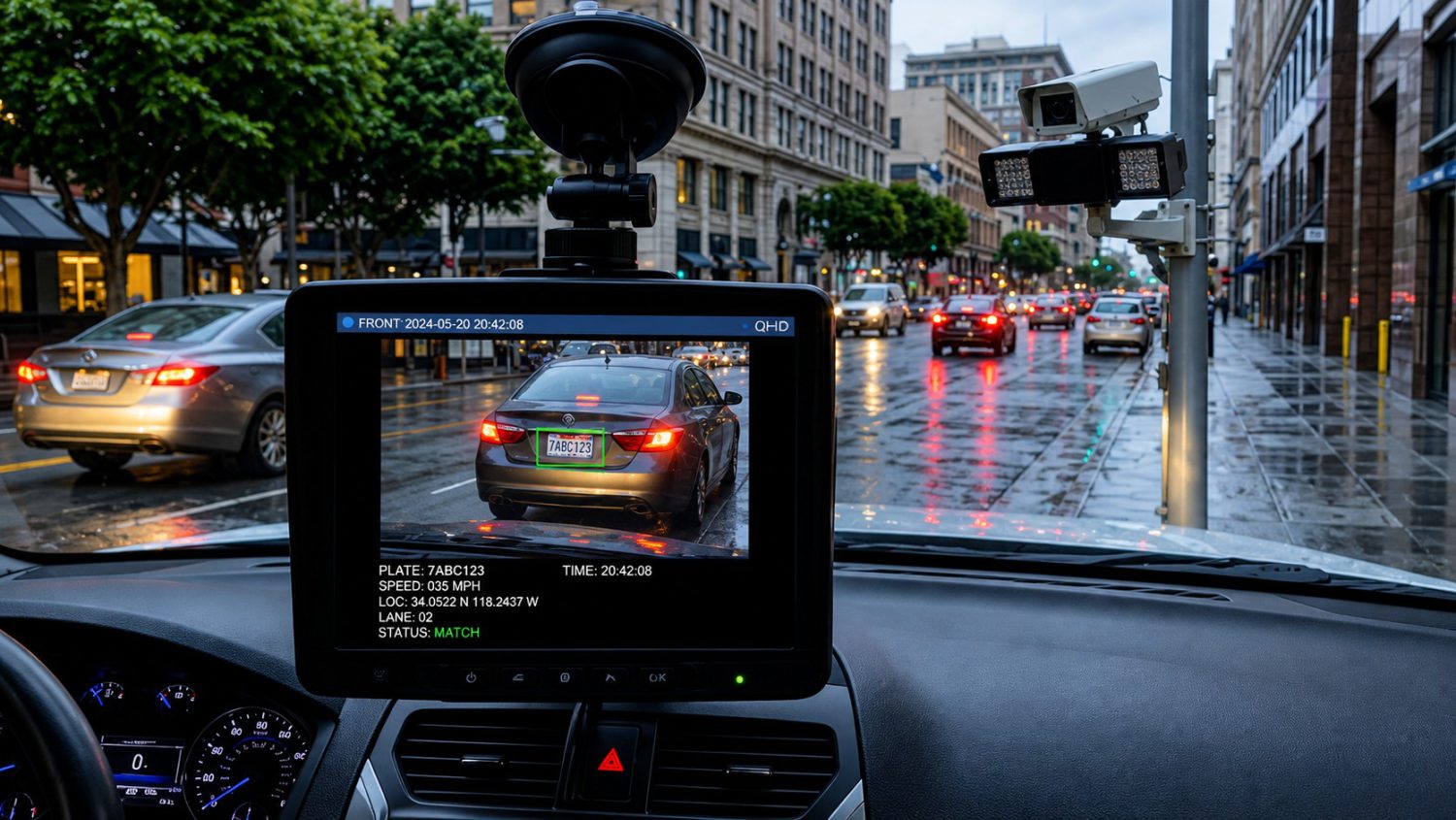
Alpharetta, Georgia has 67,000 residents and roughly 120 police officers. It also has Flock Safety cameras feeding license plate data to more than 2,000 organizations — colleges, airports, a Medicare fraud unit in Illinois, Florida’s Fish and Wildlife Commission. According to WIRED’s public records analysis published August 28, the suburb receives data from over 1,300 entities in return. This isn’t a story about one rogue department. It’s about how a vendor’s platform architecture quietly transforms a local camera purchase into a national surveillance app-enabled decision nobody consciously made.
The 500-Mile Default
A single configuration choice — auto-approving requests within 500 miles — quietly wired Alpharetta into a surveillance network spanning thousands of agencies.
Alpharetta Lieutenant Jason Hiott told WIRED the department “automatically approves” data requests from law enforcement within 500 miles. He couldn’t say whether that was the original default, when it was set, or what earlier configurations looked like. Flock’s admin panel lets agencies share by radius, by state, or by manually selecting partners — but most administrators don’t fully understand what they’ve enabled, or for how long. Flock spokesperson Jess Montejano claimed data sharing is “off by default” for new customers, without clarifying whether that had always been true.
Since June 2025, entities receiving Alpharetta’s data grew by roughly 42 percent; entities sending data to Alpharetta grew by 125 percent. Then there’s Nationwide Lookup — Flock’s 2023 tool letting any customer query cameras across the country. Palo Alto, California didn’t learn the feature had ever been active on its system until December 2025, months after Flock disabled it — a potential conflict with California law, which bars sharing ALPR data with out-of-state agencies. San Jose has a Flock problem that mirrors these same tensions around local oversight. The city manager first heard about it at a June study session. The department’s own officers found out six months later.
When the Audit Tool Finds What No One Was Looking For
Query logs from Reynoldsburg, Ohio reveal how platform design and human behavior together push searches toward the widest possible scope.
WIRED obtained 549 pages of Reynoldsburg, Ohio query logs. One officer searched 53 networks, then — 40 minutes later, same offense code — searched 5,392 networks. No explanation logged. As Commander David Hart of Minnesota’s Beltrami County Sheriff’s Office told WIRED: “It’s gotten to the point where people want to search more agencies just to be able to search more agencies, without a real reason behind it.” The platform’s design and human behavior together bias toward maximum scope — and the product was never built to push back.
Flock announced changes on August 13:
- A recommended 7-day retention period down from 30
- Mandatory criminal case codes per search
- An Audit Assistance tool to auto-flag abnormal behavior
Alpharetta’s chief activated Audit Assistance in July. By July 20, an officer was under investigation. By August 5, that officer had resigned. The accountability mechanism worked — but only after years of expansive, under-scrutinized access had already accumulated.
Any vehicle passing through an American suburb today is likely already catalogued somewhere in this network. National surveillance infrastructure isn’t built by grand design. It’s assembled one vendor contract at a time, one permissive default at a time, largely without public awareness — much like a White House app caught secretly tracking users without explicit consent.