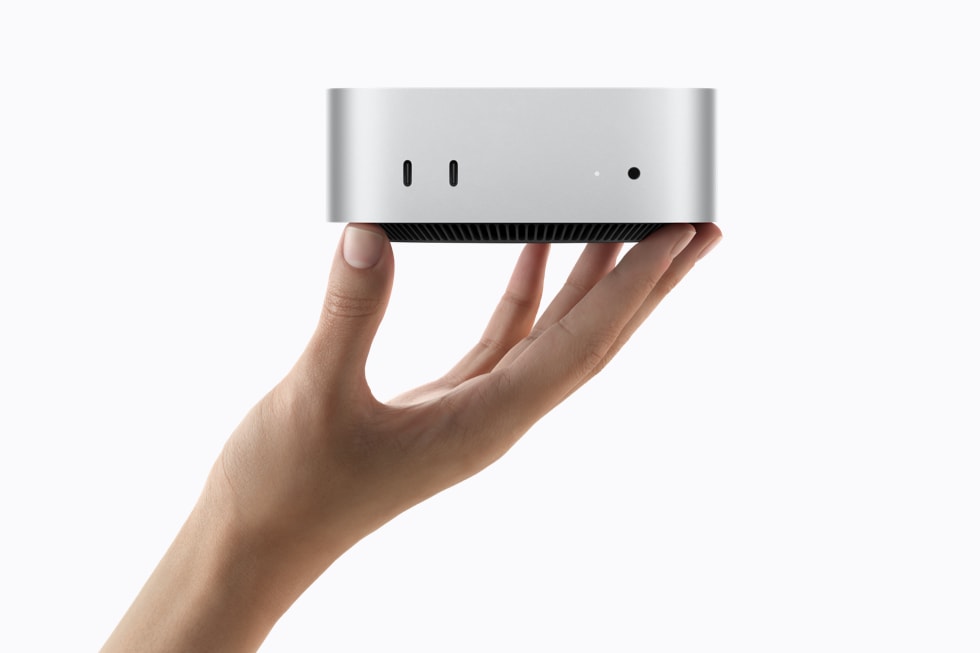
Apple’s first 2nm processor just landed in the smallest box on your desk. The new Mac mini arrives in two configurations — M6 for most people, M5 Pro for those running serious workloads — and both ship September 22, 2026. Pre-orders are open now. The chassis hasn’t changed. What’s inside absolutely has. Two machines, one compact box, and a clear fork in the road depending on what you actually do all day. Apple’s investment in custom silicon continues to pay dividends with each new generation.
What the M6 Brings to the Base Model
Apple’s first 2nm chip delivers a meaningful performance jump for everyday creators and AI tinkerers — starting at $899.
The M6 runs a 12-core CPU and 12-core GPU, starts with 16GB unified memory (configurable to 32GB), and pushes 170GB/s of bandwidth. It’s also the first Apple chip to combine all three CPU core types: 2 super cores, 4 performance cores, and 6 efficiency cores. According to Apple’s newsroom, the M6 delivers 40% faster multithreaded performance versus M4, 4x faster AI performance, and 2x faster graphics. Storage reads and writes are up to 2x faster than the previous generation.
- M6: 12-core CPU / 12-core GPU, up to 32GB unified memory
- 4x faster AI vs. M4; 13.5x faster LLM prompt processing vs. M1 in LM Studio
- 2x faster gaming with ray tracing vs. M4, tested in Cyberpunk 2077: Ultimate Edition
- Storage up to 2x faster than the prior generation
That 13.5x LLM speed claim versus M1 is the number to sit with — running a local AI model on this machine is a fundamentally different experience than it was two product cycles ago.
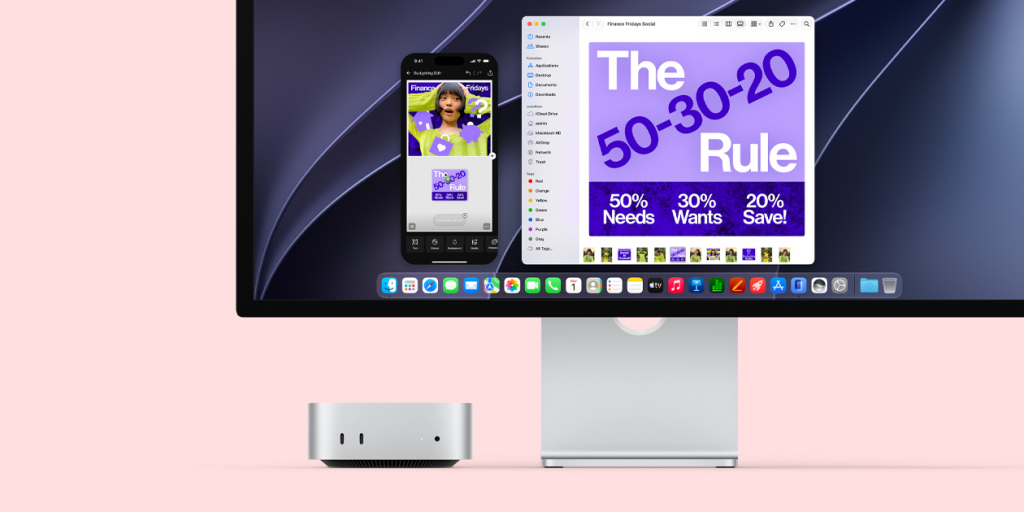
The M5 Pro – When the Base Model Isn’t Enough
Serious creative and AI workloads get 64GB of unified memory, Thunderbolt 5, and benchmarks that make M2 Pro users quietly reconsider their life choices.
The M5 Pro scales up to an 18-core CPU, 20-core GPU, 64GB unified memory, and 307GB/s bandwidth. Neural Accelerators sit inside every GPU core alongside third-generation ray tracing. Apple’s newsroom credits the M5 Pro with 8.5x faster LLM prompt processing versus M2 Pro in LM Studio and 4.5x faster Blender rendering with ray tracing, alongside 2.1x faster image processing in Affinity versus M2 Pro. It starts at $1,699, or $1,599 for education buyers.
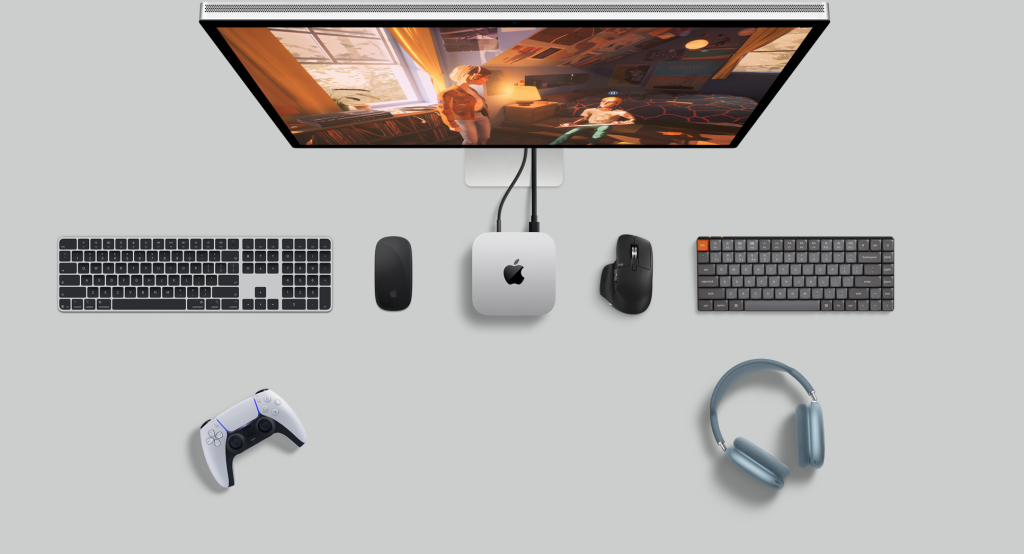
Both models get Wi-Fi 7, Bluetooth 6 via Apple’s N1 chip, and 2.5Gb Ethernet as standard (10Gb available as an upgrade). The port split matters: the M6 gets three Thunderbolt 4 ports on the back; the M5 Pro steps up to three Thunderbolt 5 ports. Both share HDMI, two front USB-C ports with USB 3 support, and a headphone jack. Video professionals get something new on both models — genlock support over USB-C, a first for Mac mini.
The Buying Decision, Simplified
A $100 base price increase buys you stronger hardware. The question is how much performance you actually need.
The base price climbed $100 over the prior entry point, as noted by The Verge. Apple is essentially saying: pay slightly more, get meaningfully more. For most people, developers, editors, and productivity-focused users running the occasional local AI model, the M6 at $899 is the honest answer. If your workflow lives in Blender, DaVinci Resolve, or LM Studio for hours daily, the M5 Pro at $1,699 is the one that won’t make you wait. Same compact box. Fork in the road. September 22 is the date.