Staff named her Jodie Foster because her intake paperwork listed “JF” for juvenile female. Someone made the call. Nobody regrets it now. In 2024, keepers noticed the python eating less — a serious red flag for any large constrictor. Investigation revealed a fibrosarcoma, an aggressive soft-tissue cancer, lodged in her jaw. Initial surgery removed it. The tumor came back and started consuming jawbone. For a reticulated python, whose entire survival strategy depends on unhinging its jaws to swallow prey larger than its own head, jaw destruction isn’t just painful — it’s a death sentence.
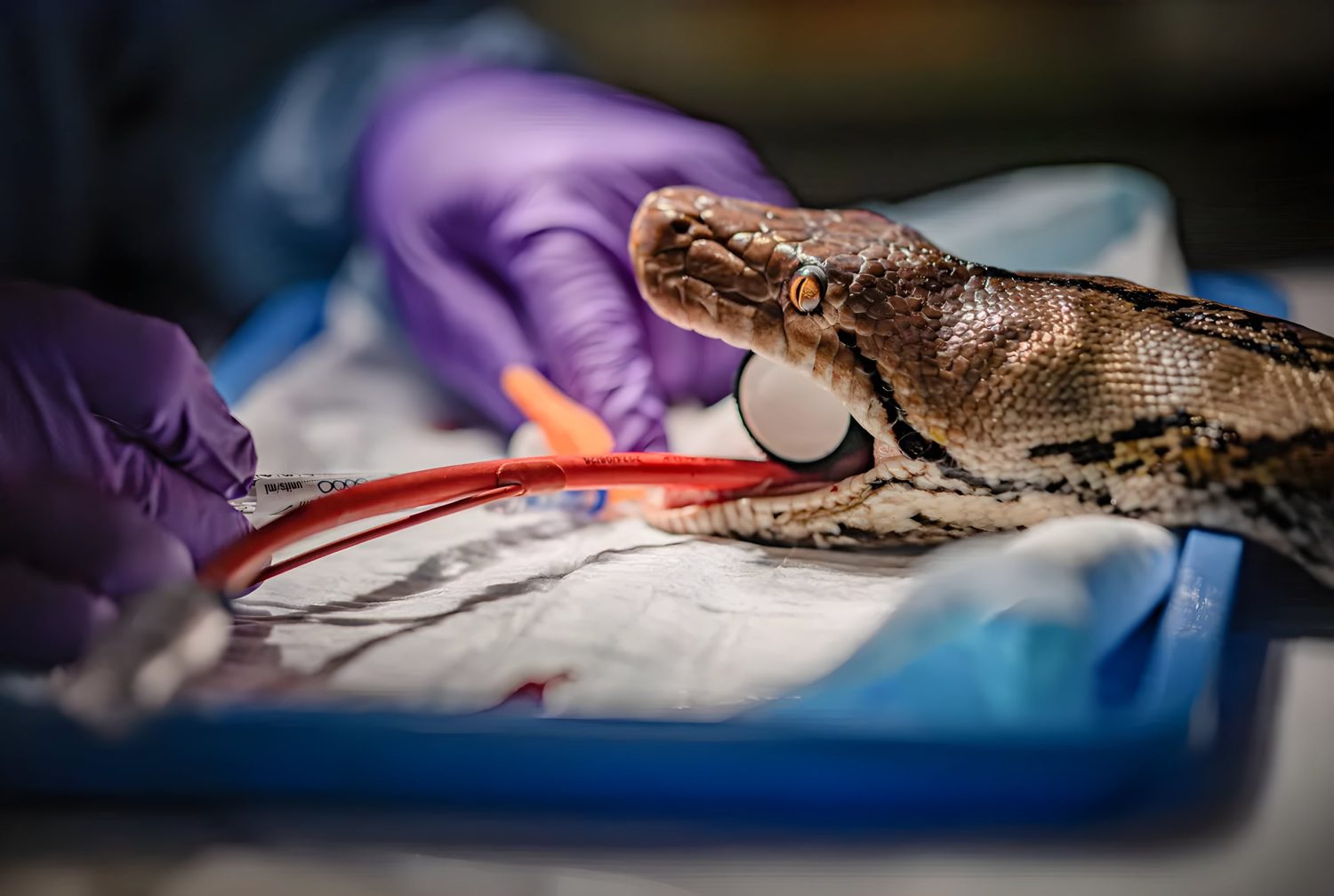
Jodie is approximately 23 years old, 15ft long, and around 50kg, and has lived at Chester Zoo for roughly two decades. The treatment deployed was electrochemotherapy (ECT): the drug bleomycin combined with controlled electrical pulses that temporarily open cancer cell membranes, flooding them with drug at far lower doses than systemic chemotherapy requires. Months later, she is cancer-free and eating normally, including whole prey.
Two Operating Tables, Heated Blankets, Ninety Minutes
The surgical logistics alone were extraordinary — vets anaesthetized a 50kg snake inside her own habitat before improvising an operating space roughly the size of a double bed.
Reptiles are ectothermic. Let their body temperature drop during surgery and you’ve compounded every other risk dramatically. So the team anaesthetized Jodie inside her habitat first, minimizing stress and the considerable handling risk posed by a large, powerful snake. They pushed two operating tables together to accommodate her length. Heated blankets and warmed air ran throughout the procedure. Lead vet Dr. Ian Ashpole then performed a partial jaw-bone removal (hemo-mandibulectomy), excising the tumor mass and the diseased bone it had invaded. Ninety minutes. Then electrochemotherapy was applied directly to the surgical site to eliminate any microscopic residual cancer cells.
“We were facing the possibility of losing her as the tumour made it more and more difficult for her to eat, so we worked with cancer specialists to see whether we could adapt electrochemotherapy for a snake. As far as we’re aware, this is the first time it’s ever been used on one.” — Dr. Ian Ashpole, Chester Zoo
Borrowed From Human Oncology, Adapted for a Snake’s Jaw
ECT has been used in humans and small animals for years — nobody had applied it to a reptile’s jaw until Chester Zoo partnered with the University of Liverpool to adapt that protocol.
ECT isn’t new. Dogs, ferrets, cats — veterinary oncologists have used it for cutaneous tumors with solid results and minimal side effects. Here’s how it works: electrical pulses temporarily increase cell membrane permeability, letting bleomycin target cancer cells without saturating the whole body with toxic doses. Applying that to a snake’s jaw, with all the anatomical and anaesthetic complications involved, was genuinely uncharted territory. Chester Zoo collaborated with cancer specialists at the University of Liverpool’s small animal clinical science centre to design the adapted approach. The team plans to formally publish the case so vets worldwide can replicate and refine it.
“A fantastic opportunity to expand the work we do within the department to support high-quality veterinary and translational research.” — José Alvarez Picornell, University of Liverpool
Bright, Feisty, and Eating Whole Chickens
Months after surgery, Jodie Foster is cancer-free, her jaw still functions, and one snake’s tumor has quietly pushed the boundaries of exotic-animal oncology.
Zoo staff describe her as “bright and feisty” — exploring her habitat, behaving normally, swallowing prey whole. Despite losing part of her jawbone, the jaw’s mechanics remain intact. When that planned publication lands, it could reshape how exotic-animal vets approach oncology across species. One snake’s recurrent tumor has become a case study with the potential to do exactly that — and that is the whole point.