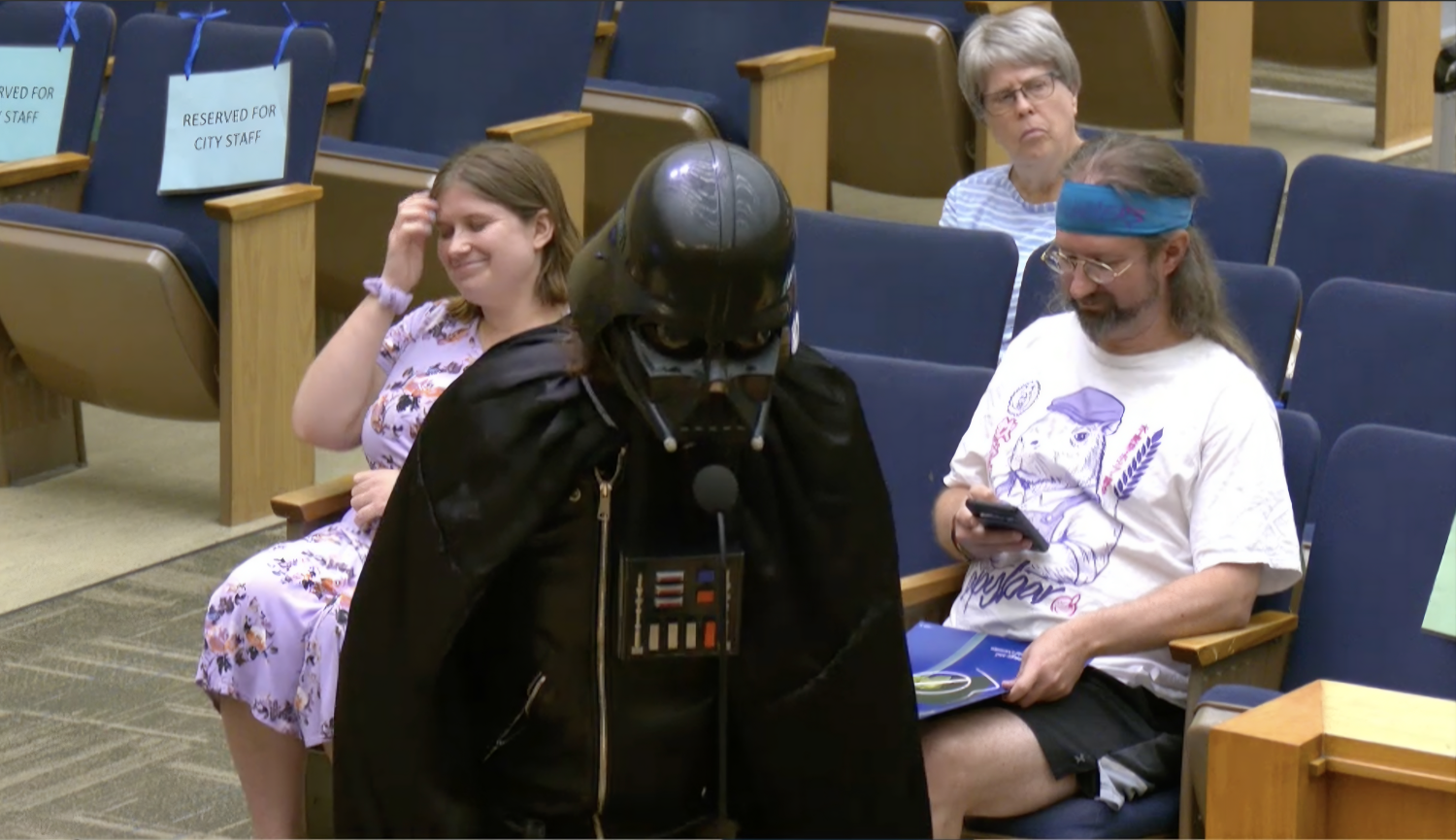
The room had folding chairs, fluorescent lights — and then a helmet, a cape, audible mechanical breathing. Darth Vader stepped to the podium. The speech that followed was framed as support for Flock Safety’s license plate camera network. It was actually a precise autopsy of one. Underneath the performance sits a genuinely serious story: San Diego has quietly built one of the densest civilian surveillance networks in the state, signed an undisclosed AI data contract, and already jailed an innocent man for nearly a month while officers trusted an automated alert over its own contradicting evidence.
The Speech That Explained Everything Without Saying It
A single satirical performance at a city committee meeting managed to name every documented concern about San Diego’s surveillance expansion.
Vader’s remarks, delivered August 19 at the Public Safety and Livable Neighborhoods Committee and reported by 404 Media, hit specific targets. The cameras were essential, he explained, to track “rebel scum as they move from playground to playground, from playground to pool, from pool to gymnasium.” He also needed them “to stalk my ex-girlfriend.” He urged council members to use “Jedi mind tricks” to convince residents that surveillance was good for them. Each line maps to a documented concern. The satire was sharp precisely because it was accurate.
The facts underneath that performance are worth knowing. According to city records and transparency trackers:
- SDPD operates roughly 500 Flock ALPR cameras mounted on streetlights across the city.
- In December, SDPD quietly signed a one-year pilot contract for Flock’s Nova platform — without informing the City Council, Privacy Advisory Board, or the public — despite San Diego’s TRUST surveillance oversight ordinance.
- Nova goes well beyond reading plates: per an internal Flock recording cited by 404 Media, it lets investigators “jump from LPR to person” and link targets through marriage, gang affiliation, and open-source intelligence.
- The pilot year was free; subsequent years would cost approximately $230,000 annually.
- After Axios reported the contract, SDPD said it has not activated Nova and does not intend to use it — though the contract remains in place.
SDPD argued Nova was exempt from TRUST ordinance review because it “only processes data from already-approved technologies.” The city’s Privacy Advisory Board pushed back. That exemption argument gets harder to sustain given how a Flock employee described Nova’s capabilities in an internal company recording reported by 404 Media: “Access data and jump from LPR to person and understand what that context is, link to other people that are related to that person… marriage or through gang affiliation… There’s very powerful linking.” That’s a significant leap from “we store plate data for 30 days.”
When the Algorithm Gets It Wrong, People Go to Jail
The case of Hugo Parra shows what happens when automated alerts override the evidence those same systems produce.
Hugo Parra was arrested for an attempted armed carjacking based on a Flock alert and a witness description. He spent nearly a month in jail. The problem, reported by Times of San Diego and amplified by journalist Dorian Hargrove: Flock’s own data showed his vehicle was approximately five miles from the crime scene at the time of the offense. Police matched him to the suspect by beard, skin color, and jacket color. His attorney, Alex Coolman, told Ars Technica: “The Flock alert clearly indicated the wrong vehicle — it was impossible for it to be in both locations at once.” Parra’s lawsuit is pending.
SDPD’s results from the ALPR program are real and worth stating plainly:
- Roughly $6 million in recovered stolen goods
- More than 400 arrests
- A reported 20% drop in vehicle theft from 2023 to 2024, according to Axios
But the Parra case illustrates exactly what Vader was gesturing at: tools adopted without scrutiny, trusted without verification, consequences borne by residents.
The most clarifying testimony at a surveillance oversight meeting came from a man in a movie villain costume. Flock Safety did not respond to a request for comment. The Nova contract dispute and Parra’s litigation are both still live. If the city’s own oversight ordinance can be quietly routed around, the question was never whether Flock works. It’s who’s watching the watchers.