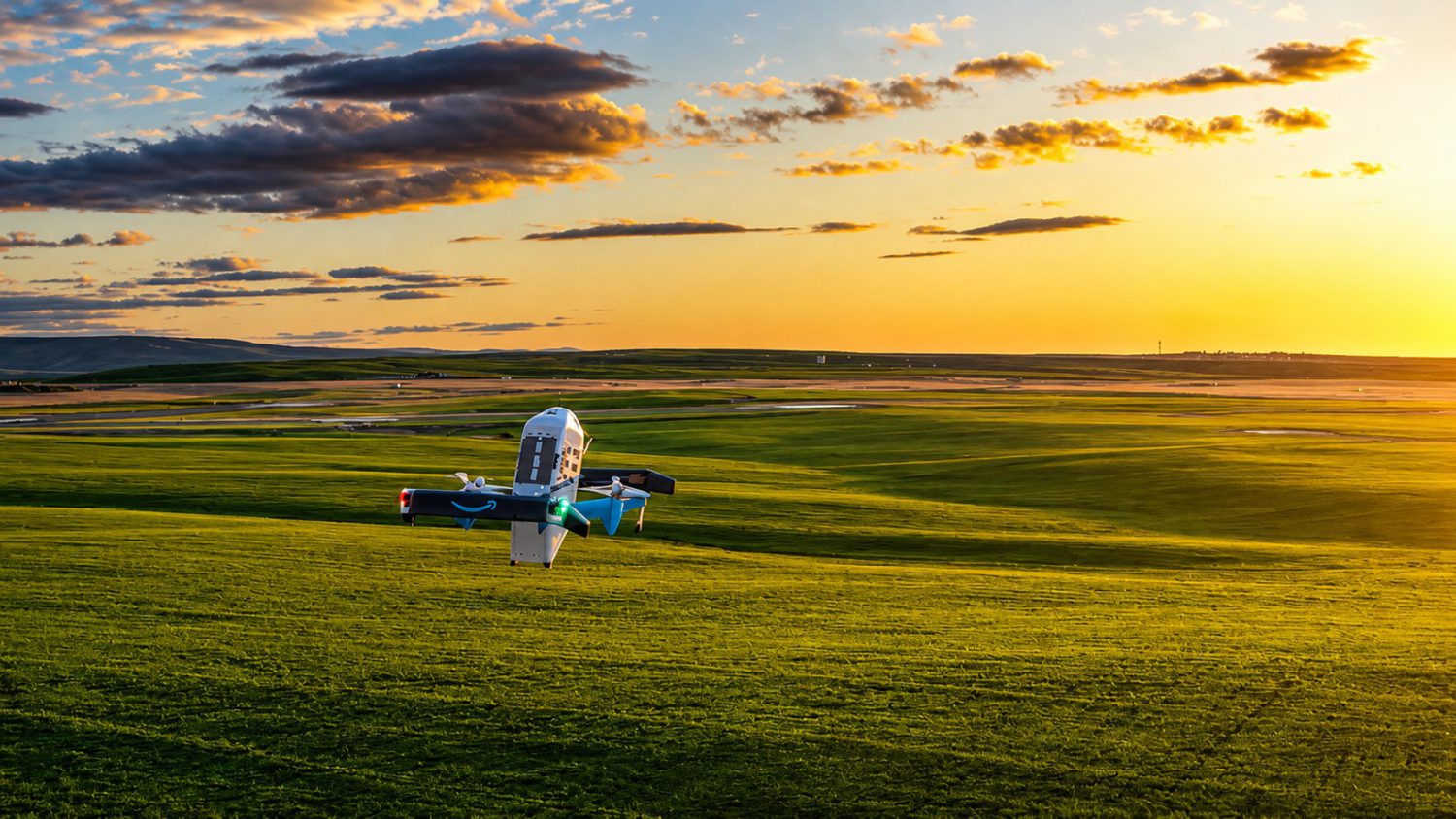
Lindsey Austen heard the buzzing first. She ran outside, phone already up, ready for her first-ever drone delivery. The drone hovered. The compartment opened. The package dropped — straight into her swimming pool. Her response, which you’ve probably already seen online, involved at least one expletive and zero ambiguity about how she felt.
Amazon’s timing couldn’t have been worse. Or more perfectly illustrative.
When the Algorithm Misses the Landing Zone
Prime Air’s sensors saw everything — except the obvious problem.
The pool drop wasn’t a collision. Nobody got hurt. But it was a precision failure on a system Amazon markets specifically on its precision. According to Amazon, Prime Air drones carry onboard cameras and sensors designed to navigate, check for obstacles, and deliver packages safely. What they don’t carry is a human operator watching each drop in real time — the visual systems handle autonomous situational awareness only, and cameras do not stream live video to employees.
The system’s credentials are real:
- FAA Part 135 certified
- detect-and-avoid technology Amazon compares to a trained pilot continuously scanning airspace
- capable of delivering packages up to five pounds in as little as 30 minutes
Non-Prime customers pay $4.99 per order for this service.
500 Cities, One Viral Pool
Amazon’s sixfold expansion announcement landed the same week its drone didn’t.
On August 19, 2026, Amazon announced Prime Air would expand from roughly 11 sites across seven states to nearly 500 U.S. cities and towns by year-end — a sixfold increase. Chicago, Atlanta, Cleveland, Boise, and Syracuse are on the list. In his annual shareholder letter, CEO Andy Jassy wrote that the company has “learned a great deal by flying drones in 11 sites” and now has “a design that’ll scale,” with ambitions to reach communities covering 30 million customers by year-end and deliver half a billion packages annually by decade’s end.
That’s an extraordinary bet. And the pool drop is exactly the reason the bet is interesting rather than straightforward.
The drone’s confident autonomous logic failing in a Texas backyard is the tech equivalent of Google Maps routing you confidently into a lake — the system executed against its own parameters without the situational awareness any human would’ve had in two seconds flat. Edge-case handling for backyards with pools, pets, and cluttered layouts is precisely what needs to be bulletproof before landing in 500 cities.
The pool incident will likely get a software update. The real question is how many pool-sized edge cases exist across those 500 cities — and whether Amazon can surface them before they go viral rather than after. Your neighbors in Chicago and Atlanta will find out soon enough.