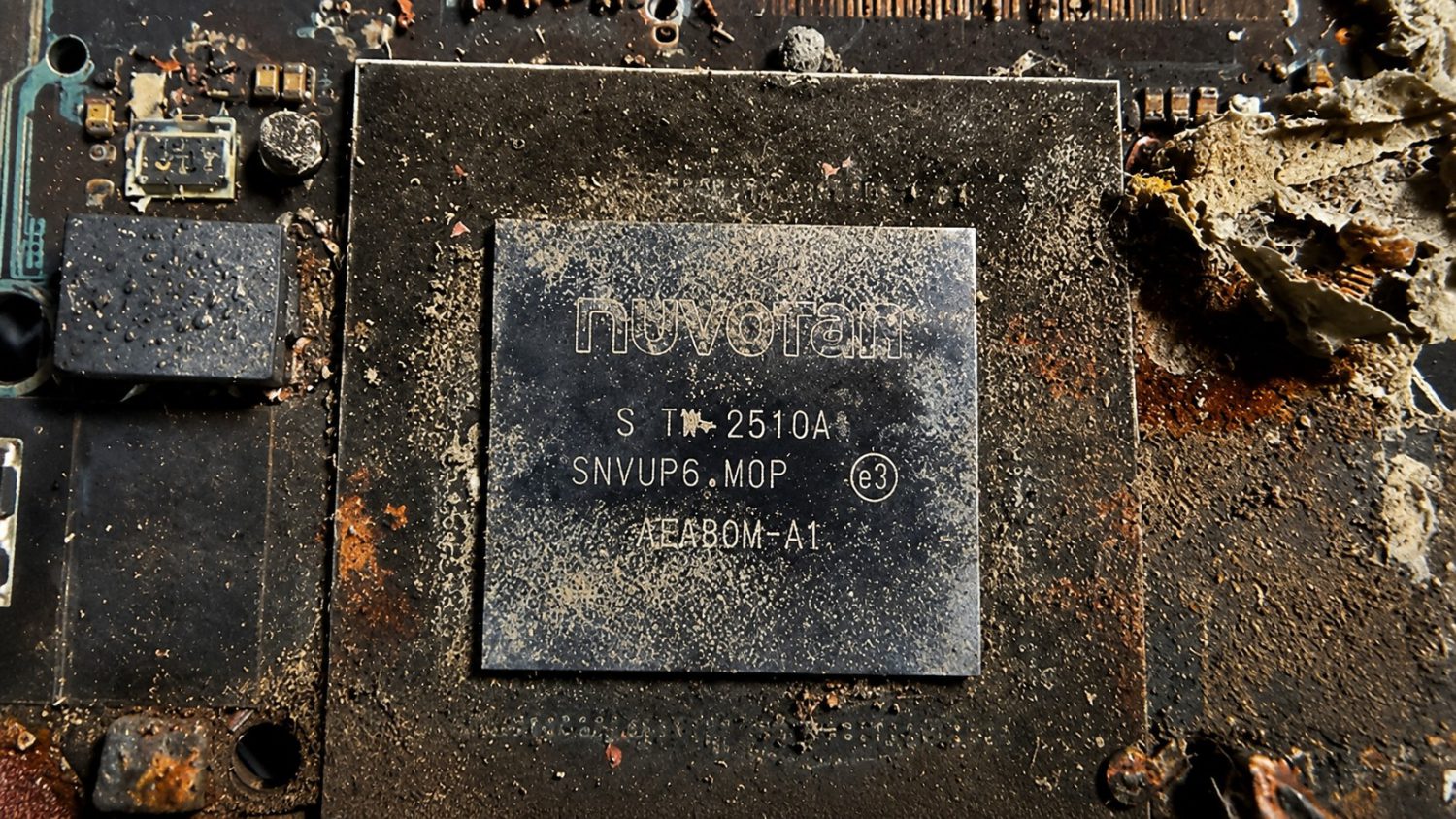
Ukraine’s Main Intelligence Directorate (HUR) recently tore apart the wreckage of Russia’s S-71M “Monochrome” — a low-observable, air-launched cruise missile with a 250 kg warhead and a reported range exceeding 300 km. What they found inside wasn’t exotic black-market hardware. It was a commercial AI chips system-on-module, chip markings TE980M-A1, consistent with a Jetson Orin NX 16GB. The same board a startup founder might order for a robotics project. Available from a German retailer for around €685 including VAT.
Sitting alongside it: a Honpho TS130C-01 electro-optical camera module from China. Together, they form a self-contained perception system. The missile sees a target, compares it against onboard templates, and steers itself — no datalink required in the terminal phase, no human in the loop.
Ukrainian defense commentators cited by Defence-UA describe the S-71M as capable of “independently searching for a target according to a predefined priority list, then attacking it without human involvement.” Worth noting: HUR hasn’t released the software stack. The chip’s presence strongly suggests AI inference capability. It doesn’t confirm a model is actively running. That distinction matters.
Nvidia’s Answer, and the Supply Chain Problem
Nvidia’s official position is clear — the messy reality of global reseller markets is anything but.
Nvidia told Tom’s Hardware plainly: “Our Jetson Orin modules are consumer-grade products sold to students, developers, and startups for a wide range of beneficial applications. They are not available in Russia and are not designed for military purposes… if we determine that any customer is violating U.S. export controls, we will take appropriate action.”
Compliance friction is a real cost of any stricter regime — but the current one has obvious gaps. Pre-owned and third-party reseller markets are global, diffuse, and largely untracked after point-of-sale. This isn’t a one-time anomaly, either. Ukraine previously recovered Jetson Orin modules from the MS001 variant of Iranian-designed Shahed drones, where the chip reportedly processed infrared video for autonomous target recognition. A pattern has emerged: Russia systematically sourcing Western edge-AI hardware through indirect channels.
The Export Control Gap Nobody Closed
U.S. policy draws the line at training-class GPUs — leaving inference hardware like the Jetson Orin NX in a regulatory blind spot.
U.S. export controls target training-class GPUs — H100, B200 — the hardware that builds large AI models. Jetson Orin NX runs models. It doesn’t train them. That distinction, sensible for commercial policy, leaves a gap wide enough to navigate a cruise missile through.
The Jetson Orin NX delivers up to 157 INT8 TOPS of AI inference performance, with integrated vision accelerators and modest power draw — exactly the profile suited to a missile-borne perception system. Edge-AI inference hardware remains formally uncontrolled, even as its military utility becomes impossible to ignore.
Tightening controls would mean compliance friction, region locks, and bureaucratic overhead for every developer buying a Jetson kit. Whether that tradeoff is worth making is a policy question without a clean answer — and policymakers are only now starting to ask it seriously.
The Uncomfortable Takeaway
Consumer AI hardware and autonomous weapons now share the same product line — and that boundary isn’t coming back.
The Jetson board on a developer’s workbench and the one recovered from missile wreckage in Ukraine are the same product. Not an indictment of Nvidia or its customers. Rather, a reminder that the line between civilian and military technology keeps getting thinner — and that “not designed for military purposes” has never meant the same thing as “can’t be used for them.”