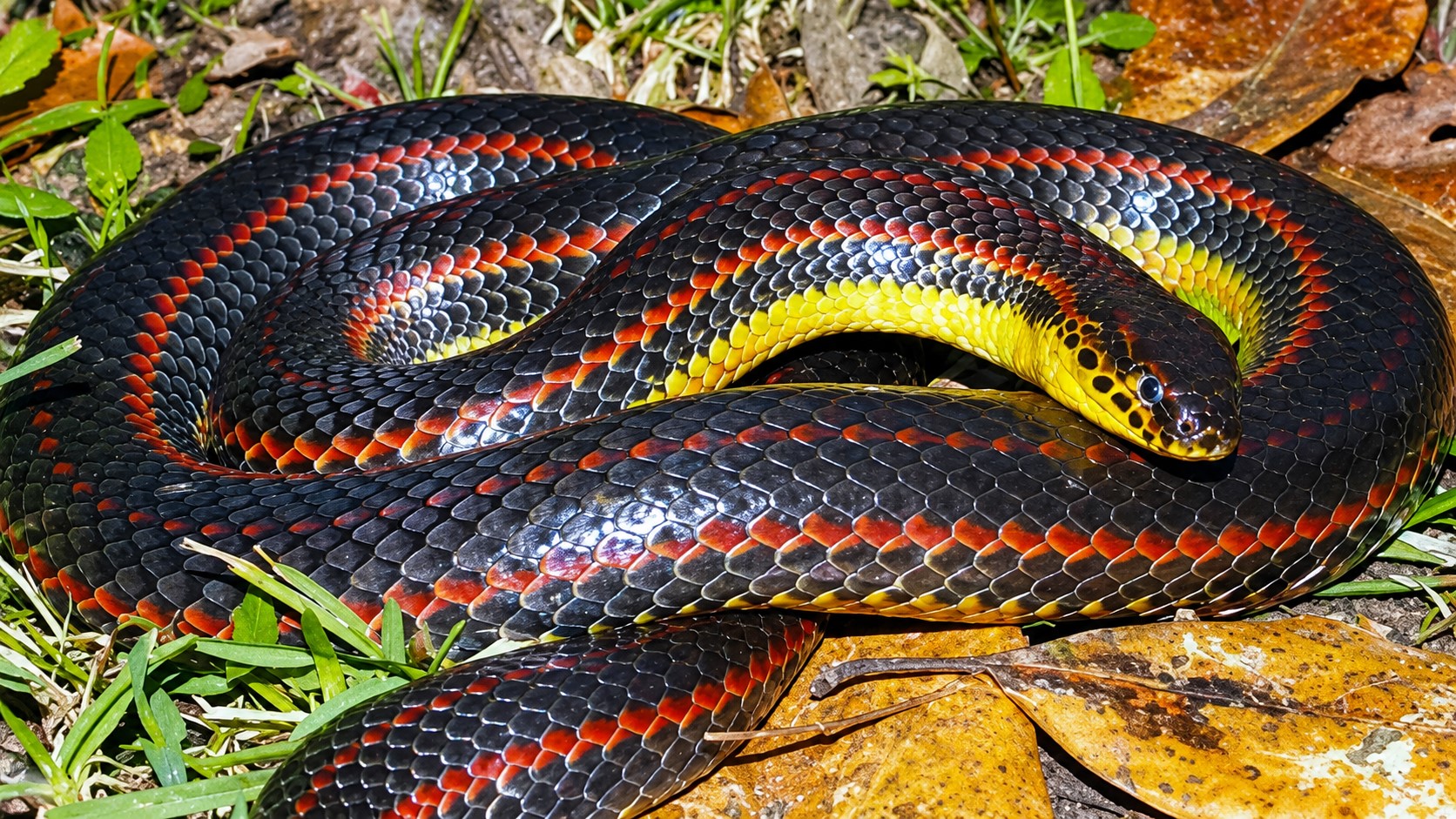
Some wildlife looks like it was designed by committee. The rainbow snake looks like it was designed by someone who just discovered the gradient tool. Hiker Tracey Cauthen was trekking through Ocala National Forest in February 2020 when she photographed a roughly 4-foot specimen — confirmed by the Florida Museum of Natural History and state wildlife officials as the first recorded Marion County sighting since 1969. Fifty-one years of radio silence, broken by one photograph.
Gone for Half a Century – Now Back
Florida’s most visually striking snake spent decades avoiding the camera.
The rainbow snake is absurdly beautiful. Iridescent black or violet-blue back. Three red stripes running its length. Yellow lip and chin scales dotted with violet spots. It looks like something that escaped a concept exhibit at a high-end aquarium. These snakes are semi-aquatic, spending their lives in and around rivers, springs, and brackish marshes. They’re not rare because they’re fragile. They’re rare because water hides everything.
Here’s what you should know:
- First confirmed Marion County sighting since 1969; photographed by hiker Tracey Cauthen
- Snake measured approximately 4 feet long
- Nonvenomous; diet consists mainly of American eels, frogs, and tadpoles
- A South Florida subspecies from Fisheating Creek in Glades County hasn’t been seen since 1952 and may be extinct
- The Florida Fish and Wildlife Conservation Commission is asking the public to report sightings with photos, location, and date
What a Single Sighting Actually Means
One photograph can tell biologists more about habitat health than years of guesswork.
Because rainbow snakes depend heavily on aquatic prey — especially American eels — a verified sighting functions like a biological diagnostic. The Florida Museum of Natural History describes the species as a strong indicator of ecosystem health: consistent presence signals a functioning aquatic food chain. The Fisheating Creek subspecies vanished over seven decades ago. That’s what the alternative looks like.
The practical ask from Florida wildlife officials is straightforward. If you spot one, document it — photos, location, and date. Population mapping depends entirely on verified reports, and a single confirmed image, like Cauthen’s, can rewrite decades of assumed absence.
One of the continent’s most visually striking reptiles has been threading through Florida’s waterways for generations. The only question is whether anyone is paying close enough attention to find it.