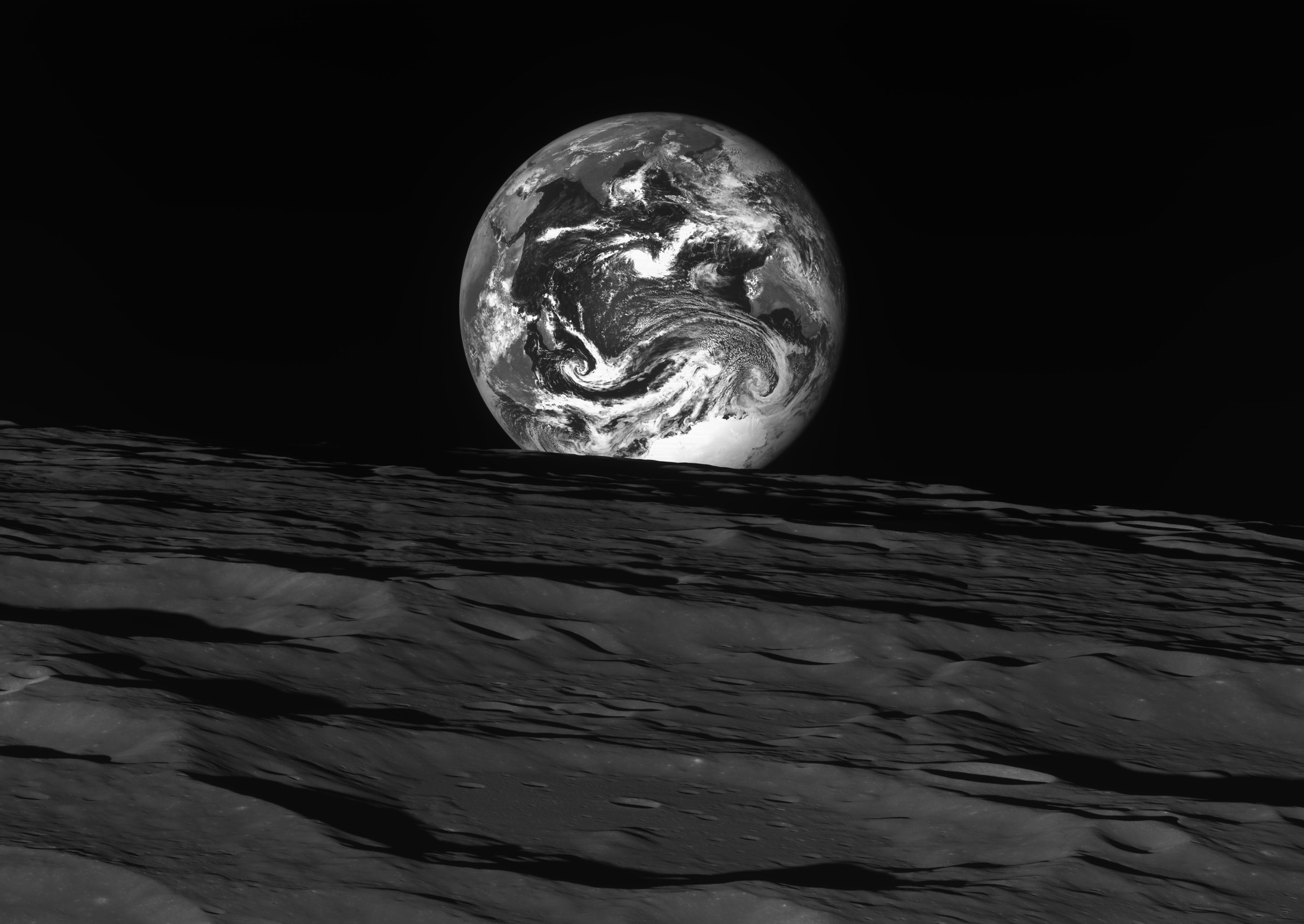
In the early hours of August 5, 2026, with most of Earth asleep, a defunct SpaceX Falcon 9 upper stage — abandoned years ago on a chaotic deep-space trajectory — hit the Moon at roughly 5,400 mph. Nobody on Earth saw it happen. Wired confirmed the impact produced no visible flash from our vantage point. Amateur astronomers struck out completely. But South Korea’s Danuri lunar orbiter had started imaging the area 30 minutes before the collision. The Korea Aerospace Research Institute reported that Danuri completed eight imaging sessions, capturing the lunar surface before and after impact — like a dashcam that happened to be pointed at exactly the right crater.
What the Images Show
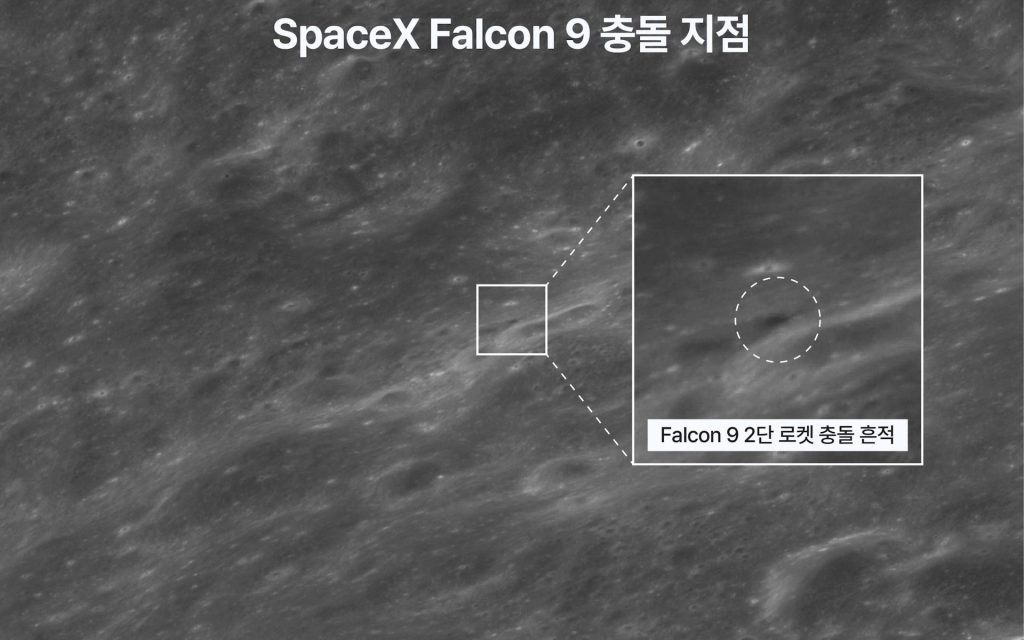
Danuri’s before-and-after shots reveal a fresh, darkened scar near Einstein crater on the Moon’s northwestern limb.
Danuri’s imagery tells a clear story. The terrain at the impact site appears noticeably darker post-collision, per AP, indicating that dust and rock were thrown outward by the strike. The crater sits near Einstein crater on the Moon’s northwestern limb, according to Live Science. NASA had modeled a crater roughly 60 to 90 feet wide and 12 to 16 feet deep ahead of the event. Whether the actual scar matches those predictions is still an open question — NASA’s Lunar Reconnaissance Orbiter is expected to image the site later, though timing depends on orbital passes and lighting conditions.
Trash Turned Research Tool
Unplanned lunar impacts are rare enough that Danuri’s documentation carries genuine scientific weight.
Artificial impacts on the Moon almost never happen with a camera rolling. That makes this accidental crater — and the eight imaging sessions bracketing it — unexpectedly valuable for studying impact dynamics and ejecta patterns. Follow-up imagery from the Lunar Reconnaissance Orbiter could refine crater-size estimates and sharpen the analysis further.
Image availability depends on “several factors, including the impact location, lighting conditions, and when each spacecraft’s orbit next carries it over the area,” according to NASA spokesperson Rob Garner.
The Disposal Problem Hiding Behind the Discovery
The crash posed no danger to Earth, but it sharpens uncomfortable questions about who’s responsible for deep-space debris.
Multiple outlets confirmed zero risk to Earth. Still, the incident splits opinion sharply. Some researchers see a scientific windfall — unplanned data on high-velocity lunar impacts that would cost millions to replicate intentionally. Others see a preventable failure: another upper stage left to drift without clear end-of-life disposal standards. No regulatory framework currently covers deep-space trajectories with any real enforcement power.
The Moon now carries a fresh crater with a human fingerprint on it. NASA’s follow-up images may tell you exactly how large the scar turns out to be. But the larger question — who’s accountable for what gets left behind beyond Earth’s orbit — remains stubbornly, conspicuously open.