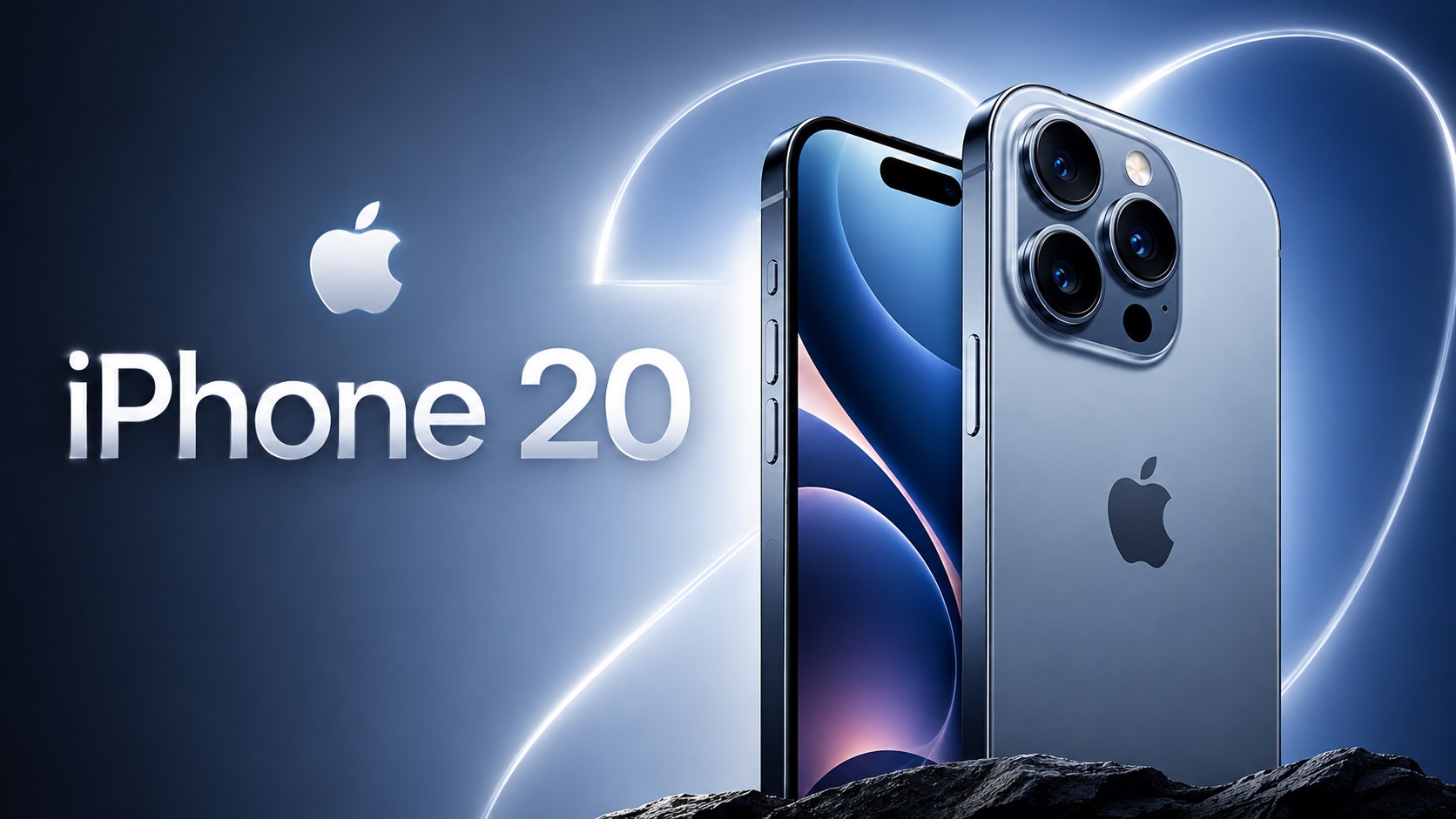
Twenty years ago, Steve Jobs held up a device and called it “an iPod, a phone, and an internet communicator.” The crowd laughed. According to Bloomberg’s Mark Gurman and multiple supply-chain reports, Apple is targeting its most radical hardware redesign since the iPhone X for fall 2027, driven by its custom silicon strategy. The rumored iPhone 20 — or iPhone XX, since Apple may skip “19” the way it skipped “9” — reportedly rewrites the playbook on materials, display, camera, and AI hardware. Here are 10 features worth tracking, and an honest read on which ones might actually ship.
The Design Is the Story
Apple reportedly wants a phone with no visible edges, no frame gaps, and no interruptions between glass and screen.
Multiple sources describe a quad-curved “liquid glass” all-glass chassis where the OLED display bends around all four sides, targeting bezels of roughly 1.1 mm — thinner than the rumored iPhone 17 Pro. The panel reportedly uses Samsung’s COE technology, where color filters are applied directly to the encapsulation layer, eliminating the traditional polarizing film. The result: a thinner, brighter, more power-efficient display. A crater-shaped diffusion layer supposedly keeps brightness uniform across those tricky curved edges.
The plan, per MacRumors, is to bury Face ID entirely beneath the display using “spliced micro-transparent glass” — no Dynamic Island, no cutout, nothing. Two sizes are expected: approximately 6.3 and 6.9 inches. Here’s the honest caveat: display analyst Ross Young has cautioned the under-panel tech may not be ready in time, and a separate report warns edge distortion and brightness falloff could push the perfected all-screen version to 2028.
Apple reportedly plans a two-stage rollout — 2027 gets the design, 2028 gets it right.
What’s Under the Hood
The internals match the ambition of the exterior, with a new chip, rethought memory, and a camera sensor Apple built from scratch.
The A21 chip, built on a second-generation 2-nm node and shared with Apple’s rumored second-gen foldable iPhone, is expected to outperform the A20-series on both efficiency and on-device AI headroom. Paired with it is reportedly HBM-style stacked DRAM — high-bandwidth memory wired directly to the GPU and AI accelerators — designed to run heavier Apple Intelligence models locally, no cloud required.
On the camera side, Apple is said to be developing a proprietary stacked image sensor to replace Sony’s hardware, targeting up to 20 stops of dynamic range using LOFIC (Lateral Overflow Integration Capacitor) technology. Each pixel handles extreme light variance independently — think human-eye HDR rather than phone-camera HDR. For shoppers researching imaging hardware, our guide to the best cameras offers useful context. For battery, rumors point to pure silicon anodes replacing conventional graphite cells for higher energy density. One leak claims 6,000 mAh capacity, though credible outlets treat that specific figure as unverified. Rounding it out: after deploying the C1 and C2 chips in mid-range and Pro models respectively, Apple reportedly targets a high-performance in-house modem for U.S. anniversary iPhone variants aimed at matching or beating Qualcomm by 2027.
The Feature That Changes How You Actually Hold the Thing
“Project Bongo” replaces every physical side button with solid-state haptic controls embedded directly into the curved glass chassis.
Think MacBook trackpad logic applied to your volume rocker. Localized vibration simulates click depth, distinguishing light from firm presses while leaving the glass chassis completely uninterrupted. Apple is reportedly stress-testing these controls for gloves, wet hands, and extreme temperatures. An ultra-low energy microcontroller is said to keep the controls functional for emergency SOS and power-on functions even when the main battery is fully depleted.
A handful of bonus rumors carry weaker sourcing but are worth knowing:
- Reverse wireless charging for AirPods and accessories
- Under-display audio that eliminates the front earpiece slit
- A next-gen Ceramic Shield upgrade to handle the curved glass’s drop-risk trade-off
- Pricing speculation ranging from $1,100 to $1,500
Treat all of these as possibilities, not promises.
Fall 2027 is the window to watch. For anyone tracking Apple’s hardware roadmap, should Apple deliver even half these features — the curved display, the custom sensor, the solid-state controls — this anniversary device stands to reset what a baseline iPhone means for years to come.