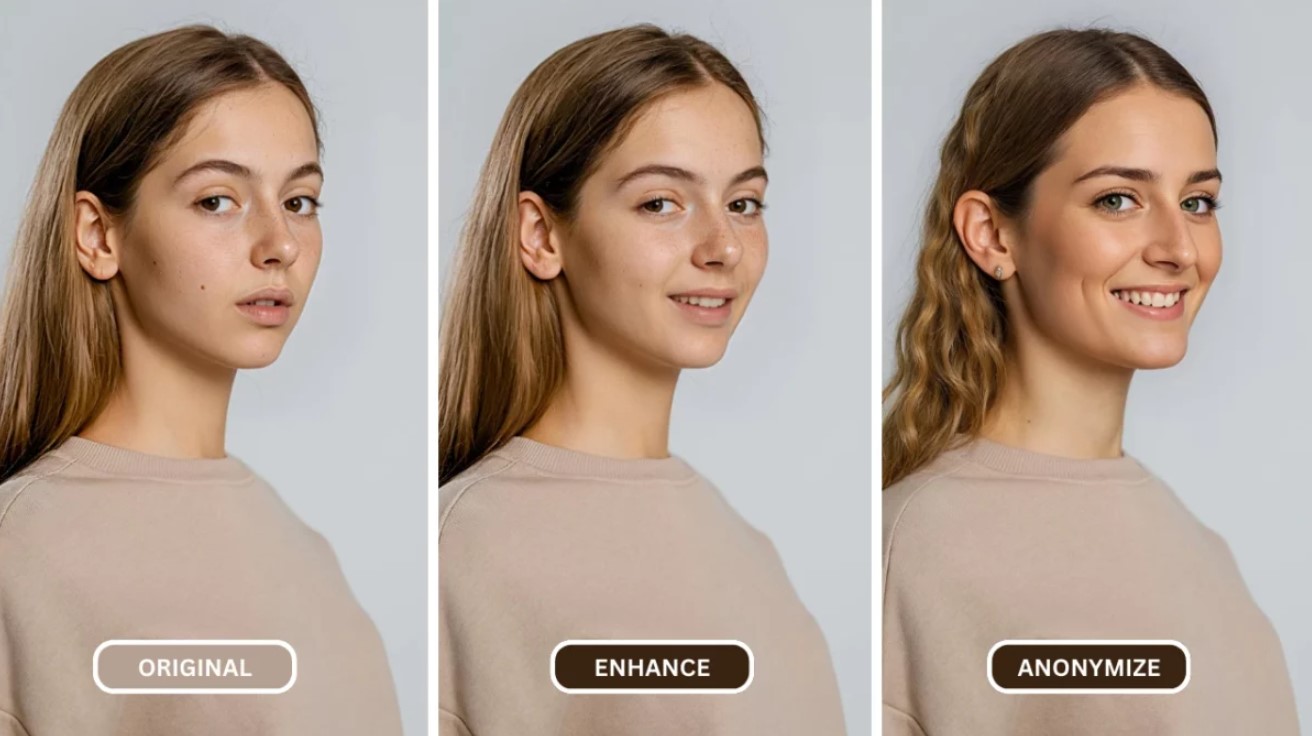
Ashley BeLoat is an oncology nurse who has faced cancer personally. She brought that raw, lived-through-it vulnerability to her micro drama series “Hate the Way I Love You” on MoboReels. Then she found a second series on the same app — identical plot, eerily similar voice, matching movements — starring a younger, more sexualized AI version of herself. Nobody asked. Nobody paid. MoboReels hasn’t responded to her manager’s requests for removal or compensation, according to Business Insider. BeLoat has since gone back to nursing. Welcome to the $1.4 billion micro drama industry, where your performance is now training data.
Your Face, Their Profit
Actors across the micro drama industry are discovering AI clones of themselves — built from their own performances, distributed without consent, and protected by contract language nobody thought to question.
Brittany Marsicek starred in “Ex-Husband, Step Aside, Lady Boss Returns,” which was later remade with an AI character that acted and sounded like her — no contract protections in sight. Evan Gambardella recognized his own face and performance style in “Mafia King’s Contract Groom” on GoodShort, a show he never worked on. Gambardella earned roughly $5,000 for the original role; the AI remake that used his likeness earned him nothing and, he believes, cost him future work after he spoke out publicly.
- The US micro drama market has “rapidly embraced AI,” according to Business Insider reporting
- Platforms including MoboReels, GoodShort, and ReelShort have distributed AI remakes of live-action series
- Actors’ contracts lacked explicit AI protections — legacy “editing rights” language is being stretched to cover synthetic replacements
- GoodShort told Business Insider it acquired the disputed series from a third-party creator and does not support unauthorized use of actors’ identities
“Being an actor is a very vulnerable thing.” — Ashley BeLoat
Under the 2026 SAG-AFTRA contract, digital replicas of an actor’s likeness require consent, according to entertainment attorney Jonathan Handel. But most micro drama actors are nonunion. Their contracts granted broad editing rights. Nobody imagined “editing” meant replacing a performer entirely with a synthetic clone. Like terms of service nobody reads until something goes wrong, the language was vague enough to drive a truck through.
The Canary Nobody Wanted to Be
Industry observers warn that what’s happening in micro dramas today is a preview of where mainstream Hollywood is headed if nothing changes.
Handel calls this situation the “canary in the coal mine” for Hollywood. Acting coach Zak Barnett says actors are “existentially worried,” describing verticals as “the first real testing ground” for synthetic replacement. The saving grace — for now — is that AI performances still fall short. Producer Guy Chachkes says they feel fake. Acting professor D’Arcy Smith’s team concluded that AI characters look “soulless,” with vacant eyes and voices that disconnect from emotional context.
“It’s a real true circumstance… we need to be talking about profit sharing and artists having ownership over their IP.” — Jen Parkhill, director
Legal protections for digital likeness remain largely contractual, not statutory. Most viewers scrolling through these apps on their commute have no idea the human performer is already gone — and that absence of awareness is perhaps the most consequential part of the story.