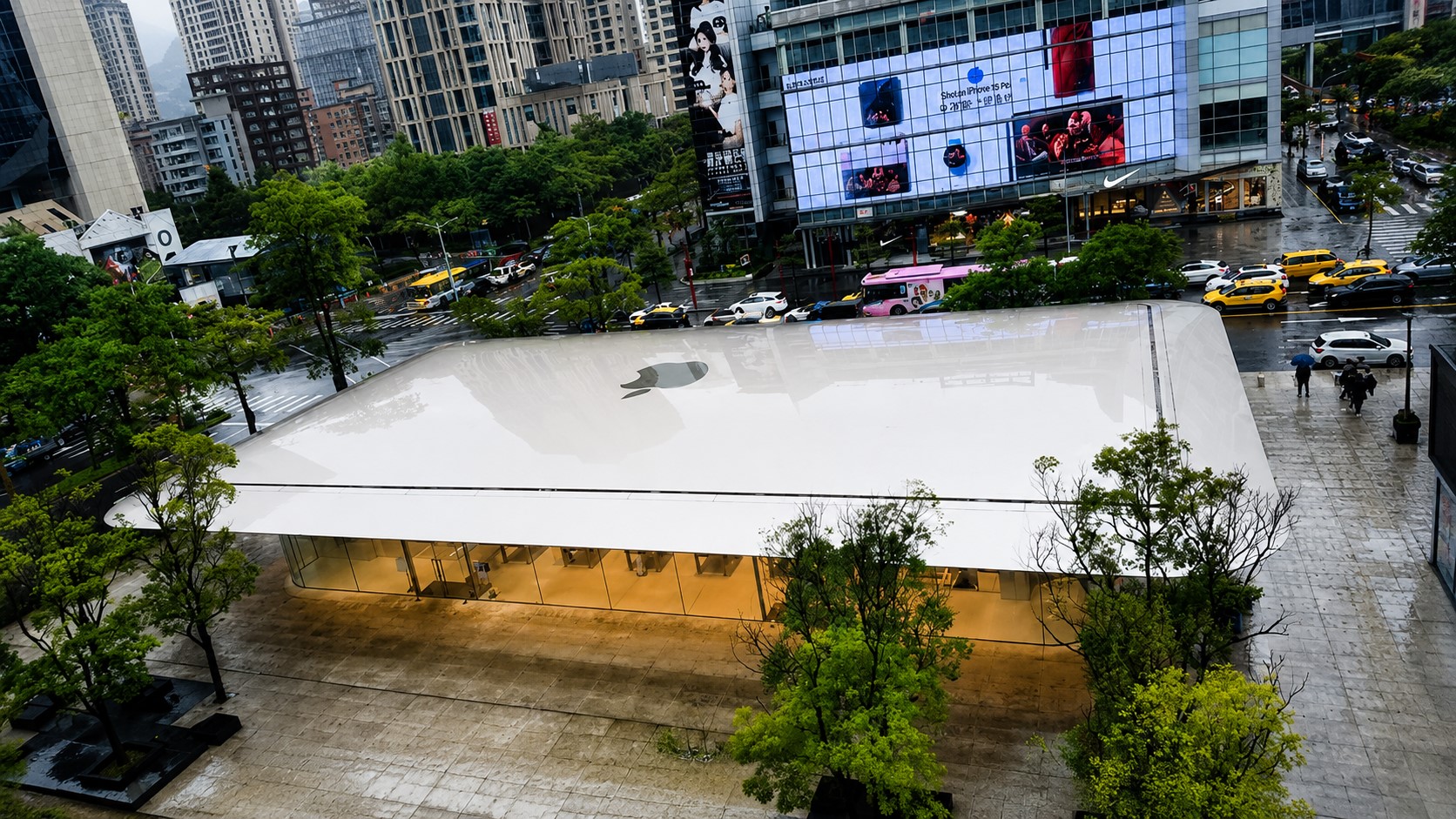
Look down from the Taipei 101 Observatory, and something familiar stares back. Sitting at No. 13, Songshou Rd in the Xinyi District, a building shaped unmistakably like a closed MacBook lid catches your eye — metallic finish, rounded corners, centered Apple logo, the whole package. That building is Apple Xinyi A13, designed by Foster + Partners and opened on 15 June 2019 as Apple’s first standalone store in Taiwan. Nobody at Apple officially called it a giant laptop. They didn’t need to.
At street level, the store plays its role straight: floor-to-ceiling glass walls, an open public plaza, the familiar hush of premium retail. Step inside and you’ll find a lower-level Forum space, sculptural staircases, timber ceilings, and planted areas — the full post-2017 Apple retail playbook. Multiple outlets, including RPP and WAUG, describe the roof as resembling “a polished MacBook resting weightlessly atop the building.” The thin carbon-fiber slab doing that hovering act is the real protagonist here.
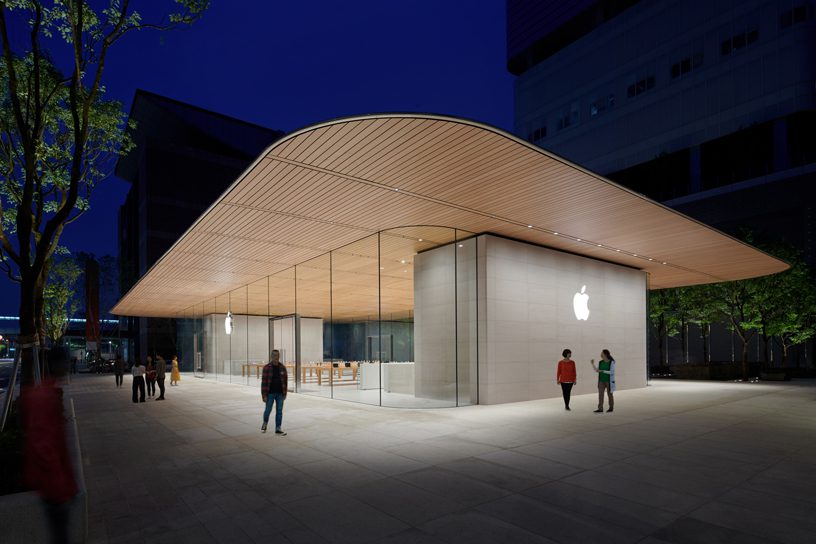
Quick facts worth knowing:
- Opened 15 June 2019 — Apple’s first freestanding flagship in Taiwan
- Located in Taipei’s Xinyi District, steps from Taipei 101
- Designed by Foster + Partners in collaboration with Apple
- Roof built from carbon fiber with rounded corners and a centered Apple logo
- The MacBook comparison emerged entirely from public observation and social sharing, not Apple’s marketing
A Brand So Consistent It Became Geography
Apple didn’t pitch this building as a giant laptop — drone culture and a nearby observatory did the work for free.
Here’s what makes this genuinely interesting. Apple’s design language has become so reflexive, so deeply embedded, that a building can accidentally — or very deliberately — replicate a product silhouette and the internet fills in the rest.
The way places get discovered now has changed entirely. Visitors scrub through drone footage, satellite screenshots, and Google Earth rabbit holes the way a previous generation flipped through postcard racks — looking for something worth sharing. Your grandparents found landmarks on postcards. Today, travelers encounter them by swiping through aerial shots, searching for something worth screenshotting. The proximity to Taipei 101’s observation deck handed visitors a built-in reveal. Stand high enough, look down, and the punchline writes itself.
Whether this counts as brilliant brand architecture or simply the most expensive logo placement in East Asia remains genuinely unclear. Either way, a retail store visible as product advertising from 1,600 feet up is the kind of flex no billboard budget can replicate.