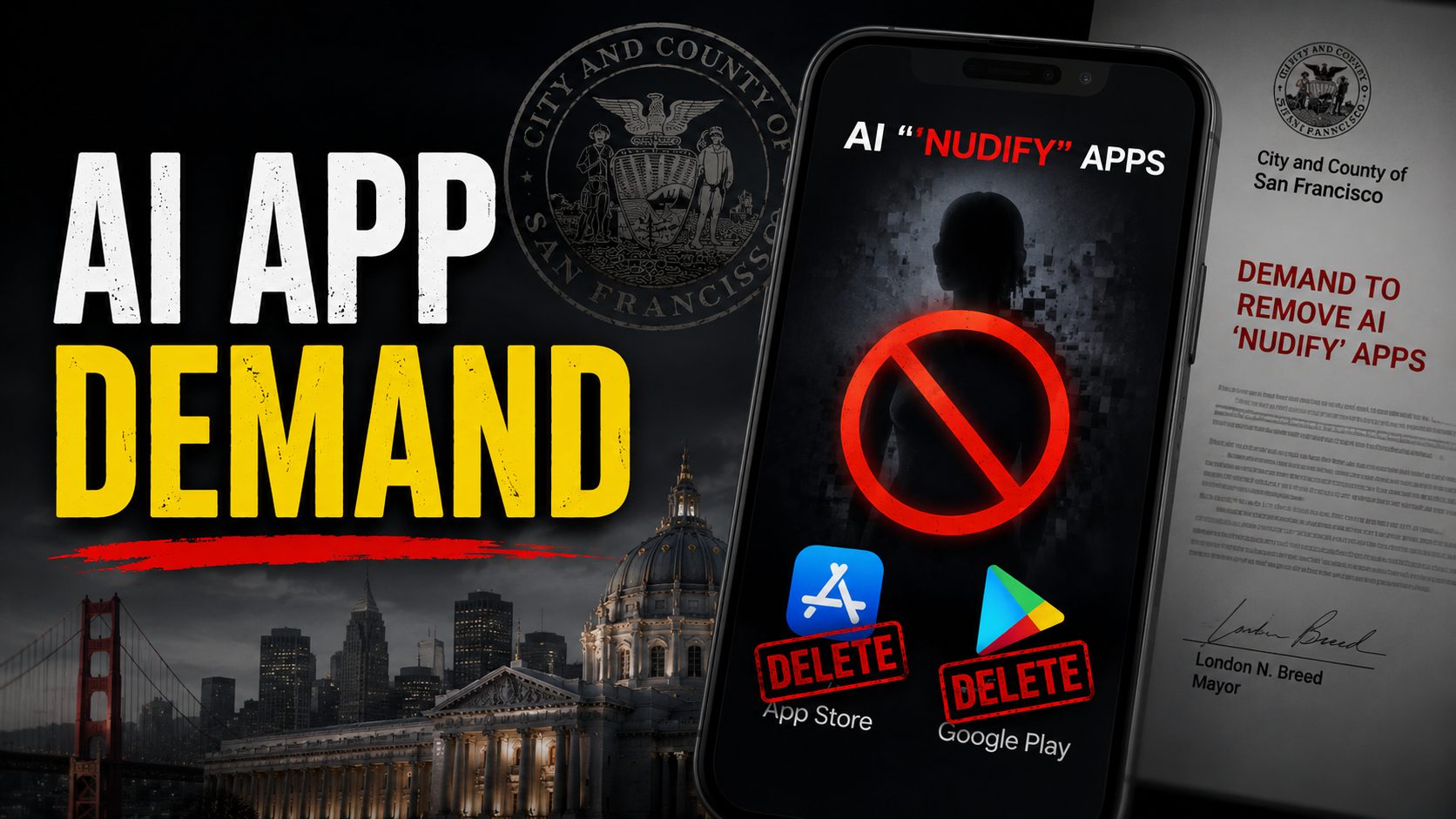
An estimated $117 million in lifetime revenue. Roughly 705 million downloads. Up to 30% commission flowing straight to Apple and Google — all from apps their own policies explicitly ban. San Francisco City Attorney David Chiu sent cease-and-desist letters to both companies on July 16–17, targeting 13 AI “nudify” or face-swapping apps: eight on the App Store, five on Google Play. The legal weapon is a 2025 California law that treats third-party facilitators of nonconsensual intimate deepfakes as liable parties, with civil penalties starting at $25,000 per violation. Both companies have 28 days to explain how they plan to comply.
The Apps Policies Were Supposed to Catch
Researchers found roughly 70% of tested face-swapping apps could generate nude deepfakes, despite being marketed as harmless fun.
These apps don’t announce themselves as abuse tools. They appear in your app store dressed as quirky face-swapping toys — the digital equivalent of packaging something harmful apps in bubble-wrap branding. Cornell and Georgetown researchers tested 155 face-swapping apps in a May preprint and found about 70% could create face swaps with nude images. One flagged app, boasting over a million downloads, advertises styles like “calm busty” and “cinematic intimacy” on its website — features conspicuously absent from its store listing. Reporting by WIRED and Indicator Media documented deepfake sexual abuse in at least 90 schools involving minors. The Tech Transparency Project found 55 nudify apps on Google Play and 47 on the App Store in a 2026 investigation. Some were rated appropriate for children.
Apple spokesperson Adam Dema said the company removed three of the eight flagged apps and is terminating those developers’ accounts. Four others must fix violations or face removal. Google spokesperson Dan Jackson confirmed deletion of all five flagged Android apps and said the company restricted search terms like “nudify” on Google Play. Both companies maintain that developers bear primary responsibility for compliance.
“Generating non-consensual intimate images is illegal, harmful, and completely unacceptable… These images are used to bully, humiliate, and threaten women and girls.” — David Chiu, San Francisco City Attorney
Watchdogs Say Reactive Enforcement Isn’t Enough
Apps keep reappearing after removal, and enforcement has historically followed media scrutiny rather than preceded it.
Tech Transparency Project director Katie Paul says platform promises about trusted, safe stores are “just not what is playing out in reality.” The pattern repeats reliably: media investigation triggers batch removal, then apps quietly reappear under new names. Chiu warns his office is considering “all of our legal options” if compliance doesn’t come quickly.
The signal here extends well past these 13 apps. If courts accept the “aiding and abetting” theory under California’s facilitator law — which builds on Chiu’s own AB 621 legislation and sits alongside the federal Take It Down Act signed in 2025 — app stores face a structural reckoning over every dual-use AI imaging tool they host. Stronger AI age laws and abuse-risk assessments move from optional to obligatory. At $25,000 per violation across hundreds of flagged apps, that accountability gap becomes very expensive, very fast.