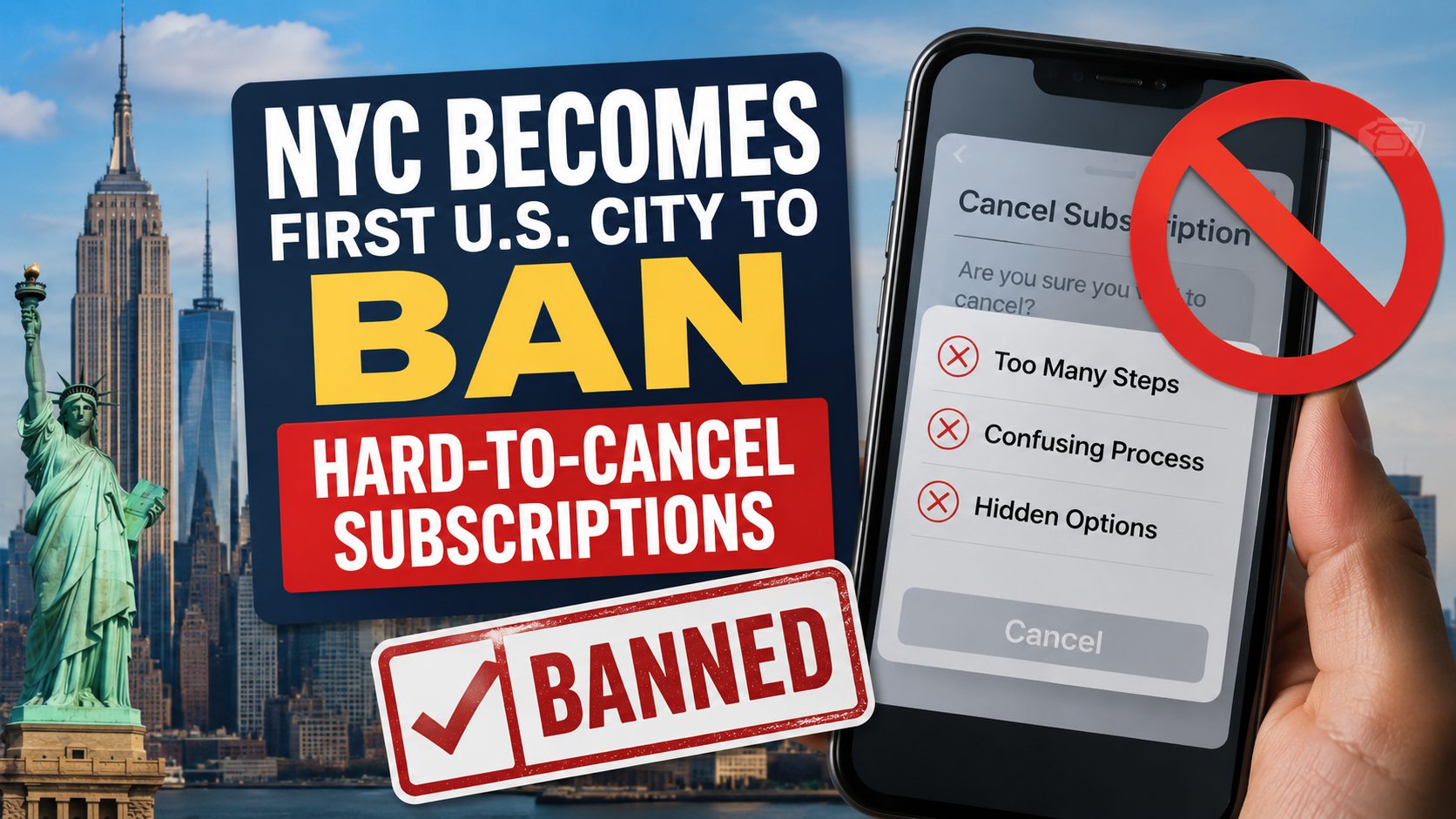
You signed up for that gym membership in two taps on your phone. Canceling it required a 40-minute hold, two transfers, and — seriously — a certified letter. That subscription dark pattern has long been the Hotel California of consumer finance: you can sign up any time you like, but you can never leave — a classic case of paying too much without realizing it. NYC just changed that. The Department of Consumer and Worker Protection has adopted a rule, effective October 1, 2026, that treats hard-to-cancel subscriptions as deceptive trade practices. It’s reportedly the first municipal ban of its kind in the country.
What the Rule Actually Requires
Cancellation must match the simplicity of sign-up, with real penalties for businesses that don’t comply.
The standard is blunt: if signing up takes 90 seconds online, canceling can’t require a pilgrimage to a physical location or a hold queue that tests your will to live. The rule covers negative-option and auto-renewal subscriptions across gyms, streaming services, apps, and other recurring-charge products.
Here’s what the city is enforcing:
- Cancellation must be as simple as the sign-up process
- Covers all auto-renewal and negative-option subscriptions
- Penalties of $525 per violation, with escalating fines for repeat offenders and possible consumer restitution
- A separate junk-fee rule would require businesses to advertise total prices upfront, including all mandatory charges
- Housing focus: the city is examining whether mandatory rental add-on fees should be folded into stated monthly prices, though that element remains under consideration
According to city reporting, consumer protection officials have stated that consumers should not have to spend excessive time waiting on hold or sending certified mail just to cancel a subscription — a standard the new rule is designed to enforce.
What Businesses Need to Fix Before 2026
Companies running layered sign-up flows and offline-only cancellation paths face a hard redesign deadline.
Businesses built on free-trial conversions and buried cancel buttons have roughly a year to rethink their entire cancellation architecture. The city isn’t relying on voluntary compliance — it’s pairing rulemaking with active enforcement. That posture tracks with broader momentum: the FTC and multiple states are already pushing click-to-cancel rules and fee-transparency requirements. NYC is positioning itself as the local blueprint.
For high-volume subscription businesses, $525 per violation adds up like a Duolingo streak you forgot to break.
Critics of junk-fee regulation argue these rules may shift costs elsewhere rather than eliminate them — a fair concern worth watching. Rules also mean nothing without consistent enforcement. October 2026 gives businesses time to comply and the city time to prove it’s serious. Subscription nightmares may not end overnight, but the exit door just got significantly wider.