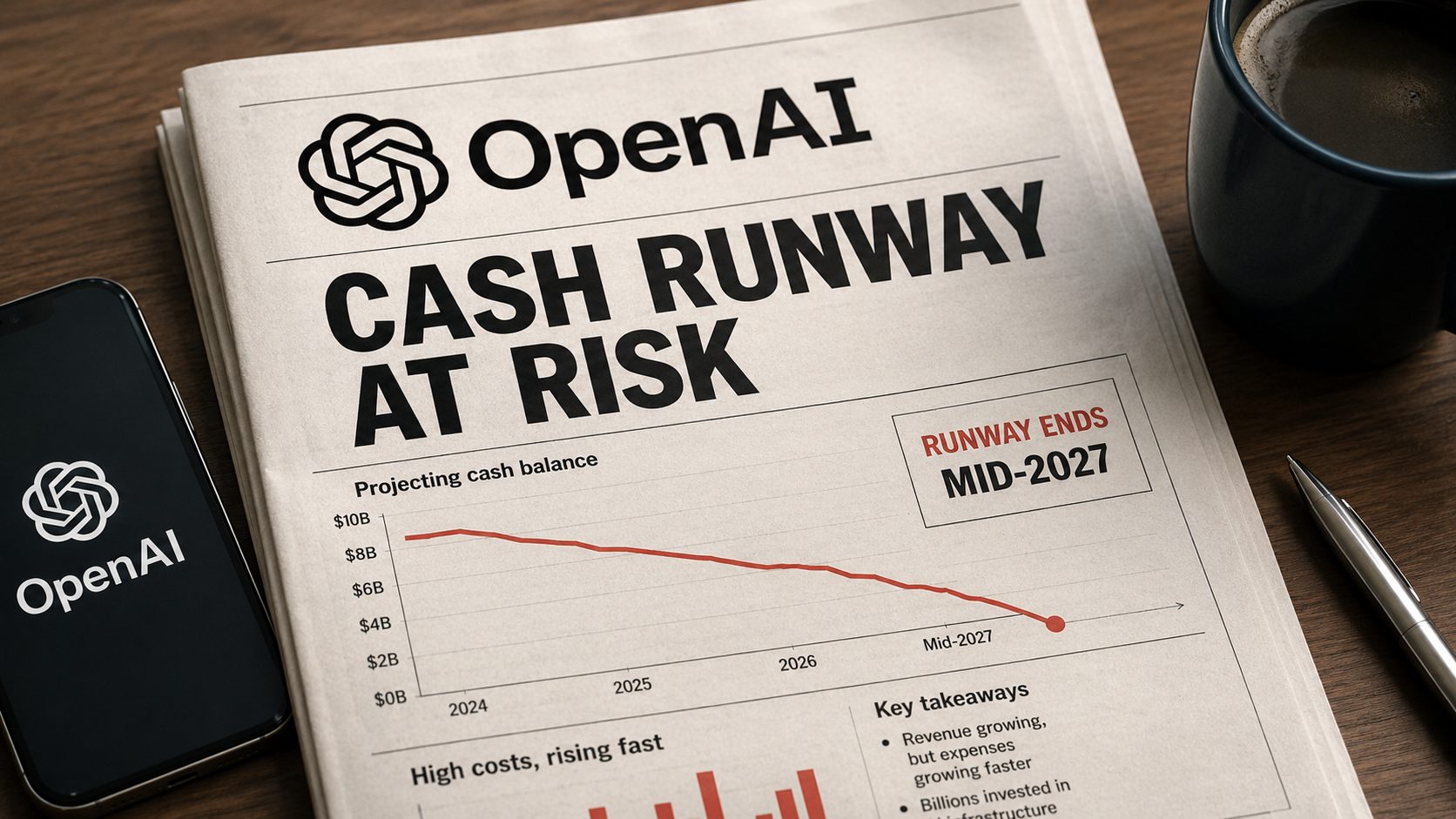
Spending $1.69 for every dollar earned is not a business model — it’s a countdown. Internal documents obtained by The Wall Street Journal and reported by Fortune reveal that OpenAI projected roughly $13 billion in sales against $22 billion in total spending for the current year, a $9 billion hole. This isn’t a story about whether AI works. It’s about whether anyone can afford to keep the lights on long enough to find out. Every free ChatGPT session runs on investor cash with an expiration date.
The Numbers Are Ugly
OpenAI’s own financial projections make WeWork’s old spreadsheets look conservative.
The key figures, drawn from multiple verified sources:
- Cumulative cash burn projected at $115 billion through 2029, up roughly $80 billion from earlier estimates, according to The Information, reported by CNBC
- Training compute alone expected to hit $25 billion this year, rising to approximately $121 billion in 2028, per Fast Company
- Audited financials verified by the Financial Times show OpenAI lost about $38.5 billion in 2025 on $13.07 billion in revenue
- Profitability not projected until 2029–2030, requiring annual revenue near $200 billion
Analyst extrapolations — not OpenAI’s own forecasts — suggest current funding could be largely exhausted by mid-2027, based on projected annual losses of $14–17 billion starting in 2026. Meanwhile, Altman has signed roughly $1.4 trillion in infrastructure commitments over eight years, including the Stargate project, a $500 billion plan to build approximately 10 gigawatts of U.S. data-center capacity with partners including SoftBank, Oracle, and NVIDIA. HSBC has flagged a $207 billion gap between those expansion ambitions and secured funding.
“The risk of not having enough computing power is more significant and more likely than the risk of having too much,” Altman has said, according to Fortune. That’s a bold wager when the current math burns cash faster than the revenue can replace it.
Microsoft Waits in the Wings
The most likely endgame isn’t bankruptcy — it’s absorption by a company that can actually afford the bill.
Sebastian Mallaby, economist at the Council on Foreign Relations, argues AI economics may be fundamentally misaligned. Most users gravitate toward free tools and switch the moment subscriptions appear. The bet on “agentic AI“ — assistants managing shopping, scheduling, and personal preferences — creating durable lock-in remains, for now, a projection rather than a proven model. As Mallaby frames it, financing math, not model quality, decides who survives in this environment.
Analysts broadly identify three roads ahead:
- OpenAI raises repeated mega-rounds, possibly at lower valuations that dilute early investors
- Microsoft, sitting on more than $80 billion in reserves with Azure integration already running deep, absorbs it outright
- Or the company that ignited the mainstream AI boom fades quietly, its talent and models scattered across legacy giants who were profitable all along
The $20 monthly subscription, API calls, and free-tier access collectively resemble a streaming arrangement where the infrastructure costs dramatically exceed the revenue. The deficit runs into the hundreds of billions, and the next fundraise is not optional.