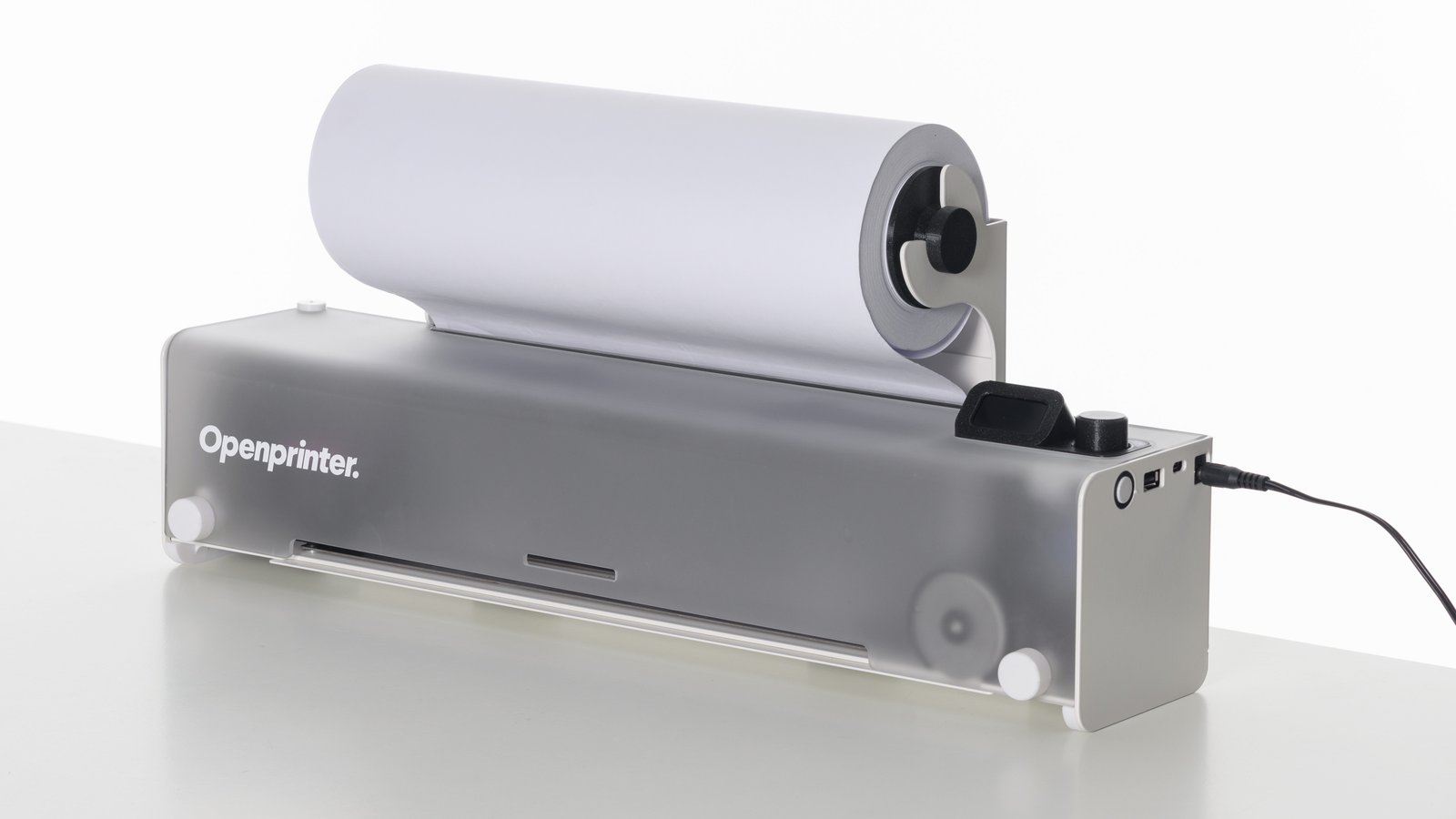
A firmware update arrives silently, a third-party cartridge stops working, and a $60 printer becomes a paperweight paying too much for $45 ink. Paris-based startup Open Tools thinks it has the antidote: the Open Printer, a DRM-free, repairable inkjet with published design files. A new prototype video — titled “Openprinter Coming Soon” — finally shows the thing working, printing and cutting pages on camera. That’s real progress. But nine months after first surfacing, the project still can’t tell you what it costs, how fast it prints, or when it ships.
What the Prototype Actually Shows
A Raspberry Pi, an STM32, and no proprietary drivers — the hardware stack is real, even if the timeline isn’t.
The video demonstrates both black and color printing from a compact unit driven by a Raspberry Pi Zero W running CUPS — the open-source print server that works across Windows, macOS, Linux, Android, and iOS without proprietary drivers. An STM32 microcontroller handles printhead firing. Roll paper feeds through an integrated blade that cuts each page. A 1.47-inch TFT screen and jog wheel handle local controls.
Confirmed specs from Open Tools’ own sheet:
- Resolution: 600 dpi black-and-white, 1200 dpi color
- Cartridges: HP 63/63 XL (US), HP 302/302 XL (EU), HP 803/803 XL (Asia) — refillable via an “Inkit” kit with 100ml bottles, no DRM blocking refills
- Connectivity: USB-C, USB-A, Wi-Fi 802.11ac, and Bluetooth 4.1 — though Wi-Fi integration remains under development, and the Pi Zero W only supports 802.11n natively, suggesting an undocumented additional module
- Print speed: officially “to be defined”
That last line might be the most honest sentence on the entire spec sheet.
The Fine Print Worth Reading
“Open-source” doesn’t mean what you think here — and escaping HP’s ecosystem while depending on HP cartridges is a structural contradiction worth naming.
The design files, firmware, and bill of materials ship under Creative Commons BY-NC-SA 4.0, which prohibits commercial reuse. Commentators on Reddit and Hacker News — in dated, linked threads following the project’s initial announcement — have flagged this as making Open Printer source-available, not open-source under OSI or FSF definitions. Third parties cannot legally build and sell derived hardware. Compare that to Prusa’s 3D-printer ecosystem, which thrived precisely because commercial manufacturing was permitted under its licensing terms.
Then there’s the deeper irony. A printer built to escape HP’s ink racket reportedly runs on HP integrated-head cartridges. Long-term refill freedom depends entirely on HP continuing to sell compatible heads — the same company that has treated third-party ink like a security vulnerability since at least 2016.
Worth Watching, Not Worth Pre-Celebrating
The right-to-repair argument has finally reached printers, but the launch details aren’t real yet.
Open Tools has built something genuinely unusual: working open hardware in a category that has resisted transparency for decades. The Crowd Supply campaign page remains active, and remaining development work — Wi-Fi and Ethernet integration, ink drying behavior, printhead cleaning cycles, dithering algorithms — signals a team taking the engineering seriously. If your subscription ink and disposable hardware have worn out your patience, this project deserves your attention. Just not your money. Not yet.