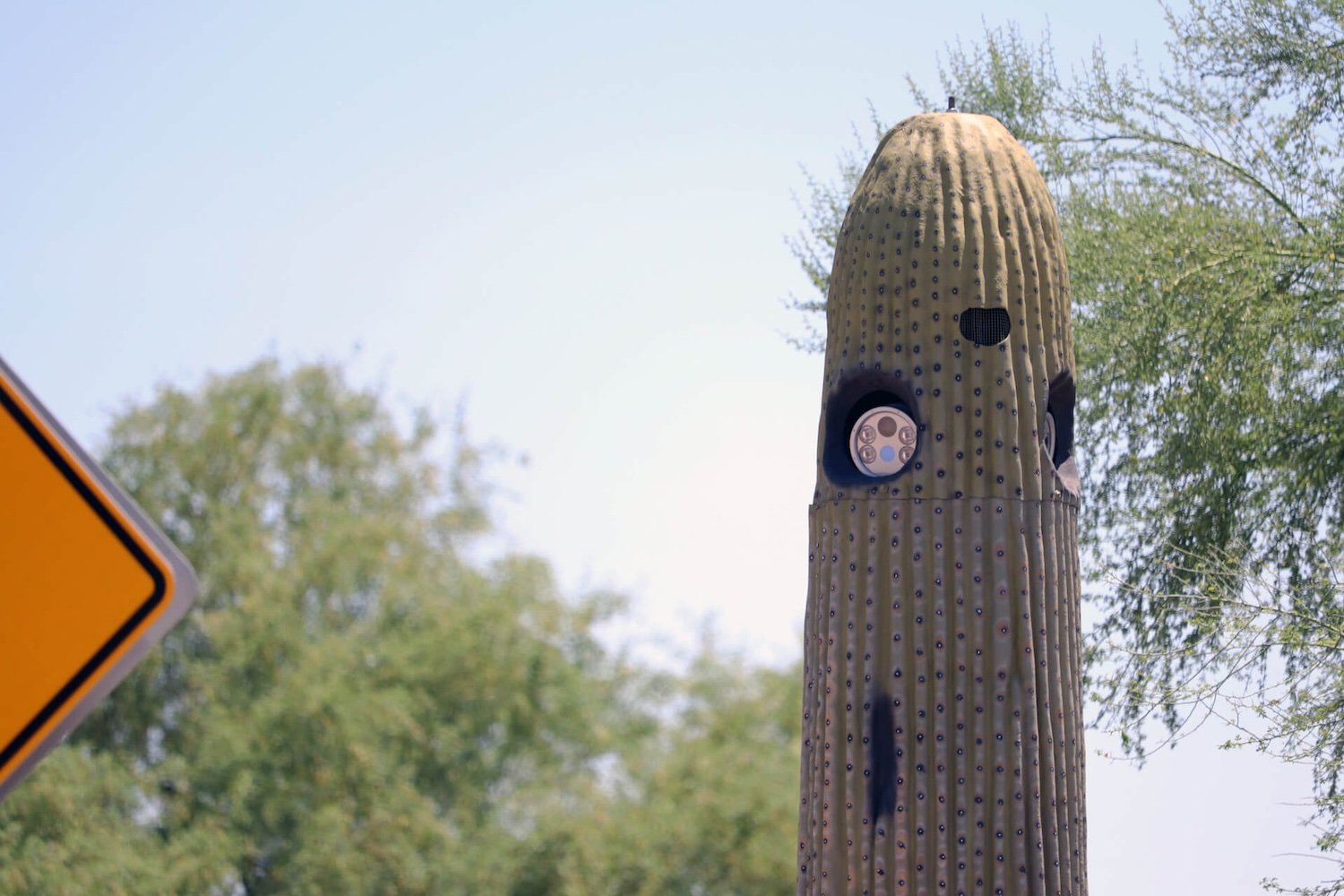
Cruising through Paradise Valley, Arizona, you might glance at a roadside saguaro and notice something off. Two camera lenses, staring right back. A viral video caught exactly that moment, and suddenly millions of people learned that this upscale town installed automated license-plate readers inside three hollow fake cactus structures — openly acknowledged by city officials, funded entirely by a wealthy private resident, and quietly logging every vehicle that passes.
Town Manager Kevin Burke told KJZZ the disguise is about aesthetics, not secrecy: “the cactus itself looks real, but if you don’t see the camera, you’re not looking.” Fair enough. The question hanging over the whole program, though, is less about the plastic plant and more about the data flowing through it.
What These Cactuses Actually Do
These aren’t your grandfather’s speed cameras — they build searchable archives of your daily movements.
- The cameras photograph every passing license plate, log the timestamp and location, then cross-check against “hot lists” of stolen vehicles, Amber Alert subjects, and criminal investigations.
- Non-investigatory data is deleted after 180 days, according to Burke. Chandler, another Arizona city using similar technology, keeps plates for just 30 days — demonstrating how wildly retention policies vary with no statewide standard to enforce consistency.
- Systems like Flock Safety — with more than 80,000 cameras nationally — don’t just read plates. They log vehicle color, make, body style, even bumper stickers, creating a searchable “vehicle fingerprint” far more detailed than any plate number alone.
“This is not data that any private investigator can just knock on the door and require… This is related to criminal activity and is limited to law enforcement use,” Burke told KJZZ.
That 180-day window sounds reassuring until you calculate how many times your plate gets scanned in half a year of ordinary errands.
Marked traffic cameras and fake foliage aren’t the same thing. Embedding surveillance inside something that mimics nature sidesteps the public visibility that makes democratic oversight possible — like hiding a Ring doorbell inside a garden gnome, except the gnome watches an entire town. The Electronic Frontier Foundation warns that federal agencies can access ALPR data indirectly through local partners, even when vendors claim restrictions are in place.
The Legal Clock Is Ticking
Recent Supreme Court reasoning on dragnet digital tracking could reshape how cities deploy — and defend — these networks.
The Supreme Court’s Chatrie v. United States decision — ruling that obtaining Google geofence data constituted a warrantless search — involved phones, not plates. But its logic about aggregated digital tracking now fuels Schmidt v. City of Norfolk, where plaintiffs challenge a 175-camera Flock grid as an unconstitutional warrantless search under the Fourth Amendment. As amici briefs from the ACLU and EFF argue in that case, “a single camera snapping a single plate is constitutionally unremarkable, but a 175-camera grid feeding a searchable, multi-week archive is a different animal entirely.” Readers interested in how surveillance technology intersects with everyday consumer products may find it useful to review home security systems that offer transparent data policies as a point of comparison.
Arizona sets no statewide retention limit, leaving every city to write its own rules. The cactus became a meme. The infrastructure it represents is quietly mapping your movements across dozens of cities. Courts are catching up — the question is whether public awareness moves faster than the cameras do.