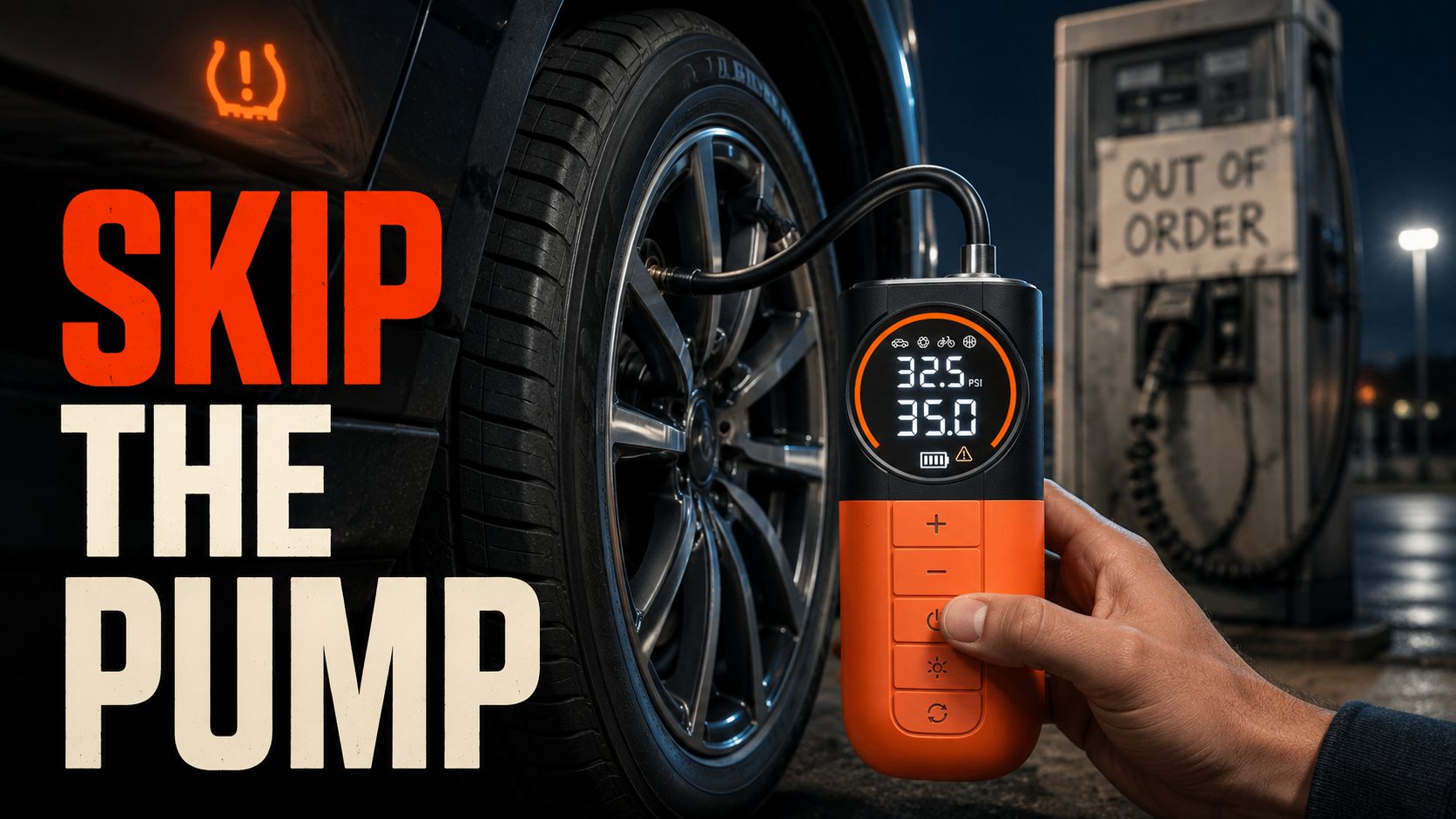
You know this moment. The tire pressure warning pops up on your dashboard, so you pull into the nearest gas station. The air pump has a cracked hose and a handwritten “Out of Order” sign. Now you are sitting in a parking lot, Googling the next station, hoping that one actually works.
This used to be a minor annoyance. It is becoming a routine one.
Why Gas Station Pumps Keep Failing
Air pumps are not a profit center for station owners. Hoses crack, gauges drift, and coin mechanisms jam, and there is little financial incentive to fix them quickly. The pumps that do work often charge $1 to $2 per use, which adds up if you are checking pressure monthly, the way tire manufacturers recommend.
Most drivers respond the way you would expect: they ignore the TPMS light entirely. That decision costs more than the inconvenience it avoids. The U.S. Department of Energy estimates that properly inflated tires can improve gas mileage by up to 3%, and underinflation wears tread unevenly, which shortens tire life. A $200 replacement because you kept putting off a two-minute fill is an expensive trade.
The ETENWOLF S1 portable inflator is built to break that cycle. It is a cordless, pocket-sized inflator that lives in your glove box, holds a charge for up to 12 months, and fills a standard passenger tire in about 60 seconds.
60 Seconds from Warning to Fixed
Filling a low tire with the ETENWOLF S1 takes about the same time as pulling out your phone to search for the next gas station. ETENWOLF says it can bring a standard 195/65 R15 tire from 30 to 35 PSI in roughly a minute, and a full 5,200 mAh charge handles up to 17 car tires before it needs a USB-C recharge.
But the speed only matters if the tool actually works when you reach for it months later. That is where the 12-month standby comes in. Competing portable inflators are notorious for dying in storage, which defeats the entire point of keeping one in your car. The S1 is designed to hold its charge long enough that you can forget about it until the TPMS light reminds you.
Once you do pull it out, the auto-stop feature removes the guesswork. You set your target PSI, press start, and the S1 shuts off automatically when it hits the number. No babysitting the gauge. No risking overinflation.
Designed to Disappear
Every design choice on the S1 points to the same idea: it should take up no space or attention until the moment you need it. The hose stores inside the body, it charges over USB-C, and the whole unit fits in a glove box or a jacket pocket. Most portable inflators are shoebox-sized and tethered to a running engine by a 12V cord. The S1 runs on its own battery.
That small footprint pays off most when you are using it at night or on the side of a road. A backlit LCD shows real-time pressure in PSI, BAR, KPA, or kg/cm², readable in a parking garage or on a highway shoulder at midnight, and a built-in LED with strobe and SOS modes keeps you visible near traffic.
One Device, Every Valve
The glove box is where most people will keep the S1, but it does not have to stay there. It ships with a Presta valve adapter and a ball needle, which means it handles road bikes, mountain bikes, motorcycle tires, and sports balls on a single charge. ETENWOLF rates it for up to 60 motorcycle tires, 70 bike tires, or 80 basketballs.
If you ride on weekends or coach a youth team, one device covers all of it.
And if none of that applies, the TPMS light is still going to come on again at some point. Next time it does, you will not be sitting in a gas station parking lot Googling the nearest working pump. You will be done in your driveway in about a minute with the ETENWOLF S1.