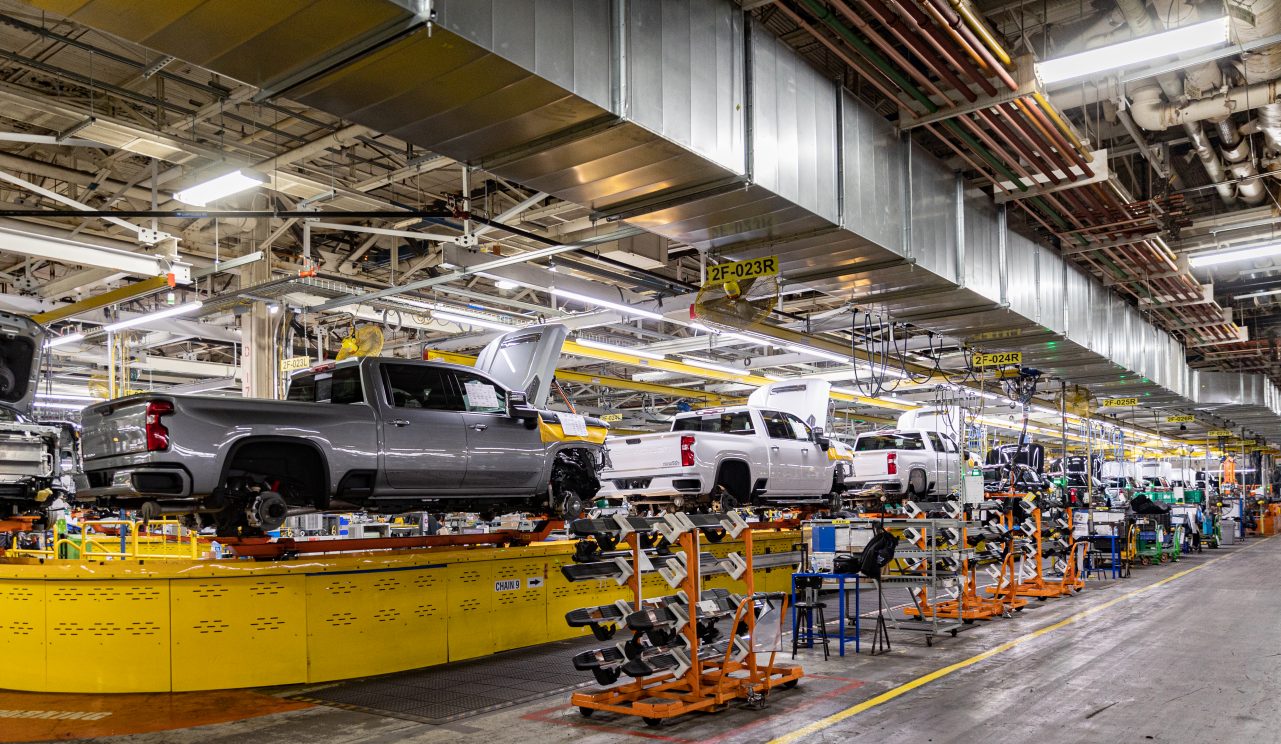
Factory Zero was supposed to be the future. GM’s flagship all-electric truck plant in Detroit, capable of producing a Silverado EV roughly every eight minutes, staffed by 4,000 workers at full capacity. That was the pitch. The reality: a single shift, more than 1,000 workers on indefinite layoff, and about 50 brand-new Fanuc cobots rolling onto the assembly line. Unlike traditional industrial robots locked behind safety cages, these machines stand right next to humans, attaching body panels as vehicles move down the track. GM calls it progress. UAW Local 22 calls it a gut punch.
What a Cobot Actually Is – And Why Workers Are Filing Grievances
The new machines work inches from human employees, and the union wants answers about both safety and job displacement.
Factory Zero already runs more than 1,000 robots for welding and assembly. The roughly 50 new Fanuc cobots are different — cage-free, operating in direct physical proximity to workers, attaching body panels and components on the moving line. UAW Local 22 president James Cotton confirmed the deployment, saying members are “disgusted,” and the union has since filed formal grievances over both job displacement and safety concerns.
After its 2023 UAW contract, GM estimated labor costs would rise about $500 per vehicle. That single number explains a lot. Vehicle assembly already requires 50–70% fewer labor hours than in the 1980s, according to Wayne State University professor Marick Masters. The cobots aren’t arriving in a vacuum. They’re arriving at a plant where GM’s spreadsheets just made human labor considerably harder to justify. “It’s always a concern when you see a robot coming to a plant, especially after they have laid off over a thousand people.” — UAW Local 22 president James Cotton.
GM CEO Mary Barra frames it differently. AI and robotics “empower our workforce to focus on craftsmanship,” she said while announcing a factory robotics partnership with NVIDIA. That’s the press-release version. The version playing out on the assembly line looks nothing like it. For the 1,200 workers on indefinite layoff, “empowerment” is a hard word to hear.
This Fight Is Bigger Than One Plant
Toyota is deploying humanoid robots, BMW is expanding its own pilots, and 2028 contract talks are already casting a long shadow.
GM isn’t an outlier. Toyota has signed a commercial deal to put Agility Robotics’ humanoid robots in its RAV4 plant in Ontario — reportedly the first such deployment at a major automaker. BMW is scaling humanoid robot programs from its Spartanburg, South Carolina plant to Leipzig, Germany. The entire industry is sprinting toward automation, and the 2028 UAW contract negotiations are shaping up as the moment workers try to install some guardrails on that sprint.
The coming talks will almost certainly center on automation language:
- retraining guarantees
- redeployment rights
- limits on deploying cobots while colleagues sit on indefinite layoff
Factory Zero isn’t a preview of what might happen in American manufacturing. It’s what’s already happening — and the clock on the next contract is already running.