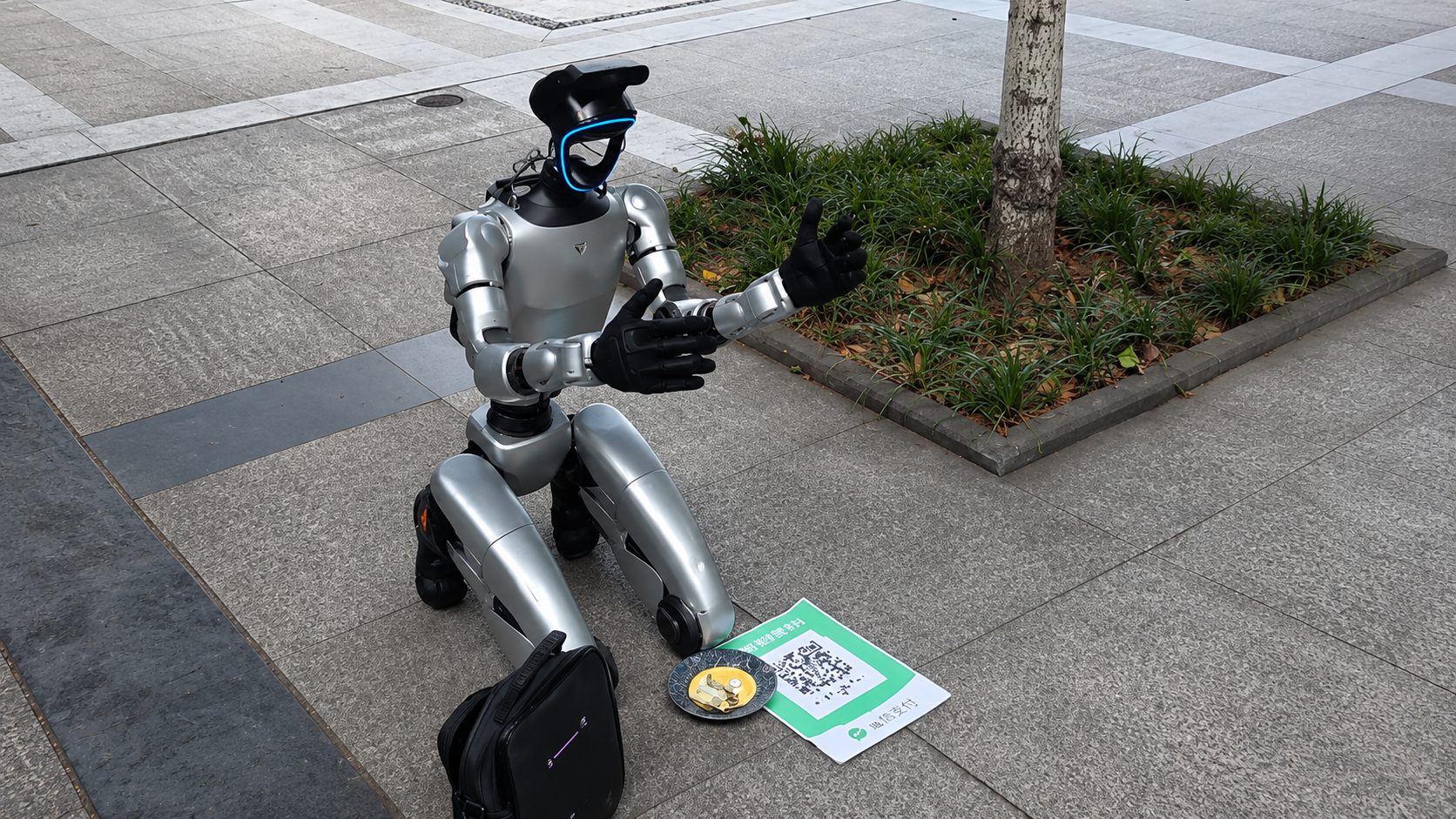
A metallic humanoid kneels on a Chinese sidewalk, sad music drifting from its speakers. An LED display strapped to its back reads “desperately need electricity fees.” A donation bowl sits at its feet. A QR code invites WeChat payments. The scene looks like a deleted Black Mirror cold open — except the robot is real, the QR code works, and thousands of people have already shared the clip.
The machine is a Unitree G1, made by Hangzhou-based Unitree Robotics. No, it did not autonomously decide to panhandle. Every available source treats this as a staged street performance: pre-programmed gestures, scripted audio, a human operator somewhere behind the curtain. The robot is a prop. A very expensive, very agile prop.
What You’re Actually Looking At
The Unitree G1 is a real humanoid that runs, flips, and retails for less than a used Honda Civic.
At roughly US $13,500 per unit — a fraction of what humanoid platforms cost even two years ago — the G1 walks, runs, navigates rough terrain, and performs synchronized martial-arts routines. CNET has covered its movement capabilities extensively. Elon Musk called a G1 demo “impressive,” according to the South China Morning Post. With Chinese firms accounting for about 80% of the roughly 13,000 humanoids shipped globally in 2025 (Forbes), debate over CGI versus real footage feels almost quaint.
This same model has also accidentally slapped a child during a dance performance in China. Nobody’s claiming perfection here.
Worth noting: some Unitree marketing clips have sparked CGI-versus-real debates on Reddit and Hacker News. This street footage, shot on what appears to be a standard smartphone, doesn’t raise the same flags.
The Joke That Isn’t Entirely a Joke
“Even beggars are being replaced” landed harder than anyone making it probably intended.
That quip circulated widely after the clip spread. The image inverts everything the robotics industry promises. Instead of replacing surgeons or warehouse workers, a $13,500 machine competes at the economic bottom. It’s the tech equivalent of a Succession heir showing up at a soup kitchen — the incongruity is the entire point. BBC reporting notes that critics argue many Chinese humanoids remain “for show” rather than genuinely useful, and this stunt practically gift-wraps that argument.
Dismissing the technology outright, though, would be a mistake. Cost reductions are real, shipment numbers are climbing, and the hardware demonstrably works. The potential for genuine workplace safety applications underscores why writing off humanoid robots as mere novelties carries its own risks.
The robot didn’t choose to beg — someone programmed it to. Yet public reaction treats it as though machine intent was involved. That gap between scripted performance and perceived autonomy is the thing actually worth your attention — and it echoes broader patterns seen in tech scandals where perception has repeatedly outpaced reality.