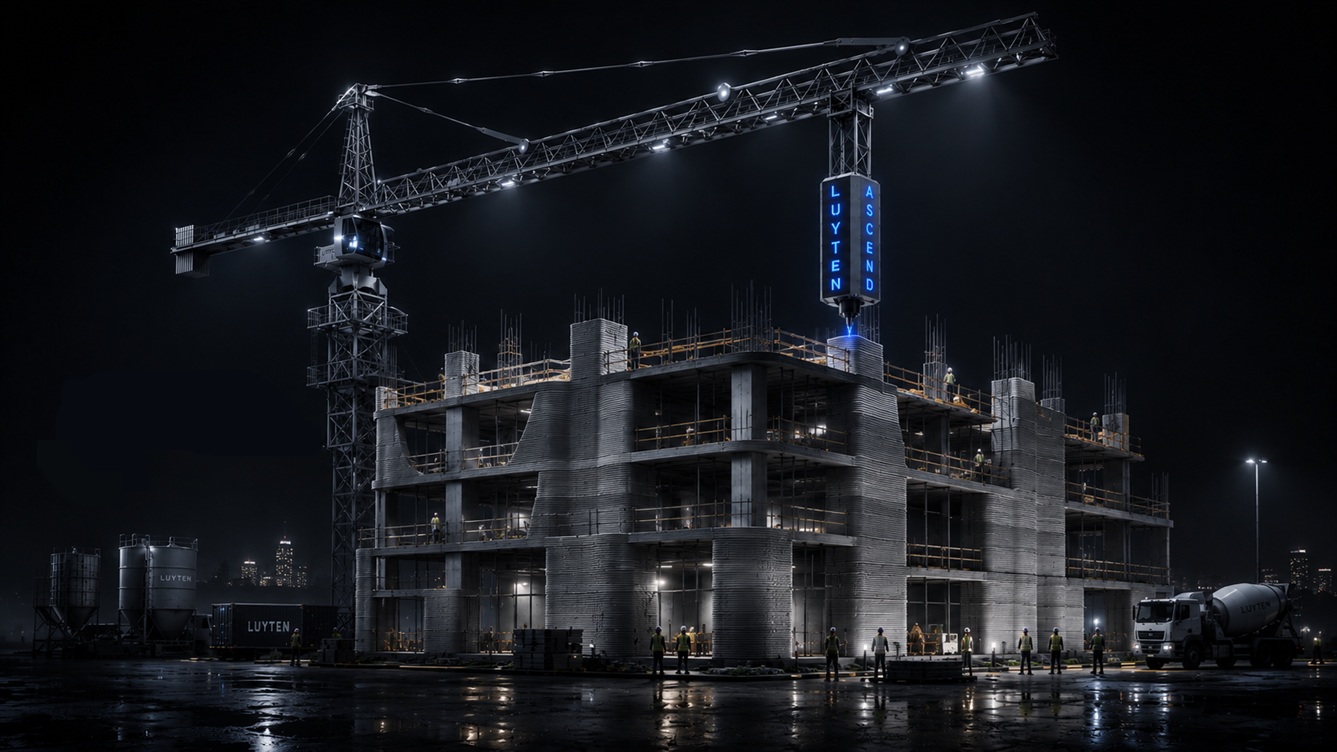
Building a high-rise usually means watching construction crews inch upward for months, one concrete pour at a time. Melbourne-based Luyten just turned that timeline on its head by converting the tower crane—that 75-year-old skyline icon—into a robotic 3D printer.
Their Ascend platform reportedly transforms any standard tower crane into a concrete-printing robot capable of building structures up to 328 feet tall within a 148-foot radius.
From Lifting Tool to Manufacturing Robot
The Ascend system embeds 3D printing robotics directly into crane architecture, turning familiar construction equipment into automated builders.
The crane boom becomes the print head’s motion platform rather than just hoisting materials. Luyten claims the system can be installed and commissioned in just 1-2 days, compared to the weeks or months required for custom robotic gantries.
The platform uses their proprietary “Ultimatecrete” material—a printable concrete formulated for structural applications with controlled flow properties that maintain shape after extrusion. AI-driven path planning software generates optimized print trajectories while monitoring build progress in real-time, aiming to reduce the formwork, manual concrete placement, and quality control tasks that typically require large crews.
Racing Against Housing Shortages
Australia’s construction labor crisis and housing demand are driving interest in robotic building systems that can work around the clock.
Ascend enters a competitive field where other Australian companies are already printing homes. Contec Australia recently completed a two-story 3D-printed house in Perth, with wall systems printed in roughly 18 hours and 30% less CO₂ than traditional concrete.
But those systems work at ground level—Ascend’s differentiator is plugging into the high-rise construction ecosystem that already depends on tower cranes. Whether that integration advantage translates to real-world deployments remains unclear, since Luyten hasn’t yet published independent verification of actual builds at the claimed 100-meter heights.
The Reality Check
Bold capabilities meet familiar obstacles as building codes and structural standards lag behind robotic printing technology.
Your city’s next skyscraper probably won’t be crane-printed tomorrow. Building codes don’t yet address high-rise 3D-printed concrete, meaning projects will likely require case-by-case approvals and extensive structural testing.
The technology’s promise—faster construction, reduced waste, predictable timelines—could reshape urban development if regulatory frameworks catch up to match the engineering ambitions. The tower crane outside your window might eventually build entire structures autonomously. Whether Ascend delivers on its 328-foot printing claims or joins the long list of construction automation promises that never scaled remains the industry’s next big test.