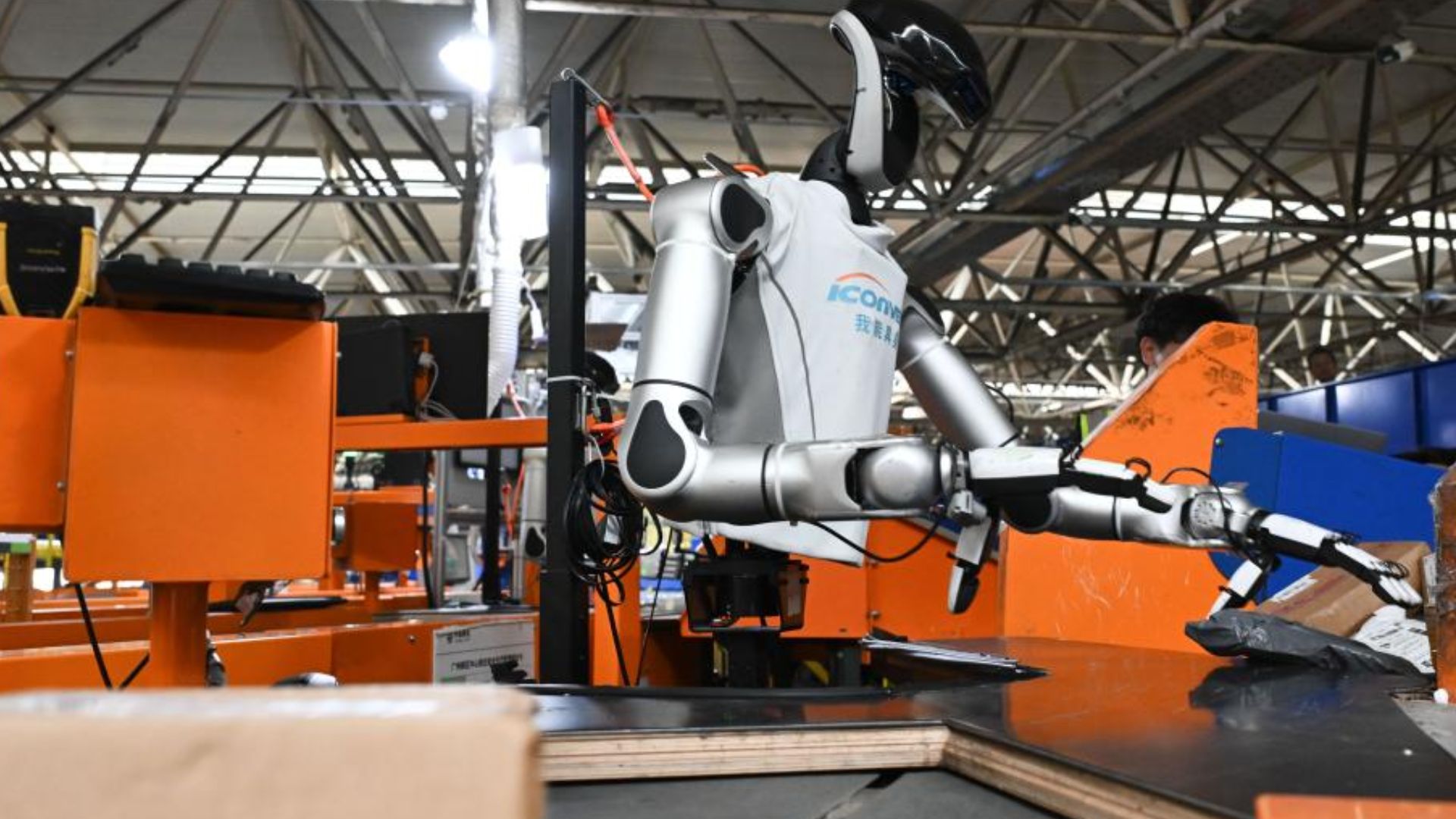
State media footage shows humanoid robots gripping packages from containers and placing them onto sorting lines at China Post’s Guangzhou facility—one of the country’s busiest hubs. These aren’t lab demonstrations. They’re live operations handling real packages in a center that processes 6.5 million mail items daily, with peaks exceeding 10 million pieces.
The humanoids work seamlessly alongside robotic arms, conveyors, and unmanned forklifts in what resembles a choreographed dance of efficiency.
Unlike traditional factory robots, humanoids navigate spaces designed for humans without expensive retrofits.
The human-shaped form factor allows deployment in existing warehouses without infrastructure overhaul.
Most industrial robots require:
- Custom layouts
- Safety cages
- Purpose-built environments
Humanoids walk through existing aisles, access standard shelves, and interact with conventional sorting equipment. This makes them attractive for retrofit automation—upgrading current networks costs less than building new robotic facilities from scratch.
Think of it like updating your streaming algorithm rather than rewiring your entire entertainment system.
China’s deployment signals a shift from experimental prototypes to practical industrial tools.
Government backing and domestic supply chains are accelerating humanoid commercialization beyond logistics into manufacturing and public services.
Beyond package sorting, China’s pushing humanoids into:
- Eldercare
- Manufacturing
- Traffic management in cities like Hangzhou
The strategic calculation is clear: develop domestic robotics capability while addressing labor shortages and workplace safety demands.
Meanwhile, Figure AI recently tested three humanoids sorting 28,000 packages over 24 hours in the US, but China’s deployment represents full integration into a live postal network handling millions of items.
Even marginal efficiency gains translate to massive operational advantages at this scale.
When you’re processing 10 million packages daily, small percentage improvements deliver enormous cost and speed benefits.
Consider the mathematics. A single robot handling 1,200 parcels per hour might seem modest until you realize the Guangzhou center’s volume. Shave even 30 seconds off average processing time, and you’ve potentially eliminated hours of bottlenecks during peak periods.
That translates directly to faster delivery speeds and lower operational costs—benefits that eventually reach your doorstep through improved service levels.
Your next package might pass through humanoid hands without you ever knowing it. The question is whether the complexity and cost of humanoid systems justify their flexibility advantages over simpler automation. China’s betting yes, and they’re using your packages to prove it.