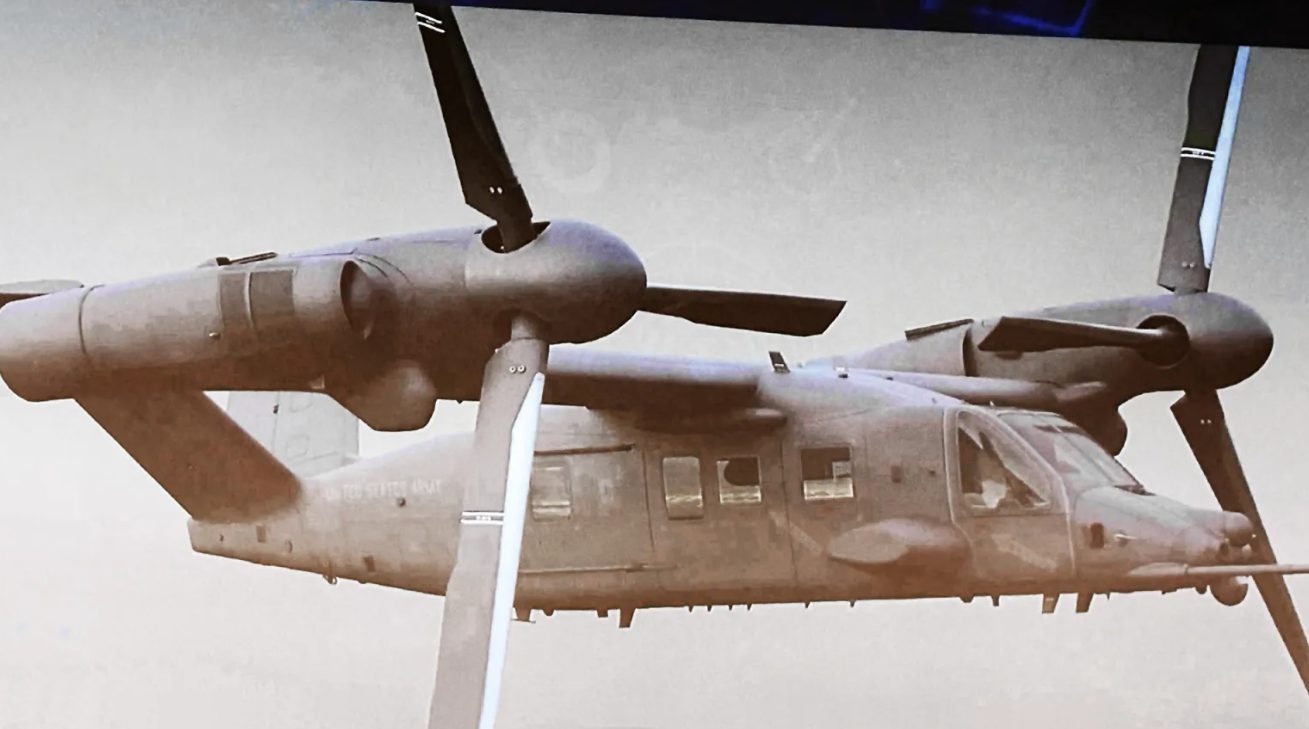
Special operations just got a serious upgrade preview. The Army finally showed what happens when you take the MV-75A Cheyenne II tiltrotor and kit it out for the 160th Special Operations Aviation Regiment—the legendary Night Stalkers who make impossible missions look routine.
Packed with Sensors That See Through Everything
The rendering reveals radar and vision systems designed for flying fast and low in terrible conditions.
This special operations variant sports the same Silent Knight terrain-following radar that already guides MH-60M Black Hawks through mountain valleys in zero visibility. But this time, it’s mounted on an aircraft that flies twice as fast and twice as far. Below the radar sits an electro-optical sensor turret—think high-definition eyes that work in complete darkness.
Most intriguing is a fixed aperture alongside the radar array, likely housing Degraded Visual Environment Pilotage System sensors. This tech essentially gives pilots superhuman vision through dust storms, sandstorms, and fog using cameras and LIDAR that map terrain in real-time. You know how your car’s backup camera struggles in rain? This system laughs at conditions that would ground conventional aircraft.

In-Flight Refueling Changes the Game Completely
A simple probe transforms regional missions into global reach operations.
The rendering clearly shows an in-flight refueling probe jutting from the right side of the nose—hardware that turns the MV-75A into something approaching unlimited range. Current Night Stalker helicopters can reach far, but this tiltrotor configuration opens entirely new mission profiles. Think hostage rescues that previously required forward staging bases, or reconnaissance insertions that span entire continents.
Col. Roger Waleski from U.S. Army Special Operations Aviation Command practically glowed when discussing the platform: “I’m exceptionally excited about this platform… the speed… the payload… the range.” His enthusiasm makes sense—aerial refueling capability means special operations forces can strike anywhere, anytime, without the logistical footprint that usually telegraphs intentions to adversaries.
Modular Design Means Rapid Mission Adaptation
Open architecture promises faster battlefield upgrades than traditional military aircraft development.
The antenna-studded fuselage hints at extensive communications and data-link capabilities, but the real story is what you can’t see. The MV-75 uses Modular Open Systems Approach architecture, letting crews swap mission packages like switching iPhone apps. Waleski emphasized this flexibility means “your ability to adapt in the warfighting environment, it’s going to be cheaper, it’s going to be quicker.”
Details remain unclear about specific fielding timelines—the Army won’t commit to first flight dates beyond “when it’s going to happen.” But the special operations configuration confirms this isn’t just another helicopter replacement. This is the Army preparing for conflicts where distance kills current capabilities, especially across Pacific theater distances that make today’s rotorcraft look like commuter vehicles.