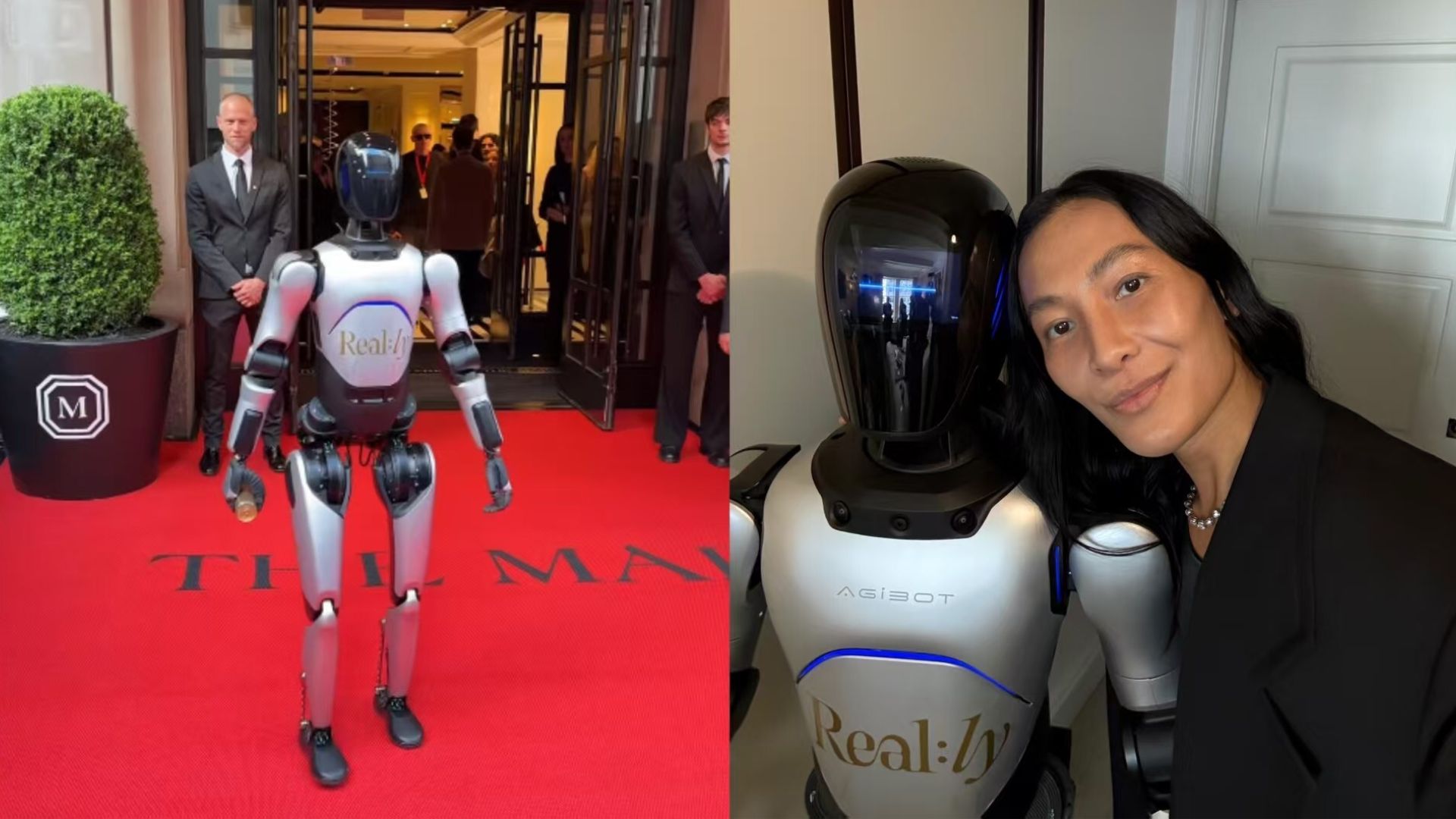
Robots just graduated from factory floors to fashion’s most exclusive red carpet. The AGIBOT A2 became the first humanoid robot to appear at a Met Gala pre-event, strutting alongside designer Alexander Wang at The Mark Hotel on May 5, 2026. This wasn’t some Silicon Valley publicity stunt—it was a 169 cm, 69 kg embodied AI system proving robots can navigate the chaos of high-stakes cultural events with surprising grace.
The A2 handled photographers like a seasoned model, responding to prompts with dynamic poses and delivering beverages to guests while navigating the crowded hotel environment. Sure, it needed brief guidance getting through an elevator doorway (even supermodels have awkward moments), but the robot’s WorkGPT AI system maintained 96% accuracy processing the sensory overload of voices, gestures, and camera flashes simultaneously.
The tech behind the runway swagger
Forty degrees of freedom and visual fingertip sensors enable human-like dexterity and social awareness.
This isn’t your typical tech demo disguised as entertainment. The A2 packs 40+ degrees of freedom with seven actively articulated joints per hand, plus visual fingertip sensors that enable precision tasks like threading needles. Its WorkGPT multimodal AI system achieves a 99% face wake-up rate for natural human interaction, while 200 TOPS of onboard computing power processes real-time decisions with optional cloud offloading for complex reasoning tasks. Walking speed hits 7 km/h with fluid, model-worthy gait dynamics that made fashion photographers forget they were shooting a machine.
The robot operates on hot-swappable batteries providing two hours of runtime, though extended variants reach up to five hours for industrial applications. Pricing ranges from $100,000 to $190,000 depending on configuration—expensive for most consumers but competitive for enterprise deployments in hospitality and retail.
From lab curiosity to cultural participant
AGIBOT’s 5,168 units shipped in 2025 establish the company as the world’s leading humanoid manufacturer.
AGIBOT already dominates real-world deployments across thousands of Chinese shopping malls, exhibitions, and hotels, proving the A2’s reliability beyond controlled environments. The company shipped over 5,168 humanoid robots in 2025 alone, making it the global volume leader in commercial humanoid robotics. Wang’s partnership positions Chinese technological innovation on fashion’s most visible stage, aligning with the 2026 Met Gala theme “Fashion is Art” to frame robots as creative collaborators rather than mere tools.
This cultural crossover signals robots evolving from functional appliances into social participants. When embodied AI can handle the unpredictable dynamics of fashion’s biggest night—complete with demanding photographers and celebrity chaos—it demonstrates readiness for mainstream cultural integration beyond traditional service roles.