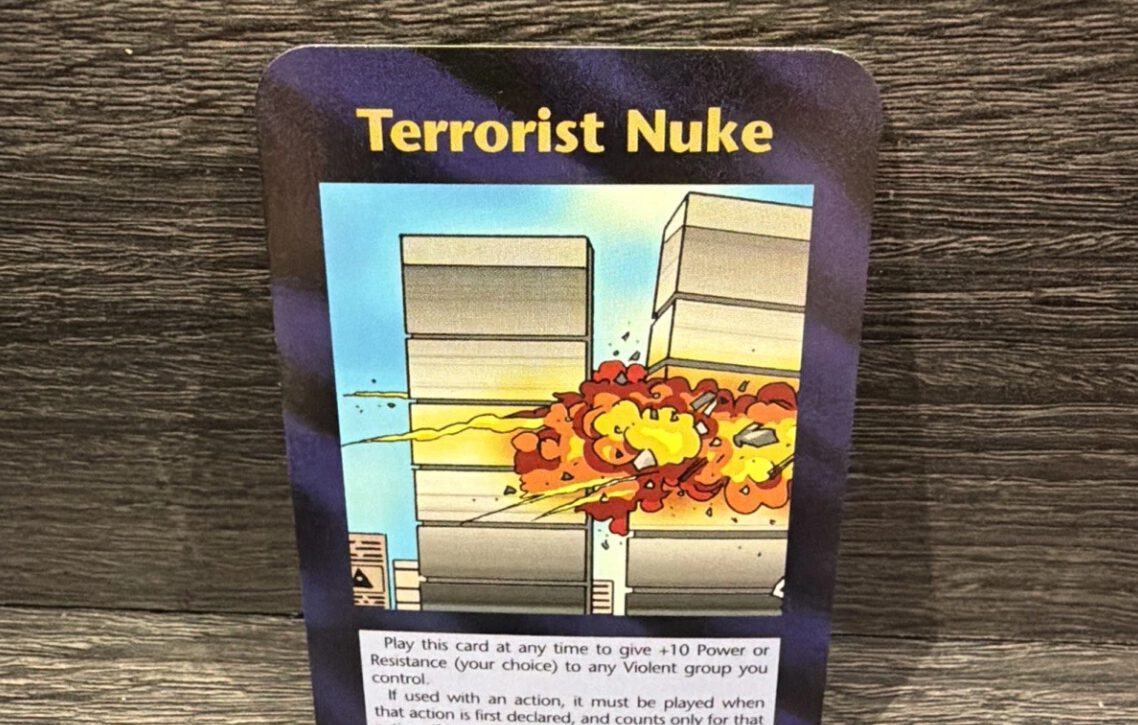
In the 90s you may have seen a card showing skyscrapers exploding in flames, drawn in 1994—seven years before 9/11. That’s the “Terrorist Nuke” card from Illuminati: New World Order, a satirical game that’s become conspiracy theory catnip. Unsealed decks now fetch over $2,000 on eBay, driven by collectors convinced this tabletop game somehow predicted the future.
The cards hit different when you’re scrolling TikTok theories at 2 AM, but the reality behind the “prophecies” tells a more interesting story about how we process chaos.
Secret Societies and Satirical Schemes
Steve Jackson Games created a darkly comedic take on conspiracy culture that struck too close to home.
Illuminati: New World Order emerged from Steve Jackson Games in 1994, evolving from a 1982 board game inspired by The Illuminatus! Trilogy. Players controlled shadowy organizations—Bavarian Illuminati, UFOs, Servants of Cthulhu—competing for world domination through disasters and manipulation.
Robert Shea, co-author of the original novels, quipped in the rulebook: “Maybe the Illuminati are behind this game… they are, by definition, behind everything.” The game satirized conspiracy theories by letting you live them out, complete with Tarot-style artwork depicting society’s darkest fears.
Cards That Hit Too Close to Reality
Specific illustrations seem to mirror real-world events with unsettling accuracy.
The “prophetic” cards that fuel online hysteria include:
- An “Epidemic” card showing masks, gloves, and body bags that conspiracy theorists link to COVID-19
- A “Charismatic Leader” depicts a blonde demagogue reminiscent of Trump’s aesthetic
- “March on Washington” shows crowd chaos that believers connect to January 6th
Even satirical cards like “Politically Correct” hangings for “Insensitive Pronoun” or “Ate Flesh of Dead Animals” feel eerily relevant to today’s culture wars. The game’s 330+ cards covered enough dystopian scenarios that some matches were statistically inevitable.
Debunking the Crystal Ball
Game creators explain the mundane reality behind the “supernatural” predictions.
Steve Jackson intended pure satire, researching conspiracy theories for entertainment value while favoring “wacky theories” for gameplay fun. Illustrator John Grigni cited post-Soviet terrorism anxieties, specifically mentioning Hamas when explaining the “Terrorist Nuke” design—not mystical foresight.
Former employee Loyd Blankenship compared the phenomenon to psychic predictions: make enough vague disaster forecasts and you’ll inevitably hit something. The 1990 Secret Service raid on the company, often cited as proof of suppression, actually targeted employee hacker activities unrelated to game content.
Meme-Worthy Mayhem
The cards persist as viral content feeding our appetite for pattern recognition in chaotic times.
YouTube channels and podcast discussions keep the “paranormal predictions” narrative alive, treating generic disaster tropes as supernatural insights. The phenomenon mirrors The Simpsons “predicting” events—when you produce enough satirical content about society’s anxieties, reality eventually catches up.
These cards work because they captured 90s fears that proved timeless: terrorism, epidemics, authoritarian leaders. Your brain craves patterns, especially during uncertainty, making a conspiracy-themed card game the perfect viral conspiracy theories itself.