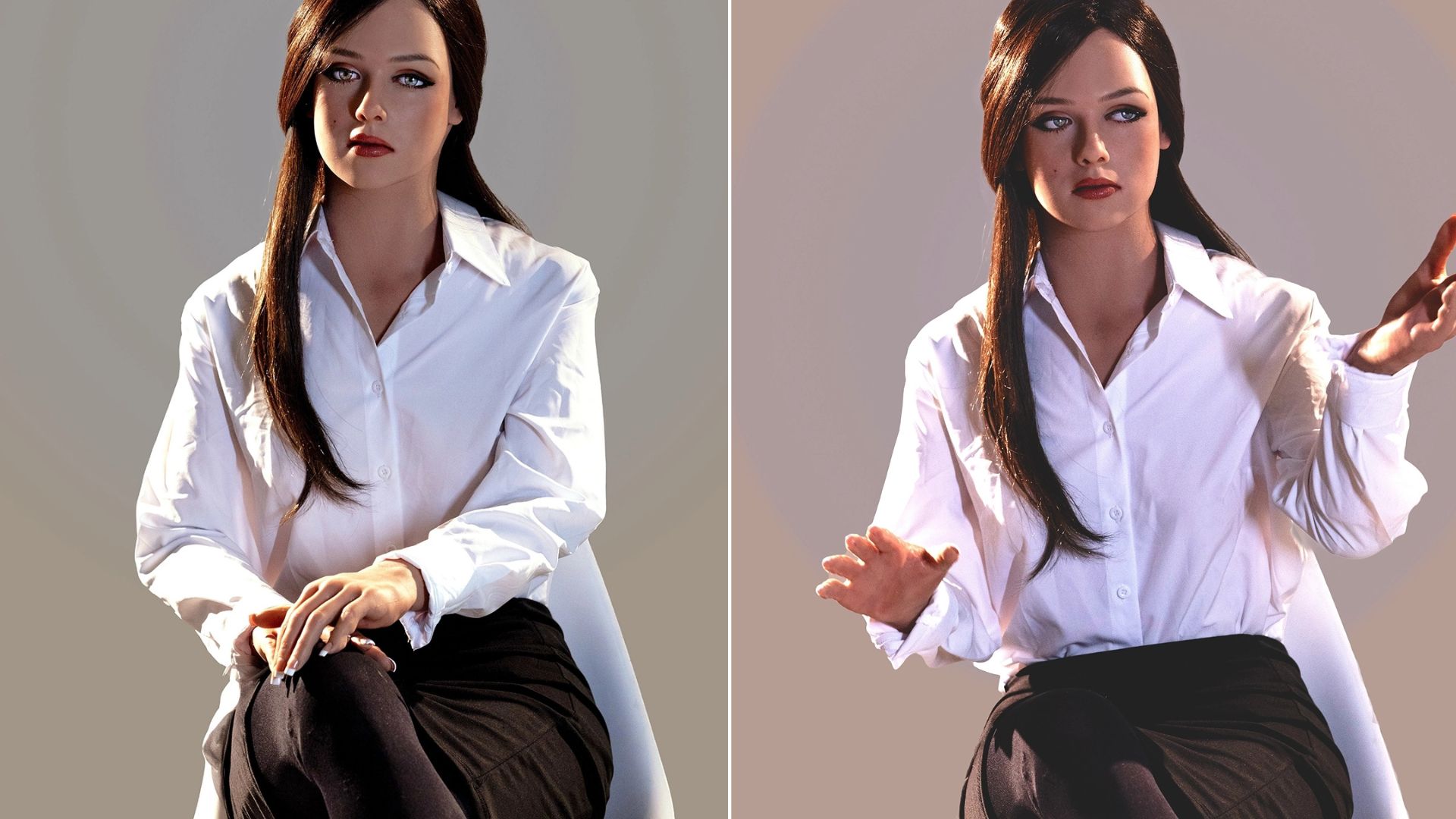
Static airport information screens and clunky hotel check-in kiosks feel increasingly prehistoric when you’re trying to get quick answers or directions. Realbotix’s Melody robot eliminates that frustration entirely, delivering human-like interaction that has people genuinely debating whether viral footage shows a real person or sophisticated machine.
The full-bodied humanoid represents a fundamental shift from industrial automation toward service roles where emotional intelligence matters as much as technical capability.
Advanced Engineering Creates Natural Movement
Thirty-nine degrees of freedom enable gestures that feel authentically human rather than mechanically programmed.
Melody’s upper body incorporates 39 degrees of freedom powered by advanced Dynamixel P-Series servo motors—the technical foundation enabling smooth, natural gestures instead of the jerky movements you’ve seen in earlier robotic devices. Micro-cameras embedded in the robot’s eyes provide real-time face recognition and object tracking, allowing Melody to maintain eye contact during conversations.
The engineering deliberately includes subtle imperfections like breathing simulation and deliberate pauses that paradoxically enhance realism rather than pursuing mechanical perfection.
Bitcoin Conference Deployment Tests Real-World Viability
Melody serves as official greeter at the 2026 Bitcoin Conference, handling thousands of daily interactions in a high-traffic environment.
Starting April 27, 2026, conference attendees at Las Vegas’s Venetian Resort encounter Melody as their official greeter—welcoming visitors, providing booth directions, and answering general questions. The robot’s modular design allows transportation in suitcase-sized luggage, solving the practical deployment challenges that plague less portable humanoids.
At $175,000 for the full-bodied configuration, Melody targets luxury hotels and premium venues willing to invest in differentiated customer experience over cost minimization.
Industry Races Toward Human-Centric Service Robots
Competition from Chinese manufacturers signals broader market recognition that emotional presence drives commercial success.
Realbotix CEO Andrew Kiguel frames the industry evolution succinctly: “AI is everywhere, but it lives behind a screen. We bring a human interface for AI.” Competing technologies from China’s AheadForm and various Japanese manufacturers demonstrate global recognition that service sector robots require relatable design over pure mechanical efficiency.
The shift mirrors how streaming interfaces evolved from utilitarian program guides to personality-driven recommendation engines—technical capability becomes secondary to user comfort and engagement.
Your Future Interactions with AI Take Physical Form
Humanoid deployment in hospitality, healthcare, and retail spaces will normalize human-robot coexistence within the decade.
You’ll likely encounter robots like Melody in hotels, hospitals, and shopping centers long before considering them for home use. The technology represents a bridge between the AI chatbots you already navigate daily and the physical assistance that service industries desperately need to improve.
While concerns about worker displacement and the psychological implications of anthropomorphic machines remain valid, the commercial reality suggests human-robot collaboration rather than replacement—at least until costs drop significantly below the current six-figure investment threshold.