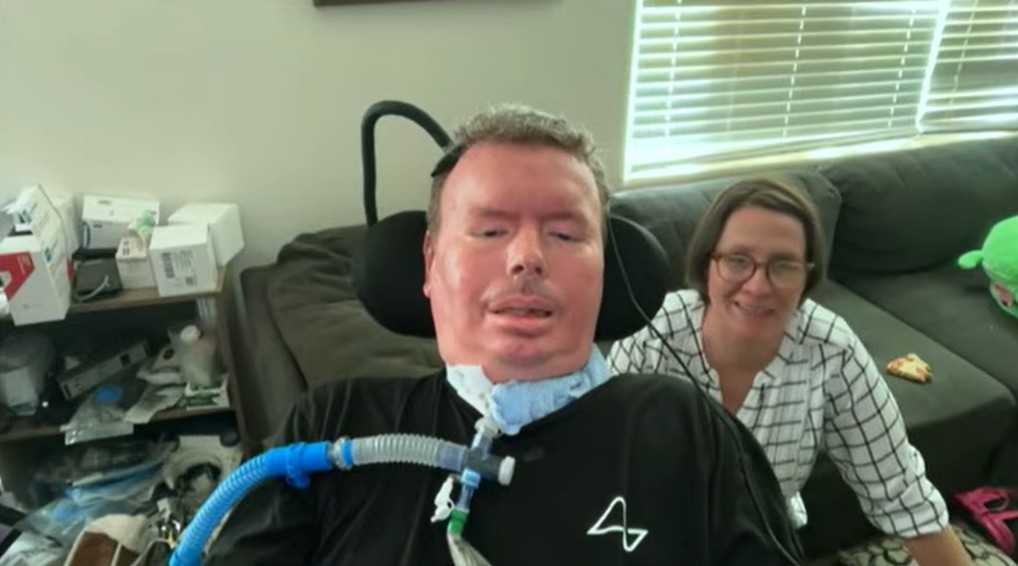
Racing to communicate during family emergencies used to mean perfect lighting and stationary positioning for eye-gaze tech—until Brad Smith’s Neuralink implant eliminated those constraints entirely. Diagnosed with ALS in 2020, Smith progressed to complete quadriplegia and lost his voice, becoming entirely dependent on family for breathing assistance and basic needs. The third human to receive Neuralink’s N1 brain chip in November 2024, Smith now controls computers through pure thought, bypassing the limitations that kept him trapped indoors.
Surgical Precision Meets Real-World Results
The N1 implant translates motor cortex signals into seamless computer control.
Neuralink’s surgical robot placed ultra-thin electrode threads directly into Smith’s motor cortex, capturing signals when he imagines hand, tongue, or jaw movements. Unlike eye-tracking systems that fail in bright sunlight or require head positioning, the wireless N1 works anywhere. Smith now edits videos on his MacBook Pro using an AI-cloned version of his pre-ALS voice, creating content that would be impossible with traditional assistive technology. The implant interprets movement intentions without accessing deeper thoughts—think cursor control, not mind reading.
Gaming Victories and Family Adventures
Thought-controlled technology brings back activities ALS had stolen.
Smith’s most satisfying achievement involves gaming sessions that would have been impossible with eye-gaze systems. The implant has restored family road trips, outdoor fireworks shows, and soccer game attendance—activities impossible with lighting-dependent technology. Neuralink developed an AI chat application using Grok 3, enabling Smith to have real-time conversations that feel natural rather than laboriously spelled out. His quality of life has “skyrocketed” thanks to regained autonomy and faster communication capabilities.
Current Limitations and Future Potential
The technology works now but requires ongoing fine-tuning as brains adapt.
The N1 isn’t perfect—yet. Smith must recalibrate regularly as his brain adapts to the interface, and the system only captures intended movements rather than complex thoughts or emotions. Still, three trial participants have logged over 670 days and 4,900 hours of combined use, proving durability beyond laboratory settings. With millions affected by paralysis, Smith’s success validates brain-computer interfaces as legitimate assistive technology rather than science fiction fantasy.