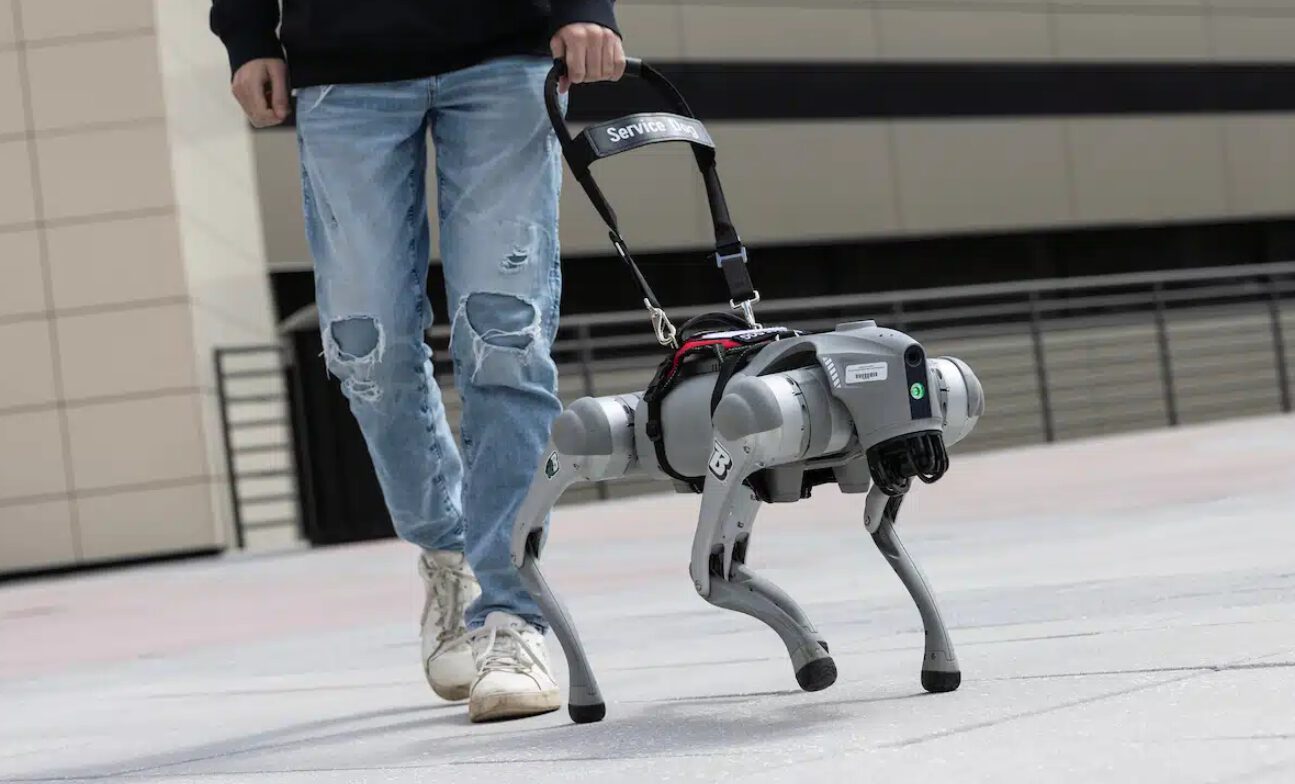
Guide dogs are incredible, but they can’t tell you “there’s a long corridor ahead with a door at the end.” Now researchers at SUNY Binghamton have cracked that code. Their robotic guide dog doesn’t just lead—it explains every step of your journey like a chatty GPS with legs.
Led by Shiqi Zhang, the team integrated GPT-4 into a quadruped robot, creating the first guide system that verbalizes complete route plans and describes surroundings in real-time. Think of it as upgrading from hand signals to FaceTime-level communication.
Users Rate Talking Robot Higher Than Silent Systems
Seven legally blind participants gave the full communication system nearly perfect scores for usefulness and ease of interaction.
During testing with seven legally blind participants (ages 40-68), the talking system scored 4.83 out of 5 for usefulness and 4.50 for communication ease. Participants navigated office environments while the robot described routes beforehand and narrated obstacles during walks.
“Real dogs can understand around 20 commands at best. But for robotic guide dogs, you can just put GPT-4 with voice commands. Then it has very strong language capabilities,” Zhang explained.
The AI handled 77 navigation requests with 94.8% accuracy, even when users gave vague directions or spoke unclearly—something that would completely stump traditional command-based systems.
Addressing the Guide Dog Shortage Crisis
Only 2% of visually impaired Americans use guide dogs due to training limitations and long waiting lists.
Only 2% of visually impaired Americans use guide dogs, creating a massive gap in mobility assistance needs. The shortage stems from lengthy training programs, limited breeding capacity, and extensive waiting lists that can stretch for years.
Robotic alternatives could scale infinitely without breeding programs, training periods, or the heartbreak of retirement. Plus, robots don’t get distracted by squirrels or need bathroom breaks during important meetings.
The prototype currently works in mapped indoor environments, but future versions aim for outdoor navigation and increased autonomy. If successful, talking robot guides could revolutionize independence for millions worldwide—finally giving everyone access to the conversational navigation companion they deserve.