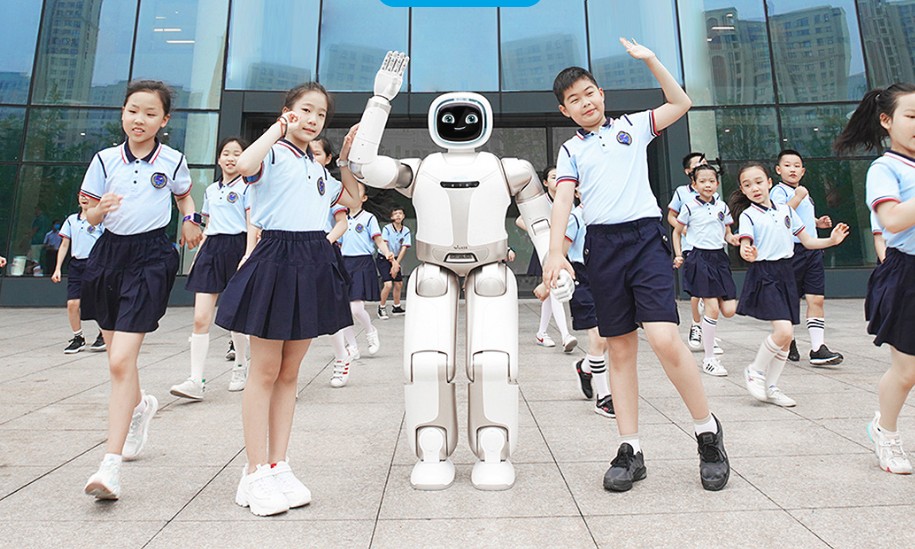
UBTech allocated $18 million on a single hire—and your future robot butler just got a lot closer to reality. China’s first listed humanoid robotics company announced this astronomical salary package for a Chief Scientist role, marking the most aggressive move yet in the global AI talent war. While tech giants usually reserve these packages for CEOs, UBTech’s betting everything on embodied intelligence—the technology that lets robots actually function in your messy, unpredictable world.
Real Money, Real Results
The Shenzhen-based company isn’t just throwing money around for headlines. UBTech reported 2025 revenue of 2.01 billion RMB, jumping 53.3% year-over-year, with humanoid products and services exploding to represent 41% of total revenue—a 20-fold increase. That’s not hype; that’s actual customers writing actual checks.
Airbus purchased UBTech’s Walker S2 humanoids for aircraft manufacturing plants in January, proving these robots work in real industrial environments, not just controlled demos. This real-world deployment validates the technology beyond laboratory conditions.
Beyond the Lab, Into Your Life
This Chief Scientist won’t just publish papers—they’ll architect UBTech’s entire embodied intelligence roadmap. The position demands expertise in:
- Vision-language-action models
- Manipulation learning
- Moving technology from controlled labs into chaotic real-world scenarios
Think less academic theorizing, more figuring out how to make robots that can navigate your cluttered kitchen or assist in unpredictable factory conditions. The role specifically targets transitioning lab research to real applications in smart manufacturing, commercial services, and home environments.
Competition Gets Serious
UBTech faces fierce competition from OpenAI, Google DeepMind, and Tesla’s humanoid ambitions, making this talent grab essential for survival. Chinese Premier Li Qiang prioritized robotics in his 2026 government work report, while competitors like Geekplus-W hired Tsinghua University’s Dr. Zhao Hao as Chief Scientist in February.
The message is clear: China won’t cede robotics leadership to Silicon Valley without a fight. UBTech is simultaneously expanding its engineering team with dozens of additional hires, including reinforcement learning algorithm engineers and hardware developers.
The salary arms race accelerates everything. Your workplace robot, home assistant, or elderly care companion arrives faster when companies compete this aggressively for breakthrough talent. What seemed like distant sci-fi is becoming immediate reality—funded by astronomical paychecks and national ambition.