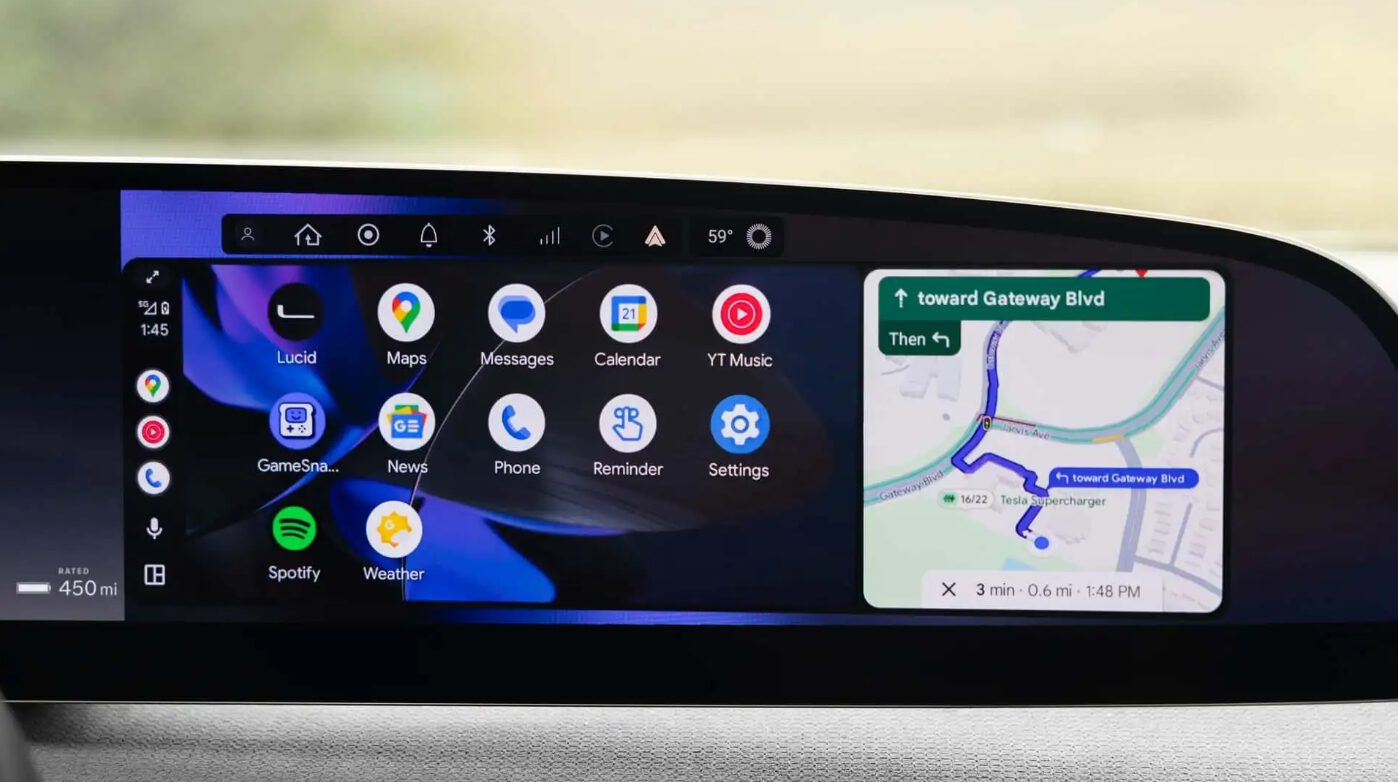
EV road trips shouldn’t require spreadsheets and prayer circles at charging stations. Google Maps finally eliminates the guesswork with native route planning that launches for Android Auto in early 2026. This isn’t another half-baked tech promise—it’s AI-powered battery prediction that understands your specific vehicle, from Ford Mustang Mach-Es to Toyota bZ4Xs across 350+ models and 15+ brands.
The system analyzes your car’s weight, battery size, current traffic, elevation changes, and weather conditions to predict exactly how much juice you’ll have left. You manually input your starting charge level once, then the system auto-updates as you drive and charge. Think of it as having a co-pilot who actually paid attention in physics class.
Tesla Superchargers Join the Party
NACS adapter compatibility opens the biggest fast-charging network to your route planning.
Google Maps now includes Tesla Superchargers in its charging recommendations, complete with NACS adapter toggle support. Your 500-mile road trip planning suddenly has access to the most reliable charging network in America, not just scattered charging options across competing networks.
The feature goes beyond basic navigation with en-route preconditioning for Ford vehicles, ensuring your battery hits optimal temperature for maximum charging speeds. Multi-stop planning shows nearby amenities while you charge, because nobody wants to stare at a Walmart parking lot for 45 minutes. You can modify, replace, or delete charging stops on the fly—flexibility that feels revolutionary after years of rigid systems.
Competition Gets Real
A Better Route Planner faces its biggest challenger, while Tesla owners remain unaffected.
This puts serious pressure on A Better Route Planner, the scrappy app that’s dominated EV route planning through direct vehicle data integration. Google’s approach lacks real-time vehicle communication, but compensates with seamless Android Auto integration and massive brand support. Tesla and Rivian owners remain unaffected—their native systems still reign supreme.
The real winners are drivers of non-premium EVs stuck with clunky factory navigation. Your Kia EV6 or Hyundai Ioniq 5 suddenly gets route planning intelligence that rivals luxury competitors. Ford’s already confirmed Mustang Mach-E and F-150 Lightning support via software update 10.1.0, with other automakers following throughout 2026.
Range Anxiety Gets an AI Therapist
Smart predictions could accelerate EV adoption by solving the charging station lottery.
This represents navigation evolution from MapQuest printouts to AI that predicts your battery’s behavior. Google’s betting that removing charging anxiety accelerates EV adoption—a reasonable gamble considering range anxiety remains the top barrier for potential buyers.
Whether this extends to Google Maps mobile apps for iOS users remains unclear. For now, Android Auto users with compatible EVs get the first taste of truly intelligent route planning. Your next road trip might finally feel less like a science experiment and more like just driving.