Your brain spots robot mistakes 300 milliseconds before your hand can hit the emergency stop. Scientists at Oklahoma State University have cracked the code on those split-second “something’s wrong” signals, creating robots that respond to your mental alarm bells faster than you can physically react.
Mind-Reading Safety Net
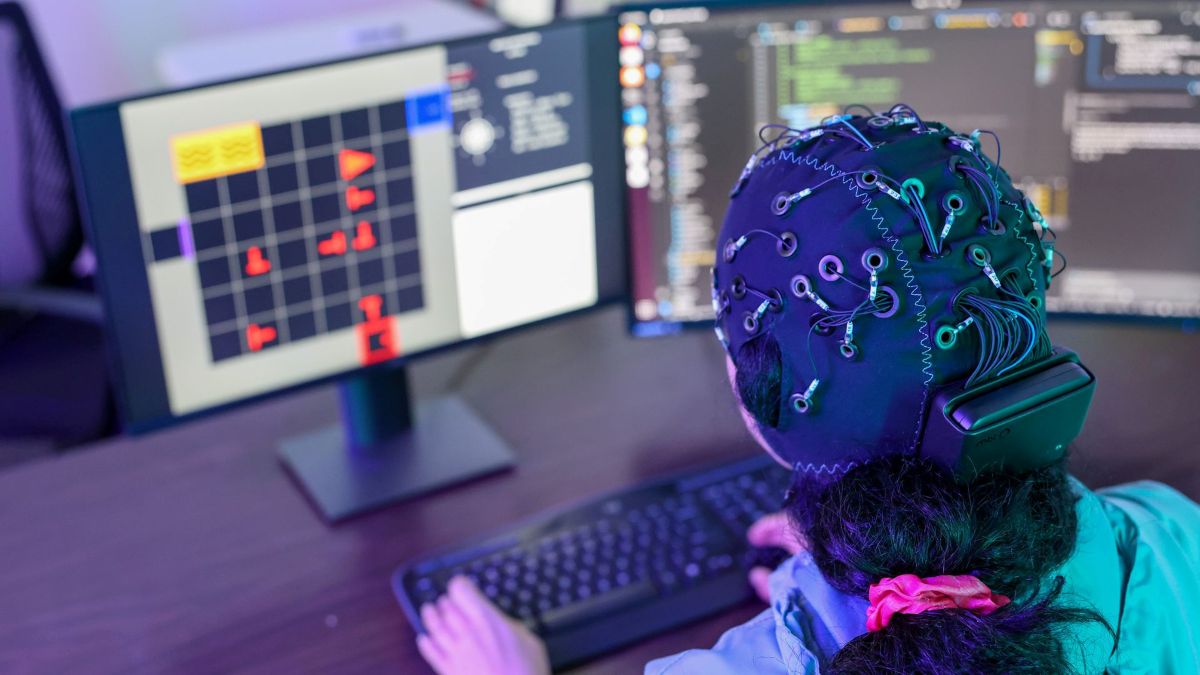
EEG caps capture error signals from your anterior cingulate cortex in real-time.
Dr. Hemanth Manjunatha’s team developed a neuroadaptive control system that reads Error-related Potentials—your brain’s instant “nope” response when watching a robot about to mess up. Think of it like your brain’s built-in quality control inspector, firing warning signals the moment something looks off.
Wearable EEG caps capture these ErrPs and tell robots to slow down, stop, or hand control back to humans within milliseconds. Current systems only detect failures after impact, like closing the barn door after the horse has already crashed into a nuclear reactor.
Built-In Guardrails
Mathematical safety rules prevent robots from misinterpreting brain signals.
The system employs Signal Temporal Logic—essentially a mathematical rulebook of “shalls and shall-nots” that constrains robot behavior alongside brain inputs. “Safety is the cornerstone,” Manjunatha explains. “Brain signals tell us when something is wrong, but STL provides the rulebook.”
This framework targets unpredictable environments where full automation fails:
- Nuclear decommissioning sites
- Surgical suites
- Deep-sea exploration
The adaptive decoding learns your specific brain patterns like facial recognition software, minimizing the lengthy calibration periods that have plagued brain-computer interfaces.
Consumer Tech Revolution
Prosthetics and smart homes could adapt to your thoughts instantly.
While the current focus involves high-stakes teleoperation, consumer applications loom large:
- Prosthetic limbs could adjust grip strength based on your mental feedback
- Smart home assistants might pause actions when your brain registers confusion
- Exoskeletons could modify assistance levels according to your comfort signals
The team uses NVIDIA’s Isaac Lab and RTX PRO 6000 GPUs for real-time processing, suggesting the computational power already exists for everyday applications.
This technology transforms the relationship between human intuition and artificial intelligence. Your subconscious becomes the ultimate safety supervisor, turning split-second hunches into actionable robot commands. The future of human-machine collaboration isn’t just about teaching robots what to do—it’s about teaching them when to stop.