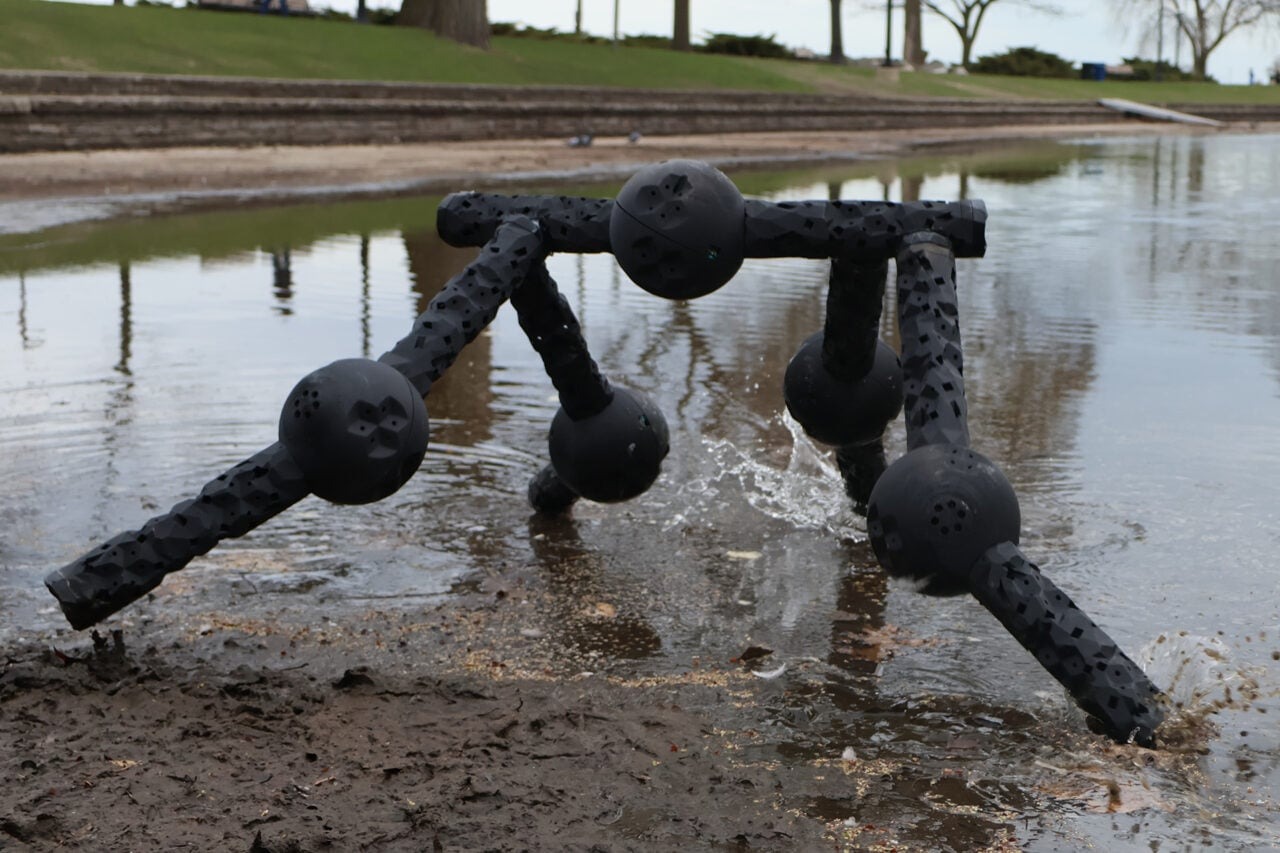
Your Roomba can’t survive being chopped in half, but Northwestern University’s latest creation shrugs off dismemberment like a digital cockroach. These “legged metamachines” represent the first robots to evolve inside computers, then successfully venture outdoors—a breakthrough that could reshape how we think about resilient consumer technology.
AI Evolution Meets Modular Design
Each sphere-shaped module contains its own brain, power, and muscle system for unprecedented adaptability.
Picture LEGO blocks that grew up watching too much Boston Dynamics. Each module resembles a sphere with two protruding cylinders, packed with motors, batteries, and circuit boards. The magic happens at the 18 attachment points—two modules create 435 possible configurations, while five modules unlock hundreds of billions of combinations.
Unlike traditional robots designed by humans, AI evolution discovers optimal forms through digital Darwinism, creating creatures that undulate like seals or bound like kangaroos. This approach eliminates human preconceptions about what robots should look like, letting natural selection find solutions we never imagined.
Outdoor Survival Without Retraining
These machines navigate gravel, mud, and roots while recovering from damage that would kill conventional robots.
“These are the first robots to set foot outdoors after evolving inside of a computer… they can survive being chopped in half,” explains lead researcher Sam Kriegman. The metamachines demonstrate bidirectional locomotion, steering through local bending, and self-righting when flipped. Most impressively, severed modules rejoin independently—damage tolerance that makes current consumer electronics look fragile.
Testing in harsh outdoor conditions required zero retraining, suggesting genuinely adaptive intelligence. Where traditional robots need careful programming for each environment, these systems adapt on the fly.
Consumer Tech’s Resilient Future
Mass-produced modular legs could enable self-repairing home assistants and exploration devices that adapt to any environment.
Current limitations prevent autonomous self-repair or morphology editing, but the foundation exists for revolutionary consumer applications. Imagine smart home devices that reconfigure themselves for new tasks, or exploration drones that adapt their shape for different terrains. The technology signals a shift from rigid gadget design toward evolvable systems that survive real-world chaos.
While movements remain “jerky and arachnoid”—triggering uncanny valley responses—standardized modular components could democratize adaptive robotics. This breakthrough marks more than academic curiosity. As our devices increasingly venture beyond controlled environments, the ability to evolve and recover from damage becomes essential. Your next robotic knee exoskeleton might literally evolve to serve you better.