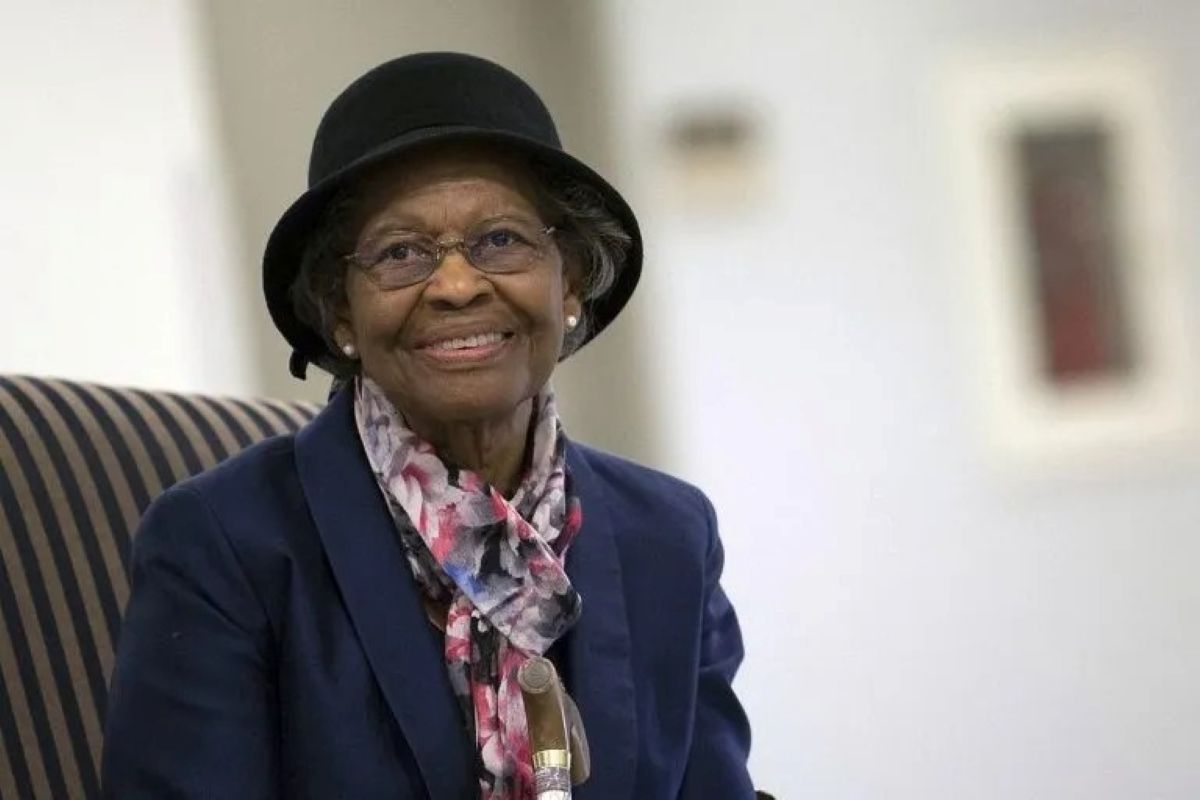
Racing to catch your Uber while staring at the pulsing blue dot on your phone screen? Thank Dr. Gladys West. That pinpoint accuracy enabling your DoorDash driver to find your apartment, your Garmin to calculate trail distances, and your iPhone to remember where you parked—all traces back to mathematical models created by a Black woman mathematician working in a segregated Naval facility during the Cold War. West passed away in January 2026 at 95, finally receiving tributes for work that touches billions of lives daily.
The Math Behind Your Maps
West’s satellite data wizardry made GPS possible for consumer gadgets.
West spent decades at the U.S. Naval Surface Warfare Center programming early supercomputers to solve a fundamental problem: Earth isn’t a perfect sphere. Her breakthrough involved using satellite data from projects like Seasat and GEOSAT to create precise mathematical models of Earth’s geoid—the actual shape our planet takes under gravity’s influence, accounting for tides, variations, and gravitational pulls.
This sounds abstract until you consider what happens when your fitness tracker calculates elevation gain. West’s algorithms ensure satellites know exactly where they are relative to Earth’s surface, enabling the triangulation that puts that blue dot precisely on your street rather than three blocks away. Her 1986 report “Data Processing System Specifications for the Geosat Satellite Radar Altimeter” became foundational reference material for GPS development.
Hidden in Plain Sight
Forty-two years of groundbreaking work earned recognition decades too late.
West joined the Naval Proving Ground in 1956 as one of the few African American women there, programming the massive NORC computer for weapons trajectories and satellite orbits. Despite leading teams that halved data processing times and publishing critical research, she faced systematic barriers to advancement.
The irony cuts deep: while her mathematical models enabled the location services that became essential to modern life—think Spotify’s running playlists that adjust to your pace, or Tesla’s navigation systems—West remained largely unknown outside naval circles. Recognition came embarrassingly late:
- Air Force Space and Missile Pioneers Hall of Fame induction in 2018
- Virginia General Assembly honors
- Scattered tech industry acknowledgments only after her story gained traction in “hidden figures” discussions
Your GPS works because West figured out Earth’s true shape with Cold War-era computing power. Every navigation app, every food delivery, every “Find My iPhone” ping relies on her mathematical precision. The next time your phone guides you home, remember the mathematician who made it possible—even if history nearly forgot her name.