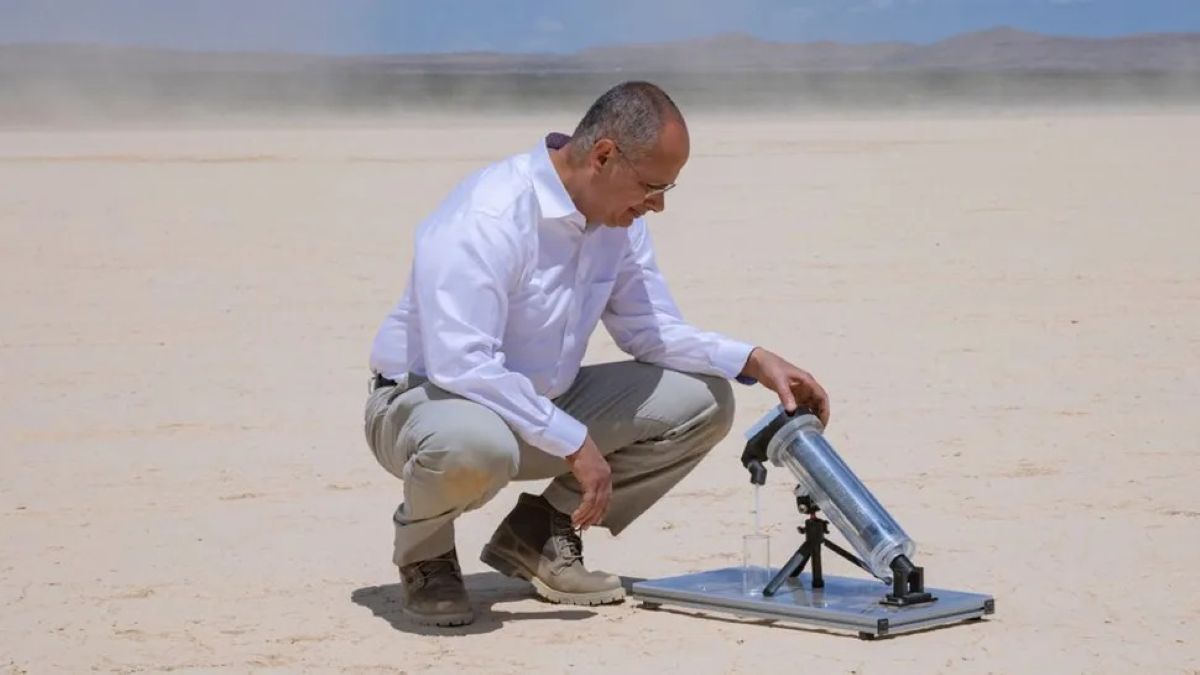
Water scarcity affects 2.2 billion people globally, but Professor Omar Yaghi’s latest creation tackles this crisis head-on. His shipping container-sized atmospheric water harvester extracts 1,000 liters of drinkable water daily from desert air with just 20% humidity—no electricity required.
The device leverages Yaghi’s Nobel Prize-winning work with Metal-Organic Frameworks (MOFs), synthetic materials so porous that a few grams contain surface area equivalent to a football field. Solar heat activates the MOFs to release captured water vapor for condensation, creating an entirely off-grid water source that works where traditional methods fail.
Death Valley Validation
Extreme testing proves the technology works in Earth’s harshest conditions.
Real-world trials in Death Valley—where summer temperatures exceed 120°F and humidity drops to single digits—validated the harvester’s capabilities. The device maintained consistent water production even under these brutal conditions, demonstrating reliability for disaster relief and remote deployments.
Yaghi’s company Atoco targets three markets:
- Household “personalized water” systems for off-grid properties
- Emergency disaster response units
- Large-scale installations for water-insecure communities
Think solar panels for water instead of electricity—a self-contained solution that generates essential resources from ambient conditions.
From Refugee Camp to Nobel Stage
Personal experience with water scarcity drives breakthrough innovation toward commercial reality.
Growing up in a Jordanian refugee camp shaped Yaghi’s mission to solve water access through chemistry. The UC Berkeley professor shared the 2025 Nobel Prize in Chemistry with Susumu Kitagawa and Richard Robson for developing MOF technology, but his focus remains intensely practical.
“The science is available; what we require now is the bravery to implement these solutions on a larger scale,” Yaghi explains. Atoco’s commercial push aims to make atmospheric water harvesting as common as rooftop solar—transforming water from a scarce commodity into a renewable resource you can generate at home.
Your cabin in Utah or emergency preparedness kit could soon include technology that seemed like science fiction just years ago.