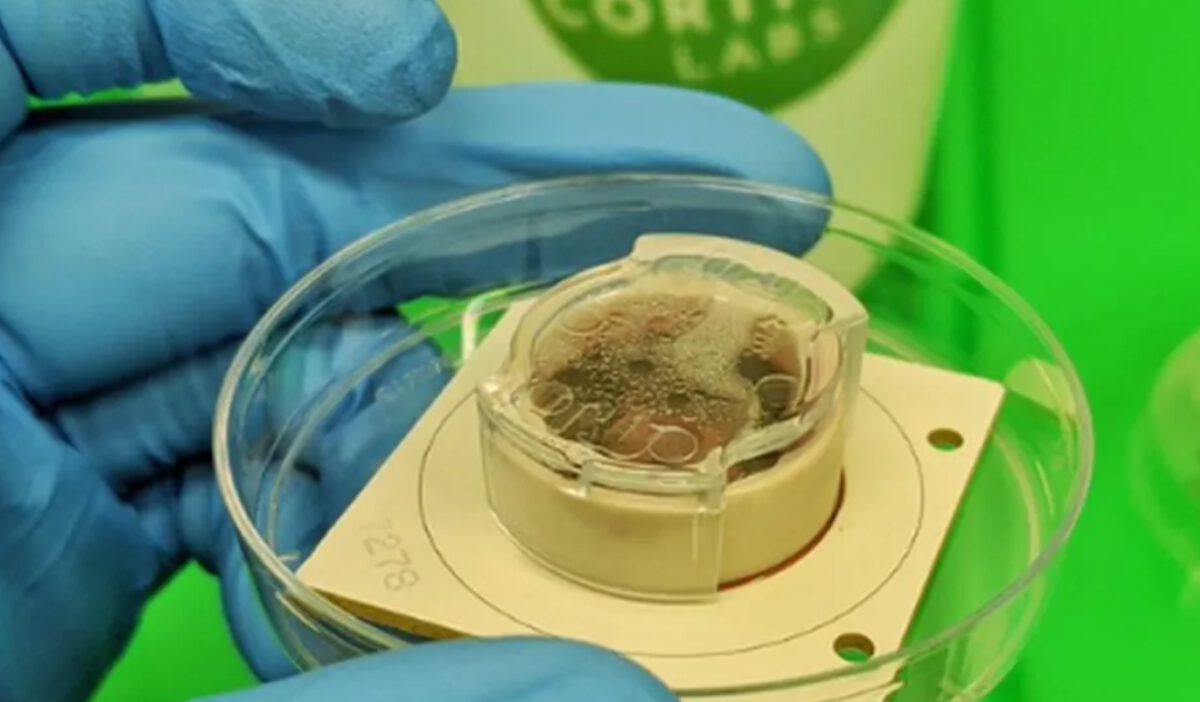
Researchers at UC Santa Cruz recently coached brain organoids—lab-grown clusters of human brain cells—to solve the “cart-pole” problem, a classic AI benchmark that’s basically digital broomstick balancing. Using electrical signals as rewards and punishments, these mini-brains improved their success rate from 4.5% to 46%. Your PlayStation might need to step up its game.
From Petri Dish to Problem Solver
These organoids prove that biological computing isn’t just science fiction anymore.
Brain organoids emerged in 2013 when Madeline Lancaster’s team first grew 3D brain tissue from human stem cells. Now they’re solving engineering problems that stump some algorithms. “You could think of it like an artificial coach that says, ‘you’re doing it wrong, tweak it a little bit in this way,’” explains lead researcher Ash Robbins.
The organoids learned without sensory input or dopamine—just raw electrical feedback teaching biological circuits to adapt. This breakthrough demonstrates that even minimal neural networks can master goal-directed tasks through reinforcement learning.
Your Future Neural Interface Takes Shape
Northwestern’s 3D bioelectronics are mapping every neural conversation in real-time.
While UC Santa Cruz trains organoids to think, Northwestern University developed bioelectronics that interface directly with brain tissue, recording from hundreds of locations simultaneously. This marriage of biology and technology accelerates everything from drug testing to personalized brain therapies.
Keith Hengen from Washington University notes that “the capacity for adaptive computation is intrinsic to cortical tissue itself”—meaning your brain’s hardware runs more sophisticated software than previously imagined. These advances are pushing us closer to hybrid AI systems that blend biological and artificial intelligence.
The Ethics of Teaching Brains to Learn
As organoids grow smarter, the questions get more uncomfortable.
Success brings scrutiny. These advances fuel treatments for conditions like Timothy syndrome, with trials advancing rapidly. But growing mini-brains that demonstrate goal-directed learning raises thorny questions about consciousness thresholds and research boundaries.
The Salk Institute has declared 2026 their “year of brain health research,” signaling major institutional investment in organoid platforms. You’re witnessing the emergence of technologies that could revolutionize how we understand and augment neural networks—both artificial and biological.