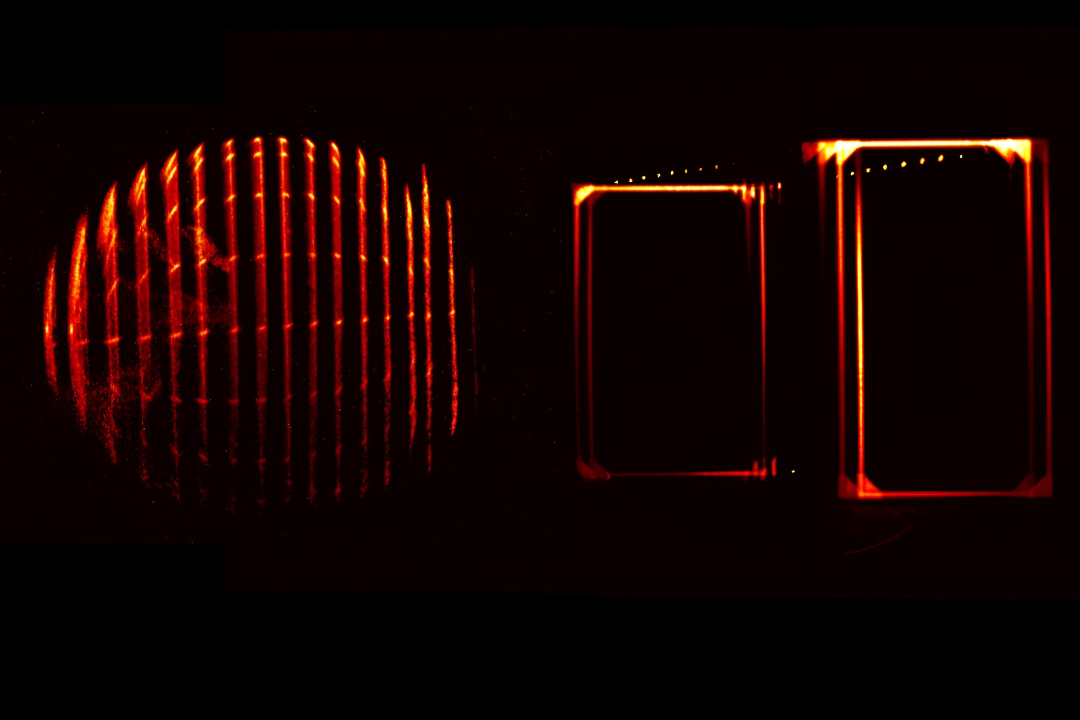
Cubes that twist like Rubik’s puzzles and spheres with their North Poles in all the wrong places—this isn’t a glitched TikTok filter. Austrian physicists just captured the first images of the Terrell-Penrose effect, a century-old prediction that objects moving near light speed appear rotated rather than squished in photographs. After 100 years of theory, you can finally see what happens when physics gets weird.
When Light Travel Time Plays Tricks on Your Eyes
The optical illusion emerges from light’s journey, not the object itself moving.
The Terrell-Penrose effect sounds counterintuitive because it defies your expectations about high-speed motion. When something rockets toward light speed, you’d expect it to appear compressed like a pancake. Instead, it appears rotated—a cube reveals two faces plus a corner, as if someone twisted reality’s camera angle.
The culprit isn’t the object changing shape but light from different parts taking varying travel times to reach your eye, creating this mind-bending optical illusion. Anton Lampa predicted this in 1924, with Roger Penrose and James Terrell refining the theory in 1959.
The Tech That Made the Impossible Visible
Femtosecond lasers and gated cameras slice light like a high-speed panorama mode.
Researchers at TU Wien and the University of Vienna essentially created the world’s most sophisticated camera setup to slow down light for human observation. Using femtosecond laser pulses lasting just 300 picoseconds, the team illuminated everyday objects while gated cameras captured precise “slices” of reflected light.
Think smartphone panorama mode, but instead of stitching space, they’re stitching time—reconstructing how light behaves when slowed to just 2 meters per second. “The rotation is not physical—it’s an optical illusion. The geometry of how light arrives… tricks our eyes,” explains Dominik Hornof from TU Wien.
Your Future Camera Might Use This Science
From mind-bending physics to enhanced smartphone photography and VR rendering.
These findings extend beyond academic curiosity into practical imaging technology. The ultra-fast photography techniques could revolutionize consumer gadgets, improving everything from burst mode captures to augmented reality rendering that accounts for relativistic effects in virtual environments.
Peter Schattschneider notes the striking visual results: “A cube appears twisted, a sphere remains a sphere, but the North Pole is in a different place.” Educational technology companies are already exploring applications for physics simulations that let students experience Einstein’s predictions firsthand.
After 66 years of mathematical theory since the 1959 formalization, seeing relativity’s visual tricks makes the abstract tangible. When your future iPhone captures motion in ways that bend perception itself, remember this moment—when scientists finally taught light to pose for the camera.