
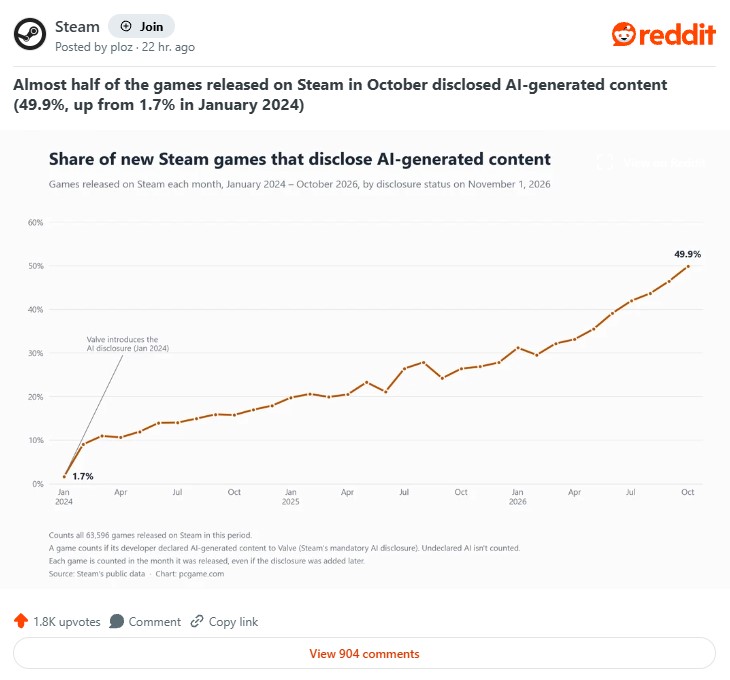
In October 2026, 49.9% of new Steam releases included a generative-AI disclosure. That figure comes from an independent analysis of roughly 63,600 Steam releases by Reddit user u/ploz, who tracked publicly available store-page data, as reported by Dexerto.
That number is not evidence that half of Steam’s new games were created by AI. A single disclosure can cover one image, one translated text string, or a store-page marketing asset.
The Growth Curve Is Real, Regardless of How You Interpret It
From a footnote to a near-majority in 34 months, the trajectory of AI disclosures on Steam is steep.
The disclosure rate stood at 13.2% across all of 2024. It climbed to 24% across all of 2025, then reached 40.1% for 2026 through October. October 2026 alone came in at 49.9%, up from 26.4% recorded in October 2025.
Whatever the scope of individual disclosures, the normalization of generative AI in Steam releases is no longer a fringe story.
Where Developers Say They Are Using It
Artwork leads every other category by a wide margin; live in-game generation barely registers.
Among games that disclosed AI use in the analyzed dataset, the breakdown by category is as follows, per the u/ploz analysis as reported by Dexerto. Because one game can report multiple categories, these figures overlap:
- Artwork: 63% of disclosures
- Text and translations: 30%
- Store-page and marketing material: 26%
- Music: 21%
- Coding: 16% (Valve’s current policy centers on player-facing content, so this figure warrants caution)
- Voices: 7%
- Live, in-game generation: 3%
Smaller and High-Output Developers Are Driving the Numbers
The trend is concentrated among lower-profile and prolific releases, not evenly distributed across the industry.
Games with fewer than 10 reviews disclosed AI use in 47% of cases; games with at least 1,000 reviews disclosed it in only 14%. Developers releasing 10 or more games per year disclosed AI use in 68% of their titles, compared with 37% for developers releasing only one game per year.
Those correlations are consistent with AI serving as a production-efficiency tool for high-output and lower-profile releases. The data does not establish why those groups disclose AI use more often.
What Valve Actually Requires
The system covers what players see and hear, not every tool a developer uses internally.
Valve introduced the disclosure framework in January 2024. It covers player-facing content: visual assets, audio, writing, localization, and some marketing materials. AI used purely as an internal development tool generally falls outside the current disclosure requirement, as described in Steam’s framework and reported by Neoteo.
Steam does not offer a native store filter to hide AI-disclosed games. Third-party tools such as SteamDB offer partial filtering based on available disclosure data, but they cannot identify games where AI use went unreported.
The Data Has Real Limits
The figures measure what developers chose to disclose, and the absence of a disclosure is not confirmation that a game used no AI.
The analysis tracks reported disclosures, not independently verified AI use. Undisclosed AI use does not appear in the dataset, whether because no qualifying use occurred or because a developer did not report it. The figures come from an independent researcher, not a peer-reviewed study or Valve’s own statistical report.
The presence of a disclosure does not indicate how extensively AI was used. What the data does confirm is that AI-content disclosure has moved from an edge-case practice to a near-majority norm among new Steam releases in under three years.