




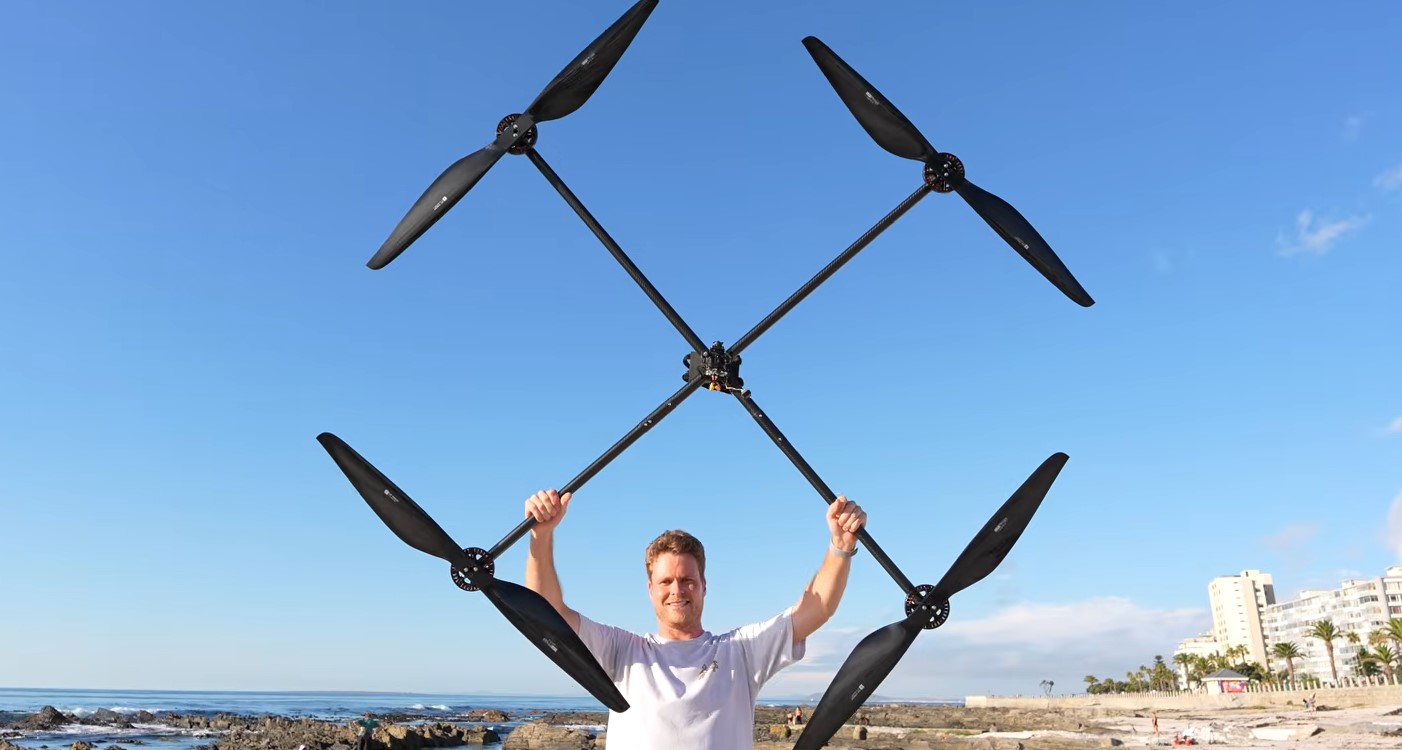
Most drones tap out after 30 minutes of flight time, leaving surveyors and search teams constantly swapping batteries. Luke Maximo Bell just obliterated that limitation with a custom quadcopter that stayed airborne for 3 hours, 31 minutes, and 6 seconds—crushing SiFly Aviation’s official Guinness World Record of 3:11:54. This South African mechatronic engineer didn’t need a corporate lab or venture funding, just obsessive attention to DIY and some clever battery hacks.
Low-RPM Efficiency: The Secret Sauce
Bell’s counterintuitive approach trades speed for marathon flight times through massive propellers and gentle motors.
Bell made his name building the world’s fastest RC quadcopters, hitting 670 km/h with his Peregreen series. But endurance demanded opposite thinking. Where speed drones scream at high RPMs, Bell’s endurance machine whispers with 40-inch T-Motor G40 carbon fiber propellers spinning at leisurely speeds.
The lightweight MN105 V2 Antigravity 90 KV motors generate maximum lift with minimal power draw—like switching from a Formula 1 engine to a Prius hybrid. CFD simulations through AirShaper optimized the 800mm carbon fiber frame to minimize propeller wake interference. You know those desk fans that barely use electricity yet move serious air? Same principle, scaled up for flight efficiency.
Battery Hacks That Actually Work
Stripped packaging and upgraded connectors saved 360 grams while doubling energy density.
The real breakthrough came from Tattu’s semi-solid state NMC LiPo batteries delivering 320 Wh/kg energy density—double what standard batteries manage. Bell didn’t stop there. He stripped 180g of packaging from each battery pack and swapped heavy connectors for lighter XT60s, shaving another 360g total.
During flight, power consumption hovered around 400W in static hover but dropped to just 250W when moving forward—headwind airflow actually improved efficiency. The drone exceeded SiFly’s benchmark at the 2:14 mark with 33% battery remaining, finally touching down at 2.95V per cell. Like optimizing your phone’s battery life, except the stakes involve not crashing a thousand-dollar build.
Beyond YouTube Views: Real Applications
Commercial drone operations could benefit from Bell’s efficiency innovations in surveying and emergency response.
Bell plans an official Guinness attempt using autonomous forward flight, potentially pushing past four hours airborne. Those extra hours matter for search and rescue teams covering vast terrain or surveyors mapping remote areas without constant battery swaps. The longer flight times could reduce operational costs by cutting the number of battery packs and charging cycles needed for extended missions. While most drone enthusiasts chase flashy stunts, Bell’s methodical engineering approach offers practical solutions the industry desperately needs.


























