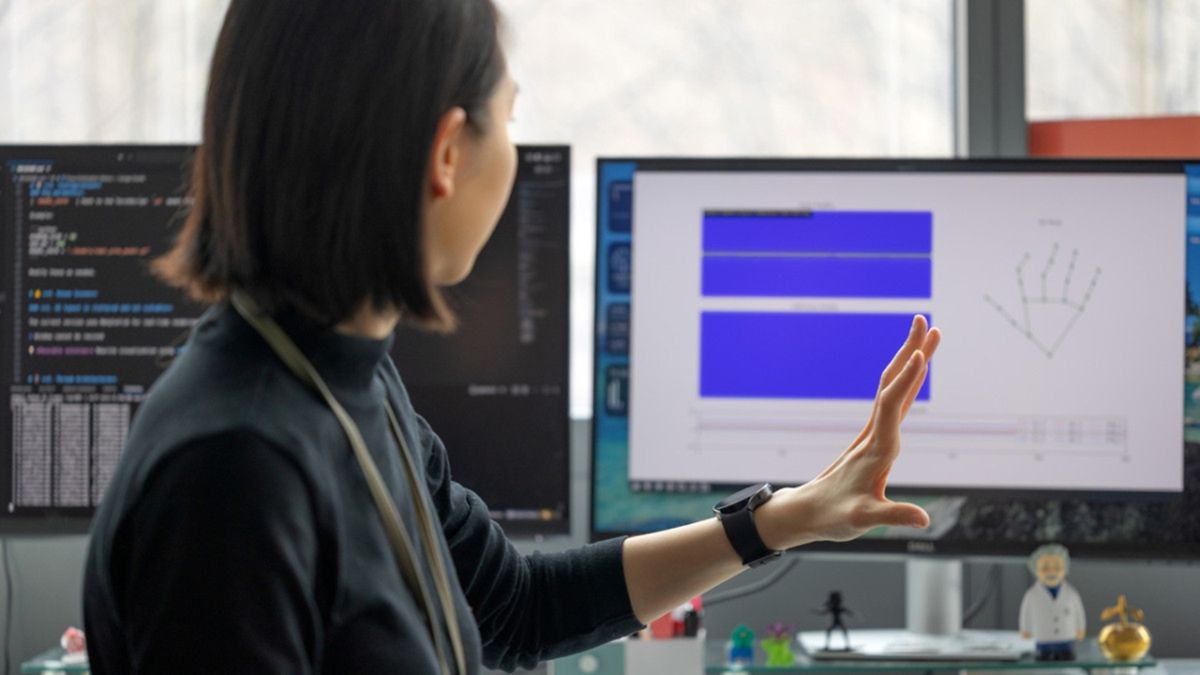
Waving at your TV remote or air-typing on invisible keyboards sounds like something from Minority Report, but your Android smartwatch might already have the hardware to make it real. Researchers from Cornell University and KAIST just cracked the code on turning any speaker-and-microphone combo into a 3D hand tracker—no cameras, no extra sensors, just clever AI listening to echoes.
Sonar Meets Machine Learning
Sound waves bouncing off your fingers create detailed gesture profiles.
The WatchHand system works like acoustic echolocation for your hand movements. Your smartwatch emits inaudible sound waves through its speaker, which bounce off your fingers and palm before returning to the microphone. On-device machine learning processes these echo patterns in real-time, mapping your hand’s 3D position and finger movements with surprising accuracy. Think dolphin sonar, but for tracking whether you’re making a fist or pointing.
Beyond Touchscreens and Keyboards
Air-typing and gesture control finally escape the lab setting.
This isn’t just a tech demo collecting dust in academia. The applications span from air-typing emails while your phone sits on a table to controlling VR environments without handheld controllers. “In the future, with this kind of hand-tracking technology, we might be able to track our typing with just our smartwatch. Our hands can act as an input device with computers,” explains Chi-Jung Lee, Cornell doctoral student and co-lead author.
The Android-Only Reality Check
Current limitations keep expectations grounded in reality.
Before you start conducting digital orchestras, know the constraints. The system currently works only on Android smartwatches—iOS remains locked out. Accuracy drops when you’re walking around, and the researchers are still refining motion compensation. It’s promising technology that’s not quite ready for your daily commute, but the foundation is remarkably solid after testing on 40 participants across 36 hours of data.
Software Update, Hardware Revolution
Millions of existing devices could gain new capabilities overnight.
This transformation requires zero additional hardware. “WatchHand substantially lowers the barriers to hand-pose tracking. If any device has a single speaker and microphone, our approach is applicable,” notes Jiwan Kim, KAIST doctoral student. With just a software update, millions of smartwatches could transform into gesture-control hubs. The research will be presented at ACM CHI 2026 in Barcelona, potentially accelerating real-world deployment timelines.