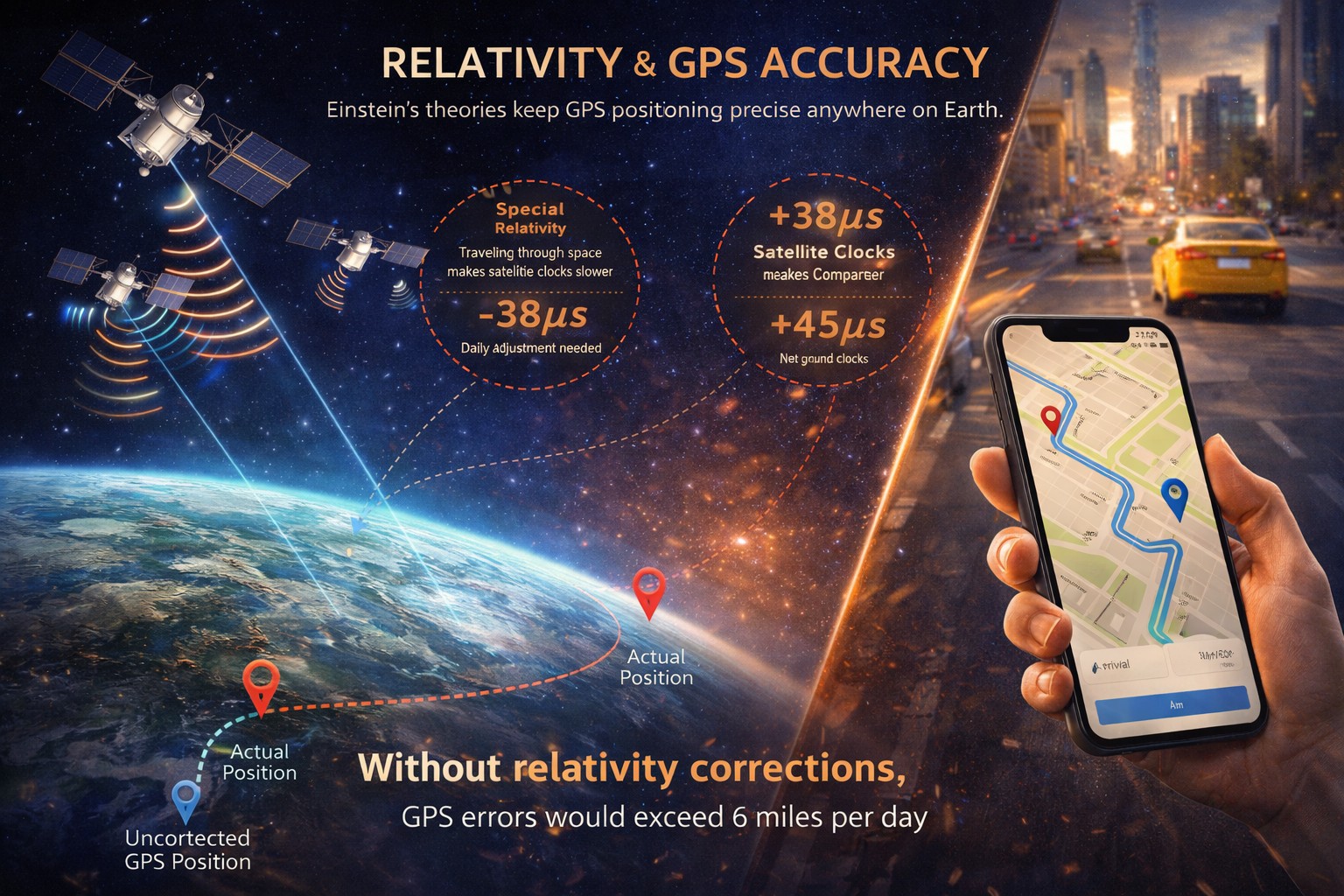
Fumbling with directions while your rideshare driver waits? Your phone’s GPS seems like pure magic—pinpointing your location within a few meters anywhere on Earth. But this everyday miracle depends on something that sounds like science fiction: Einstein’s theories of relativity, formulated over a century ago. Without corrections based on these abstract physics principles, GPS would accumulate errors exceeding 6 miles per day, making it essentially useless for navigation.
The Nanosecond Problem
GPS works by measuring how long radio signals take to travel from satellites to your phone. Those satellites orbit 12,550 miles above Earth, racing through space at 14,000 kilometers per hour. The system’s accuracy hinges on nanosecond-level timing precision—a single nanosecond error translates to roughly 30 centimeters of positioning error.
This extreme sensitivity means that even tiny discrepancies in satellite clocks create massive navigation problems. Your phone needs signals from at least four satellites to calculate position, and each timing miscalculation compounds the error.
Time Gets Weird in Space
Here’s where relativity enters the picture. Einstein’s special relativity shows that moving clocks run slower—satellite clocks lose about 7 microseconds daily due to their extreme velocity. But general relativity reveals the opposite effect: weaker gravity at satellite altitude makes clocks run faster by 45 microseconds daily.
The net result? Satellite clocks gain 38 microseconds per day compared to ground-based clocks. GPS engineers deliberately program satellite clocks to run slow before launch, compensating for these relativistic effects.
When Physics Meets Reality
Consider this nightmare scenario: climbing Mount Everest using uncorrected GPS for navigation. After three days, you’d find yourself approximately 6 kilometers away from the actual summit—potentially at Ronghuk Glacier instead of the peak. Your morning commute would become equally chaotic as accumulated errors place you blocks away from your actual location.
Every GPS calculation performed by every receiver tests Einstein’s theories thousands of times daily, making relativity one of the most validated scientific theories in human history.
The Invisible Infrastructure
GPS represents something remarkable: abstract theoretical physics becoming critical infrastructure. Other positioning systems—Europe’s Galileo, Russia’s GLONASS, China’s BeiDou—all require identical relativistic corrections, proving this isn’t a GPS quirk but a fundamental characteristic of space-based navigation. Your phone essentially carries a pocket-sized validation of Einstein’s work, connecting century-old insights about spacetime to getting your DoorDash delivery to the right apartment.