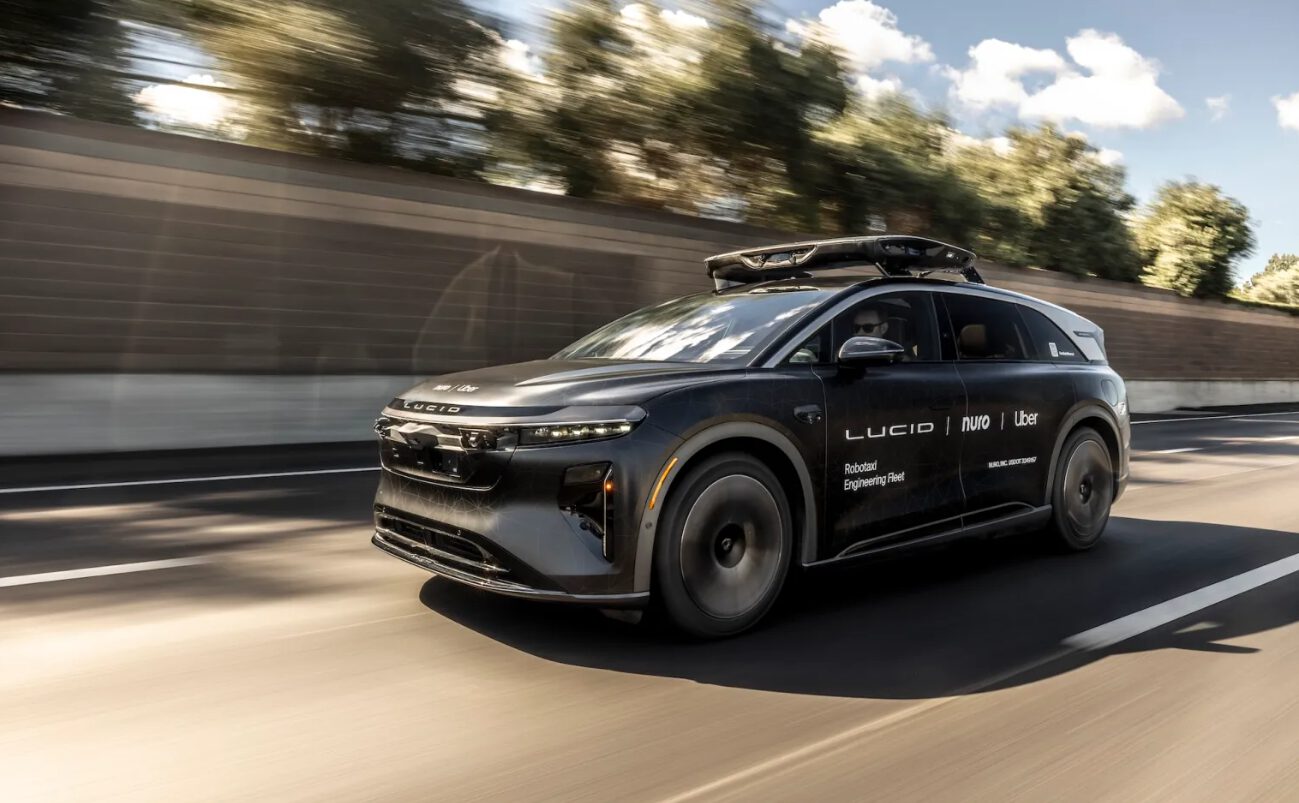
Uber staff can now request rides in autonomous Lucid Gravity SUVs through the regular app interface. Your last Uber ride probably cost more than dinner and arrived twenty minutes late. But Uber employees in San Francisco are experiencing a different reality—sliding into autonomous Lucid Gravity SUVs that handle the driving while passengers enjoy climate controls and interactive screens.
These aren’t your typical robotaxi pods cramped with sensors. The Gravity delivers genuine luxury with its spacious EV interior, roof-mounted LED “halo” for visibility, and cabin monitoring cameras that feel more Tesla than taxi.
The Tech Behind the Comfort
Nuro’s Level 4 autonomy system transforms Lucid’s premium SUV into a self-driving experience machine.
Nuro’s sensor suite reads the road through high-resolution cameras, solid-state lidar, and radars, all powered by Nvidia’s Drive AGX Thor platform. The result feels like riding in a well-appointed living room that happens to navigate San Francisco’s notorious hills and intersections.
“Riders can step into a Lucid Gravity and focus on enjoying the experience,” according to Lucid Motors—though a safety operator still sits behind the wheel during this testing phase, ready to take control if algorithms falter.
The 20,000-Vehicle Gambit
Uber’s massive fleet commitment targets a 2026 Bay Area launch with global expansion planned.
Uber committed to purchasing at least 20,000 Gravity SUVs over six years, with production ramping up at Lucid’s Arizona factory in late 2026. This represents a fundamental bet that riders want luxury over low-cost transportation—think executive sedan rather than shared shuttle.
The partnership challenges Waymo and Cruise by positioning autonomous rides as premium experiences rather than utilitarian point-A-to-B services.
Reality Check on the Road Ahead
Current testing reveals both promise and persistent hurdles for driverless deployment.
Despite the polished marketing, these vehicles still require human oversight during real-world testing. Nuro operates roughly 100 Gravity SUVs across U.S. cities for validation, focusing on scenarios like complex intersections and pedestrian interactions that remain challenging for autonomous systems.
The 2026 launch timeline depends on regulatory approval for truly driverless operation—something that’s proven elusive for competitors despite years of testing. Whether riders will pay premium prices for robot chauffeurs instead of demanding cheaper, more reliable human drivers remains the industry’s biggest unanswered question.