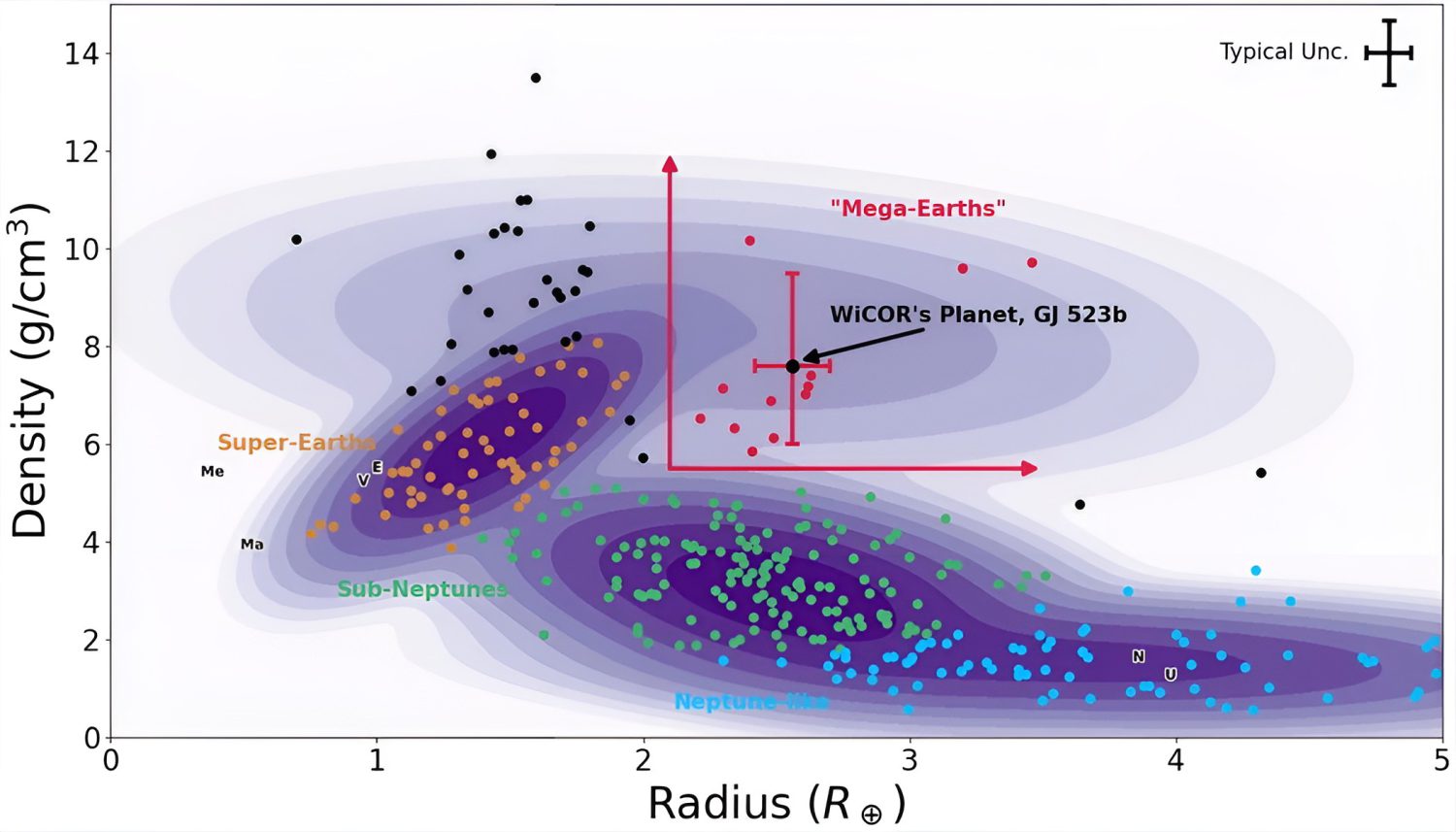
Standard planetary physics says a rocky world that massive should have hoovered up hydrogen and helium long ago, inflating into a gas giant. GJ 523b defies that expectation entirely. Researchers at the University of Wisconsin–Madison have confirmed an exoplanet packing 23.5 Earth masses into a body just 2.55 times Earth’s width — with a density of 7.8 g/cm³ and little to no atmosphere to speak of. Earth averages 5.5 g/cm³. Neptune, roughly comparable in size, is barely 1.64. This thing is essentially a planet-sized cannonball.
A Planet That Broke the Rules
The core numbers paint a picture that current formation models struggle to explain.
Straight from the preprint submitted to The Astronomical Journal:
- Mass: ~23.5 Earth masses (±3.3); radius: ~2.55 Earth radii
- Density: ~7.8 g/cm³ — denser than Earth itself
- Orbital period: 17.75 days; equilibrium temperature: ~538 K (~265°C)
- System age: ~170 million years — a toddler next to Earth’s 4.54 billion
- Detected by NASA‘s TESS; confirmed via WIYN telescope in Arizona and JWST data
In planetary formation theory, there’s an informal threshold around 20 Earth masses. Cross it, and gravity starts pulling in so much gas that you become Neptune at minimum, Jupiter if you’re ambitious. GJ 523b has 23.5 Earth masses and essentially no thick envelope — a device that benchmarks like a flagship but ships with no RAM. The numbers refuse to tell a coherent story.
“Dense planets like this aren’t uncommon, but they’re usually small rocky planets similar to Earth or Mercury. This planet is two and a half times bigger than the Earth,” lead author Max Kroft told Newsweek.
Two Theories, Zero Certainty
Scientists have two competing explanations for GJ 523b’s missing atmosphere — and neither is confirmed.
The discovery chain itself was methodical. TESS spotted a repeating dip in starlight as GJ 523b crossed its star. The WIYN telescope then measured the gravitational tug to nail down mass. JWST data helped constrain density and rule out a substantial atmosphere — three independent instruments closing off simpler explanations one by one, like cross-referencing sources before hitting publish.
- The planet once orbited much closer to its star, and intense radiation stripped the atmosphere bare.
- Two large rocky planets collided, merging into a single dense remnant, with the heat of impact driving off any gas.
Co-author Thomas Beatty framed the broader significance plainly: “People have been using the phrase ‘Mega-Earth’ for more than a decade, but we’ve never had a planet that let us say concretely what one is. GJ 523b finally does.”
Fully understanding it will require expertise beyond astronomy — geophysicists modeling iron behavior at pressures no Earth lab can replicate, plus atmospheric scientists hunting for whatever thin envelope might remain. JWST follow-up observations are the clearest next step, and whatever they find will likely force a rewrite of at least one chapter in the planetary formation playbook.