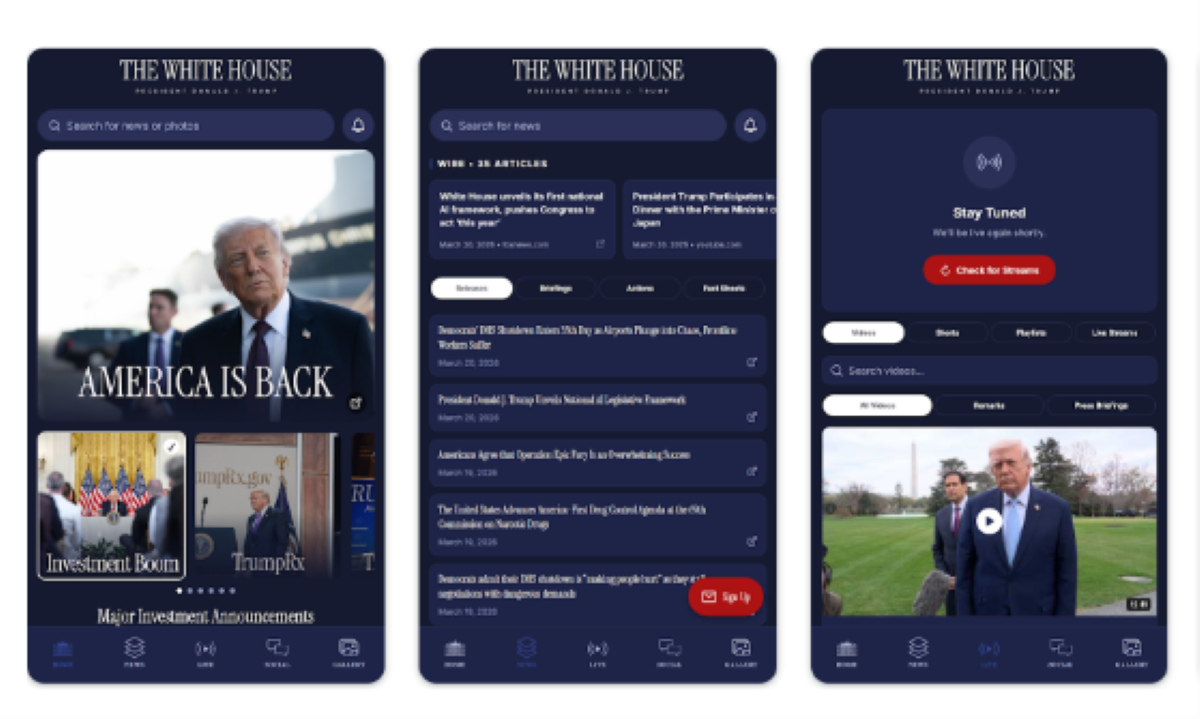
Somewhere in a DHS office right now, a government-issued iPhone is about to get a new app it never asked for. According to an internal email dated June 16 and first reported by Politico Pro, “The White House” app will “soon” be automatically loaded onto all department-managed mobile devices. The FAA got the same treatment in May, with IT staff told to auto-install the app on every agency-issued iPhone and iPad “as mandated by the White House,” according to Government Executive. Employees were told they “do not need to take any action.” Federal CIO Greg Barbaccia coordinated the broader executive-branch rollout.
What’s Actually on This App
Think less secure government comms tool, more presidential fan page with push notifications.
Built by the Executive Office of the President and launched in March 2026, this is the same app anyone can download from Google Play or the App Store right now — no special security hardening, no purpose-built government configuration. It serves up:
- breaking news alerts
- livestreams
- executive action updates
- social media posts
- a curated photo library
The standout feature is a “Text President Trump” button that pre-fills a message reading “Greatest President Ever!” Sending it opts users into SMS alerts, according to Government Executive — functioning more like a campaign opt-in list than a neutral government notification system. Critics quoted by tech outlets argue the app blurs the line between official communication and political messaging, particularly given its presence on civil-service work devices.
Privacy Gaps and the Consent Problem
The app shares user data with third parties without clear disclosure — and employees may have no path to remove it.
Notus reporting cited by Gizmodo found the app shares user data — including time zone and IP address — with third-party services, and “doesn’t disclose its data sharing the way most others do.” Because this is the standard consumer version, any commercial-grade analytics or third-party SDKs baked in come along for the ride on devices that may handle sensitive government health, financial, and legal data — or other sensitive internal government information.
White House spokesperson Olivia Wales framed the rollout as a civic service: “The White House App gives all Americans direct access to White House live streams, breaking news alerts, new policy initiatives, social media posts, and more,” she told Government Executive.
The gap between that framing and the technical reality is hard to miss. When Apple force-pushed U2’s Songs of Innocence onto every iTunes library in 2014, users revolted over the sheer presumption of it. That was Bono on a personal phone. This is politically charged content landing on a federal employee’s work device — with neither DHS nor FAA communications mentioning any opt-out path.
Government Executive notes the app contains content “overtly political or directly related to campaigns,” precisely the material federal employees are generally discouraged from engaging with on the clock under Hatch Act guidelines. That tension — between agency ethics rules and a White House directive placing this app on those same work devices — hasn’t been publicly resolved.
The precedent here outlasts any single administration. Once MDM infrastructure becomes an accepted channel for pushing politically branded content onto the federal workforce, every future White House inherits that same capability. The line between official government communication and political messaging — and the broader pattern of tech scandals where platforms exploit trusted channels — just got a lot harder to locate.