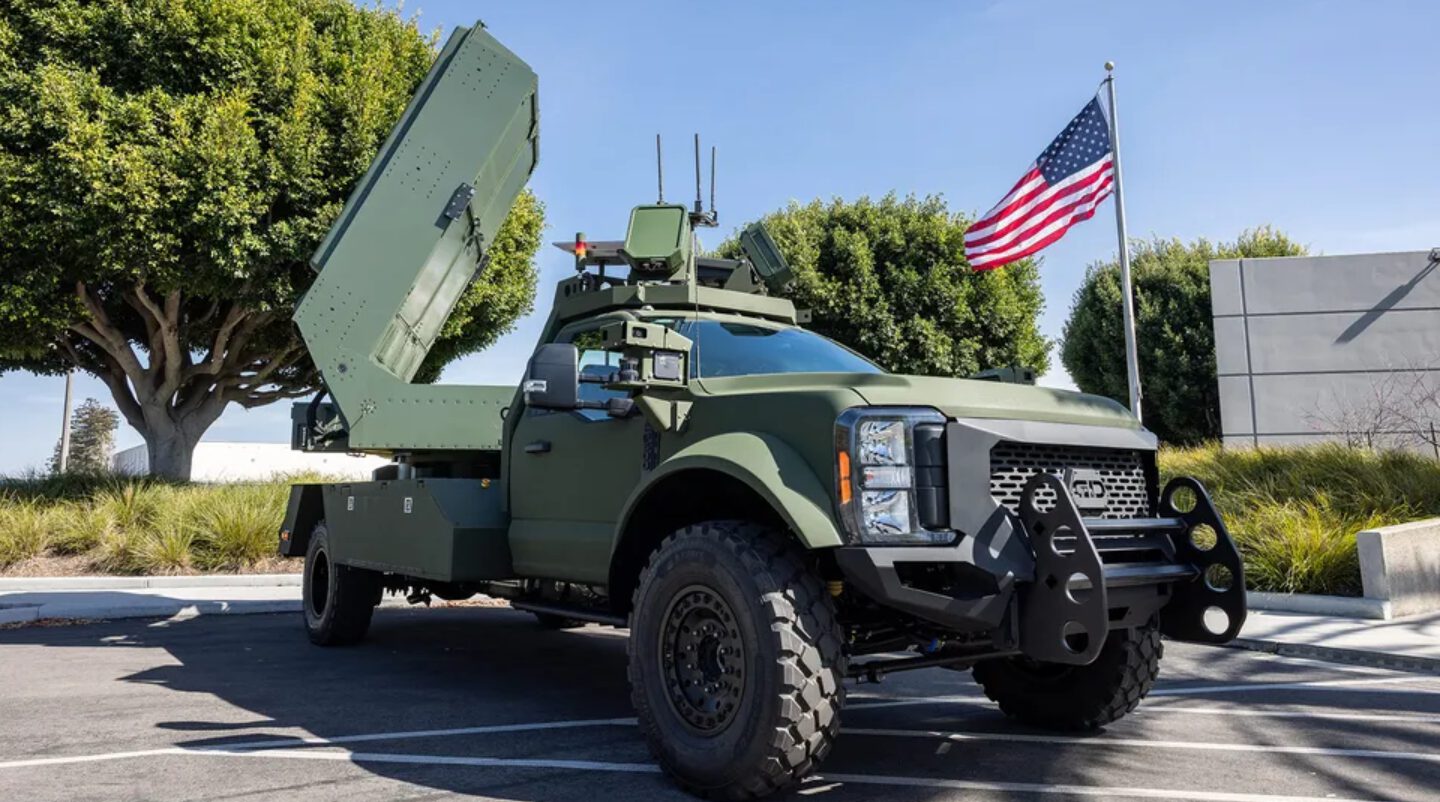
Forty-nine drones fell from the sky in a single microwave blast. That’s not science fiction—that’s the field test result from the Leonidas Autonomous Ground Vehicle, a collaboration between three U.S. defense companies that just changed the economics of drone warfare.
The Tech That Makes Swarms Fall Silent
Epirus, General Dynamics Land Systems, and Kodiak AI announced their trilateral partnership in March 2026, combining directed energy weapons with self-driving technology. The Leonidas AGV mounts Epirus’ proven high-power microwave platform onto a commercial truck controlled by Kodiak’s autonomous driving system.
Think of it as a Tesla with a drone-frying death ray—except this actually works. In controlled trials, the system disabled all 61 targeted drones, proving that electromagnetic warfare scales better than traditional missiles when you’re facing coordinated swarm attacks.
Why Robots Fighting Robots Makes Sense
The AGV operates in two modes: fully autonomous deployment to pre-planned positions, or remote teleoperation for dynamic maneuvering. “Saturation drone attacks demand a fundamentally different approach to defense,” explains Andy Lowery, CEO of Epirus.
“Leonidas AGV combines autonomous mobility with high-power microwave effects to deliver a counter-UAS capability that rapidly maneuvers to defeat drone swarms without more boots on the ground.” Translation: your soldiers stay safe while robots handle the robot problem.
Commercial Tech Meets Military Necessity
Kodiak AI’s contribution matters more than you might expect. The company delivered the first customer-owned driverless trucks in commercial service during 2024. Don Burnette, Kodiak’s CEO, positioned the military application as natural evolution.
“By integrating the Kodiak Driver with Epirus‘ Leonidas platform, we are demonstrating how commercially developed autonomy enables mobile counter-UAS capabilities that protect critical assets and keep warfighters out of harm’s way.”
Beyond the Battlefield
The U.S. Army already took delivery of four prototype units for extensive testing, but the potential applications stretch beyond military bases. Airports, ports, energy facilities, and major public events all face asymmetric aerial threats that traditional air defense systems can’t economically address.
Keith Barclay from General Dynamics Land Systems emphasized the scalability: “This collaboration directly meets the U.S. military’s need for scalable, adaptable and cost-effective autonomous ground vehicles.” When cheap drones can overwhelm expensive interceptors, you need solutions that work repeatedly. The Leonidas AGV prototype was displayed at April’s AUSA Global Force Symposium, signaling confidence in transitioning from concept to deployable capability.