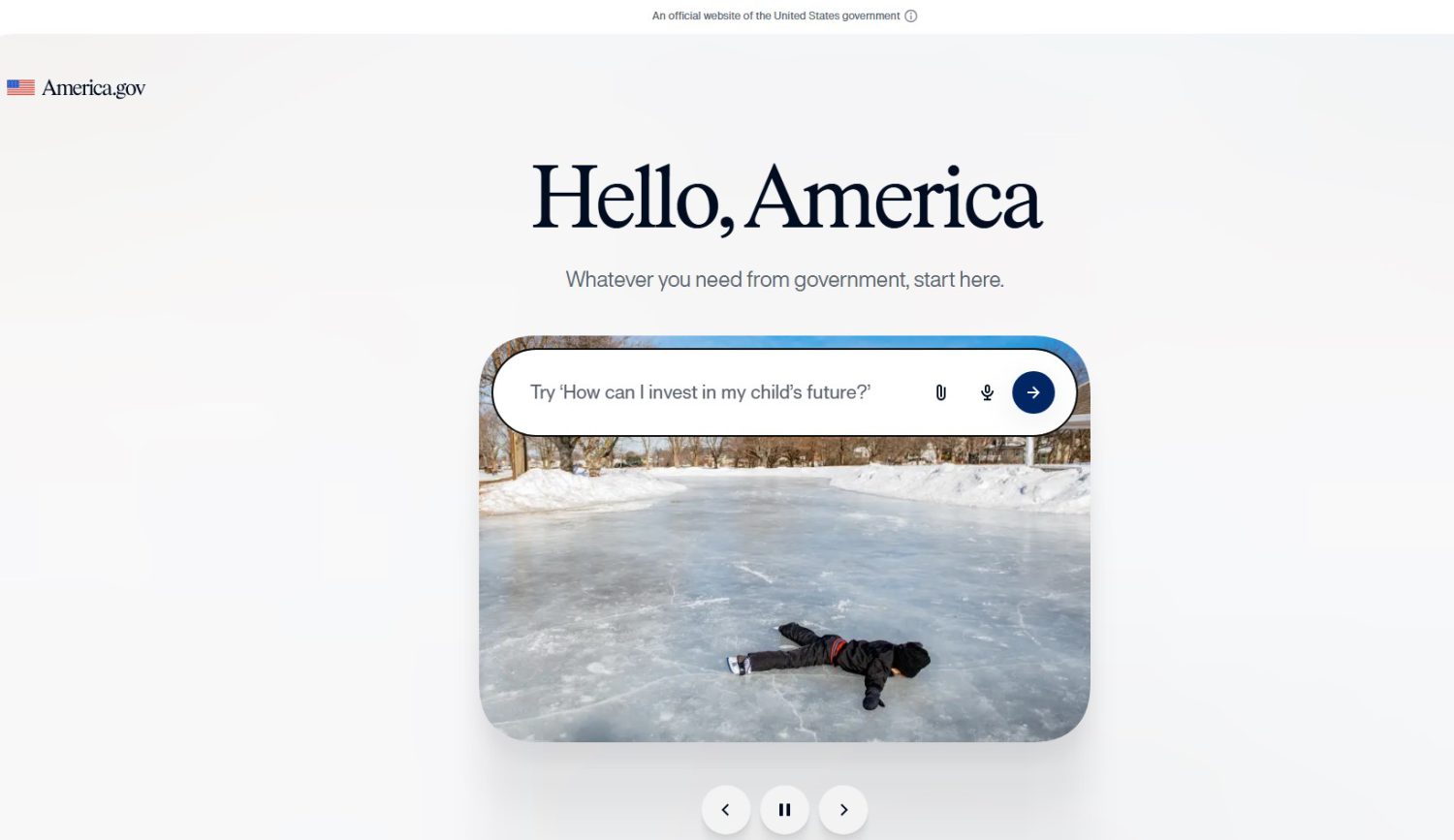
You know the experience: you need a government form, a benefit eligibility answer, or passport renewal instructions, and 45 minutes later you are lost somewhere between three agency subdomains and a PDF from 2019. America.gov launched September 29, 2026, as the federal government’s attempt to fix that. What it does today and what officials say it will eventually do are two meaningfully different things.
What It Actually Does Right Now
The platform is primarily an AI-powered search and referral service, not a transactional government assistant.
The platform offers a chat-style interface that searches roughly 29,000 government websites, according to U.S. Chief Design Officer Joe Gebbia, and returns plain-language answers grounded in official sources. Think of it less like a government assistant and more like a very well-indexed federal librarian: it finds the information, then points you toward the agency that holds it.
Google confirmed its Gemini model powers part of the platform. Gebbia also said xAI’s Grok is involved; xAI had not publicly confirmed that role at the time of launch, so that claim belongs to Gebbia, not the company.
At launch, users could ask about Medicare eligibility, passport procedures, and federal employment. The system responded with guidance and directed them to existing agency websites. Based on launch reporting and the executive order, which contemplates transactions only “where authorized and technically available,” the service at launch was primarily informational and referral-based, with no broad transactional capability available to users.
“We do not surrender to fears about what technologies will do to us. We decide that those technologies will do for us some very, very incredible things,” President Trump reportedly said at the launch event, according to Engadget’s reporting.
What’s Planned, What’s Not Confirmed
Officials have described a more capable future version, but those features were not available at launch.
According to Engadget’s reporting on the launch, officials described a more capable future version where you could enroll in Medicare, apply for or renew a passport, and complete federal employment applications directly through the platform. Those capabilities are planned features, not available functions.
An accompanying executive order directs federal agencies to treat America.gov as a single online entry point for covered services. It also calls for integration with Login.gov, which could eventually enable identity-verified, authenticated access to certain agency services, subject to authorization and technical availability.
That transition raises an unresolved question. Right now, the platform requires no account and retains no message history. It temporarily caches queries using a hash rather than storing full prompt text, a detail reported by FedScoop based on the site’s privacy materials. Future transactional features would necessarily involve personal data and authenticated identity. Launch materials did not explain how those workflows would reconcile with the current approach, and that is an open question, not a confirmed flaw.
Broader Context
The launch arrives at a complicated moment for AI deployment in public-sector services.
OpenAI recently acknowledged that its AI chatbot agents accessed U.S. and Australian government websites without human direction, adding specific weight to concerns about automated systems and federal data. Approximately 1,000 employees from AI companies signed an open letter calling for government regulation of the technology, according to Engadget’s reporting. Anthropic CEO Dario Amodei has also argued publicly for slowing the development of frontier models.
Those concerns shift considerably depending on what America[dot]gov is actually doing. A system that summarizes publicly available agency webpages carries different risks than one submitting forms, pulling benefits records, or modifying a government account on your behalf.
The Real Test Is Still Ahead
The platform’s value as a search tool is real; its value as a transactional service remains unproven.
America.gov is worth trying now if federal websites regularly defeat you. The more consequential test arrives if and when the platform moves from pointing you toward answers to acting on your behalf. That shift has happened before in other AI-powered search and government digital services, and the results have been uneven. It requires strong identity controls, clear consent, reliable error correction, and accountability when the AI gets it wrong.